The last message Celeste Rivas Hernandez ever sent was pure teenage cadence. “girly pop i’m almost there open ur door if ur home.” Minutes later her phone went permanently silent. Prosecutors say that when the 14-year-old walked through David Burke’s Hollywood Hills door on April 23, 2025, the indie-pop singer known as D4vd stabbed her to death, then spent the following months turning her body into evidence he tried and failed to erase. On Monday a Los Angeles judge decided the public will now hear the full case.
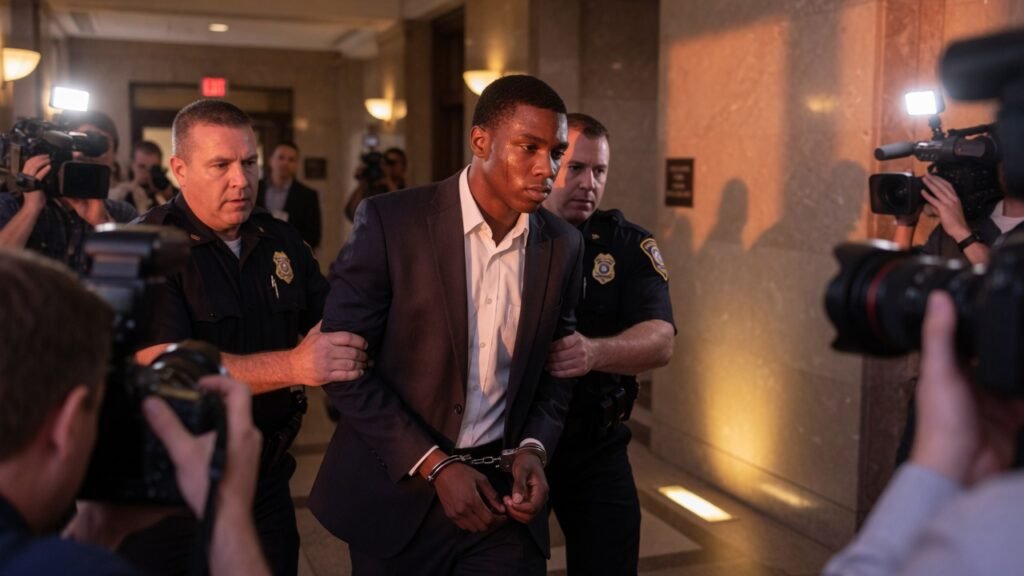
Judge Charlaine Olmedo did not hedge. “The people have met their burden on all counts.” Murder. Continuous sexual abuse of a child under 14. Unlawful mutilation of human remains. Special circumstances that make the case death-eligible: lying in wait, financial gain, killing a potential witness. Burke, 21, sat in orange and glasses and showed nothing. He has pleaded not guilty. His lawyers will get their shot at a jury. The probable-cause bar is cleared. The real fight starts now.
She Threatened the Only Thing He Could Not Afford to Lose
The night before she died, Celeste texted fury. Prosecutors introduced messages in which she told him she would end his career and his life, including the line “i will end ur career and ur life.” Another exchange captured in the hearing: “I swear to GOD I will kill u” and “I will end ur career.” She was angry about another woman. She was 14. He was the adult who had allegedly been sexually involved with her since she was 13 and he was 18, after first meeting her when she was 11. A year earlier they had messaged about a pregnancy she said was his and an abortion that followed.
That is the motive the state is selling, and it is brutally simple. Burke’s debut album was days from release. “Romantic Homicide,” the track that made him a streaming phenomenon with well over a billion plays across his catalog, had already turned aestheticized heartbreak into a brand. Nearly four million TikTok followers were watching the ascent. A 14-year-old with texts, photos, and the willingness to talk could detonate all of it. Deputy District Attorney Beth Silverman put it without poetry: “Based on the mountains of evidence presented, all of the allegations have been proved way beyond the standard required.”
The mountain included Amazon orders under aliases for chainsaws, an inflatable pool, body bags, a shovel, a burn cage. Blue plastic fragments consistent with that pool turned up with the remains. Blood in the garage matched Celeste. Her left ring and pinkie fingers, one tattooed with “David” in red ink, were severed and never recovered. The Tesla where her decomposed, dismembered body was found in September 2025, more than four months after she vanished, held nearly a dozen air fresheners. Location data, iCloud caches measured in terabytes, explicit images of the two of them together. The defense cross-examined hard on missing cameras, secondary DNA transfer, and the fact some tools tested clean. They called no witnesses. Their core claim on the murder count came from attorney Marilyn Bednarski: “There’s no evidence that Mr Burke harbored a deliberate intent to kill Miss Hernandez.”
A judge heard five days of that record and still bound him over. Intent is now a jury question, not a dismissal argument.
The Song Was Always a Costume
Pop culture has spent years monetizing pretty darkness. Pale young men with guitars and blood-red aesthetics sell doomed romance to teenagers who feel too much. D4vd’s entire lane ran on that currency. “Romantic Homicide” was never supposed to leave the playlist. The horror is how cleanly the branding mapped onto the allegation: a relationship that never should have existed, a career worth protecting at any cost, and a body left in a luxury EV until the smell and the tow yard forced the story into daylight.
This is not an isolated monster story. It is what happens when fame arrives faster than scrutiny, when an 18-year-old with a rising profile can allegedly keep a child in his orbit for years, and when the first serious threat to the money and the myth is treated as an extinction-level event. District Attorney Nathan Hochman said outside court that the hearing showed only “a significant but small fraction” of the evidence and that his office is still weighing the death penalty. The parents sat through what they could. The rest of us are left staring at the gap between the soft-focus artist the algorithm served and the man in the orange jumpsuit who never flinched when the ruling landed.
Burke’s team will argue the texts show a volatile teenager initiating contact and making threats, that the forensic chain has holes, that coincidence and panic are not premeditation. Juries have bought thinner stories. They have also rejected them in open court when the digital trail is this loud. Arraignment is set for August 31. A trial could begin roughly 60 days after that. Between now and then the catalog will keep streaming, the think pieces will multiply, and every parent who ever let a kid disappear into a parasocial corner of the internet will feel the temperature rise.
The final text still sits there in the record, casual and trusting. Girly pop, almost there. Open the door. The door opened onto a case that just survived its first real test. Whatever the jury eventually decides, the industry that crowned this sound already lost the plot the moment it mistook aestheticized violence for harmless vibes. The courtroom is done pretending the two were ever separate.