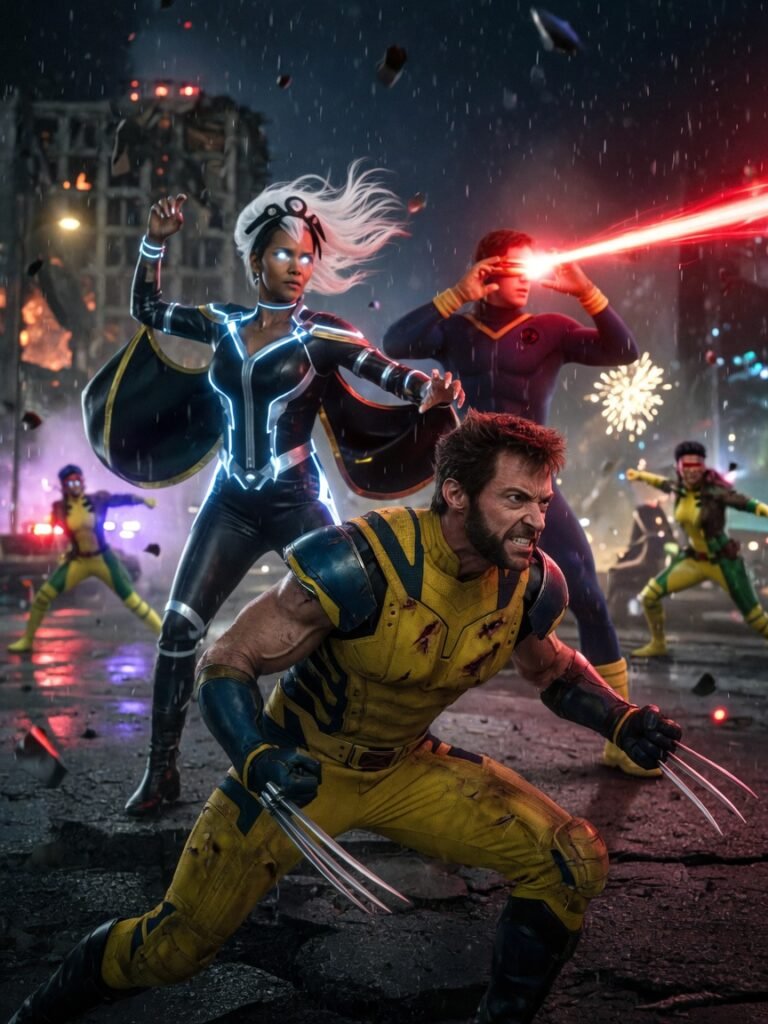
Alright, so the word on the street, or rather, the convention floor in Shanghai, is that the X-Mansion is officially making its MCU debut in *Avengers: Doomsday*. They’ve got promo images, booth displays, the whole nine yards, showing off Xavier’s School for Gifted Youngsters right alongside Avengers HQ, the Baxter Building, and Wakanda. And, you know what? It’s a massive shock. Absolutely stunning and brave. Who could have possibly seen this coming, after years of teases, Easter eggs, and a multi-billion dollar corporate acquisition?
Look, I get it. The X-Men *had* to come to the MCU. It was always going to happen. The ink dried on the Fox deal, the clock started ticking, and it was only a matter of time before the mutants burst through the dimensional barrier, or got snapped into existence, or whatever convoluted explanation they cook up this time. My cynicism isn’t about *if* they’re coming, but *how*. Because if the last few phases of the MCU have taught us anything, it’s that just having the ingredients doesn’t guarantee a Michelin-star meal. Sometimes, you just end up with a lukewarm casserole of committee-approved mediocrity.
Let’s rewind for a second. The Fox X-Men films, for all their glorious highs (*Logan*, *X2*, a decent chunk of *First Class*) and abysmal lows (*The Last Stand*, *Apocalypse*, *Dark Phoenix* – let’s not even talk about *The New Mutants*), actually understood something fundamental: the X-Men are not just another superhero team. They are an allegory. They are a mirror held up to society’s deepest fears and prejudices. As Bryan Singer, director of the first two *X-Men* films and others, once put it, “The X-Men were never just about superheroes; they were about allegory, about prejudice, about fear of the other. That’s why they resonated.” And he was right. When those movies worked, it was because they tapped into that. When they failed, it was often because they forgot it, devolving into generic superheroics or, worse, confusing character motivations that made zero sense.
Now, you might be thinking, “Rogue, lighten up! This is exciting! It’s the X-Men!” And yes, theoretically, it *is* exciting. The X-Men, done right, are arguably the most compelling ensemble in all of comics. They offer a sprawling canvas for complex character dynamics, political commentary, and deeply personal struggles. But the MCU, lately, has struggled with complexity. They’ve perfected the art of the 2-hour-20-minute placeholder, a film designed to move pieces around the board for the *next* film, rather than existing as a complete, satisfying narrative in itself. The scripts often feel like they’ve been run through a focus group, sanded down to the smoothest, least offensive edges, prioritizing quips over consequence and spectacle over substance.
And that’s my fear for the X-Men. They are inherently messy. They are about division, about fighting for acceptance in a world that hates and fears them, often with internal ideological battles that are just as intense as their external ones. This isn’t the Avengers, a government-sanctioned team of earth’s mightiest heroes who mostly get along after their initial squabbles. The X-Men are an illegal private school run by a telepath, training super-powered teenagers to fight for a dream that most people actively reject. That’s a rich, complicated tapestry, one that demands a confident, singular vision, not a committee trying to hit every demographic and set up twenty spin-offs.
Consider the recent *Avengers: Doomsday* setup. We’re talking about a movie that, by its very title and the inclusion of all these iconic locations, is clearly meant to be an enormous culmination, a narrative earthquake. How do you introduce the X-Men, with all their history, their dozens of vital characters, and their unique thematic weight, into a film that is already going to be juggling the existing Avengers, the Fantastic Four (Baxter Building), and presumably whatever other cosmic threats are brewing? It’s a recipe for narrative bloat, a character buffet where everyone gets a tiny, unsatisfying bite.
Think about what makes a great ensemble film. *Aliens*, for example, understood that even with a squad of badasses, Ripley was the undeniable anchor. Her journey, her trauma, her fight for Newt, drove the entire film. Every secondary character, from Hicks to Hudson to Vasquez, served a clear narrative function, either advancing the plot, revealing character, or raising the stakes. They weren’t just there to show off cool powers. Compare that to some recent MCU outings where characters are introduced, given a paper-thin arc, and then shuffled off-screen, only to reappear in a post-credits scene to remind you they exist. That’s not storytelling; that’s inventory management.
The X-Men, at their best, thrive on deeply drawn characters and their relationships. Wolverine, for instance, isn’t just a guy with claws. As Hugh Jackman often said, “He’s an outsider, he’s kind of a rebel, he’s got this dark side, but he’s also incredibly loyal. He’s probably the most human character in the X-Men, despite having claws.” That’s the nuance, the internal conflict that makes him compelling. Can the MCU, in a massive ensemble film like *Doomsday*, afford to give that kind of depth to even a handful of mutants, let alone the dozens they’ll eventually need to introduce? I have my doubts.
My worry is that Marvel, feeling the pressure of recent fan fatigue and box office wobbles, will rush the X-Men’s integration. They’ll throw them into the deep end of a multi-verse saga, expecting the audience to just “get it” because, hey, it’s the X-Men! But without proper setup, without earning their place, without making us *feel* the weight of their struggle and the prejudice they face, they’ll just be another set of power-fantasy avatars. The core allegorical power, the very thing Chris Claremont fought to instill in his legendary run, will be lost in the noise. Claremont famously stated, “The X-Men are, at their heart, a metaphor for all the different kinds of prejudice that exist in the real world.” If they strip that away, if they make them just another group of heroes, they’ve missed the entire point.
Kevin Feige, speaking at SDCC 2019 about the X-Men’s impending arrival, stated, “The truth is, I don’t know when, I don’t know where, I don’t know how, but it’s been a long time coming.” That “I don’t know how” part is the crucial bit. Four years later, with *Doomsday* looming, I sincerely hope they’ve figured out the “how” in a way that respects the source material and elevates the MCU, rather than dragging the mutants down into the current creative slump.
What do I want? I want a script that dares to be slow. That allows for character moments, for difficult conversations, for the weight of prejudice to actually land. I want the X-Mansion to feel like a haven, but also a target, a place constantly under threat. I want the struggle for mutant rights to be central, not just a backdrop for punchy-kickies. Give me a writer’s room that understands the profound tragedy and resilience of these characters, not just their merchandising potential.
If *Avengers: Doomsday* simply introduces a dozen X-Men with flashy powers, a couple of one-liners, and no real narrative heft, it will be one of the greatest squandered opportunities in blockbuster history. It’s not enough to just show the X-Mansion; you have to make us believe in what it represents. You have to earn the characters. Anything less is just another committee-driven product, and frankly, we’ve had enough of those. The X-Men deserve better. We deserve better.