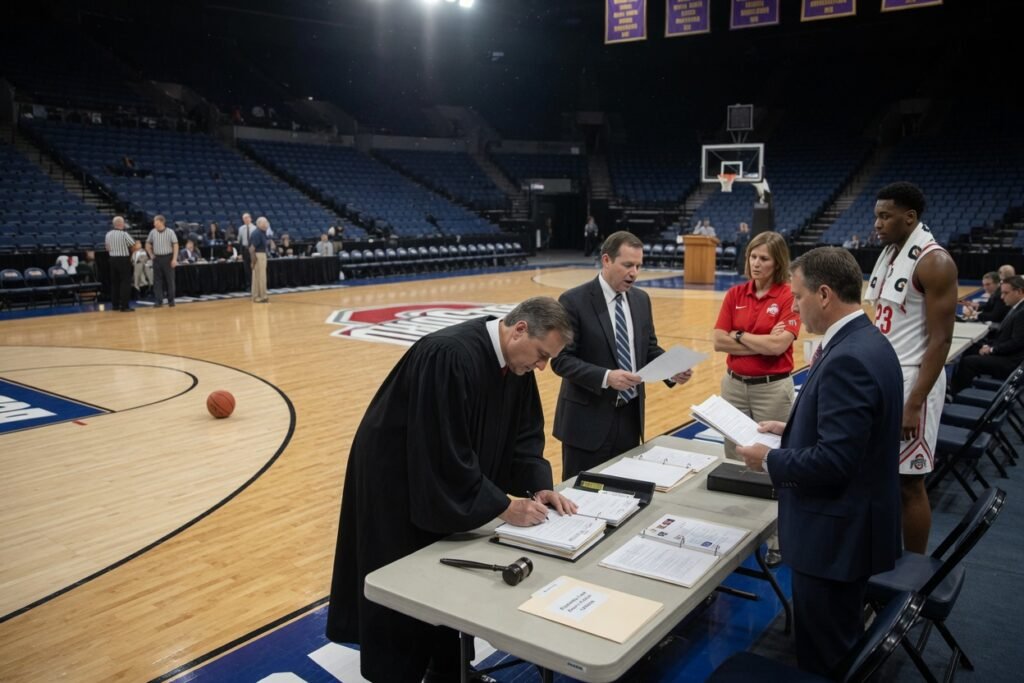
An Ohio judge just dropped a bomb on the NCAA, and if you think this is just some niche legal squabble, you’re missing the entire damn point. Judge Christopher Wagner didn’t just grant a preliminary injunction for 24 college hoops players. He didn’t just open the transfer portal for a couple dozen athletes who thought their careers were cooked. Nah, what he did was expose the NCAA for what it truly is: a flailing, toothless dinosaur that has absolutely ZERO aura left in the modern sports landscape.
I watched the news break, and I immediately thought, *here we go again*. The NCAA, once the unquestioned overlord of amateur athletics, is getting dragged through the mud, one arbitrary, capricious ruling at a time. They trot out their dusty rulebooks, their “amateurism” rhetoric, their sanctimonious pronouncements, and the courts just laugh in their face. This isn’t just a legal setback; it’s a full-on L for an organization that lost the plot years ago.
Let’s be real: college sports have been in a state of controlled demolition for the better part of a decade. The NIL era, the transfer portal, the COVID year exemptions – it all chipped away at the old model. The NCAA, bless their corporate hearts, thought they could just slap a fresh coat of paint on a crumbling foundation and call it good. They thought they could introduce an “age-based model” that allows five seasons over five years, but suddenly, if you started in 2022 and *didn’t* redshirt, you’re out of luck.
Tell me, how is that NOT arbitrary? How is that NOT capricious?
I know what you’re about to type in the comments. “But Ryan, rules are rules! They knew the deal!” Stop. Just stop right there. That’s the exact same corporate drone energy I hear from every ESPN talking head who still thinks college athletes are just playing for the love of the game. They’re not. They haven’t been for a long time. These are student-athletes, yes, but they’re also part of a multi-billion dollar industry that has been built on their backs.
When these players stepped on campus in 2022, the landscape was already shifting faster than a point guard on a fast break. The COVID year had given a whole generation of players an extra season. The transfer portal was already a free-for-all. Coaches were openly talking about it. Jay Wright, a guy who knows a thing or two about building a dynasty, once said, “It’s like having free agency in college basketball. It’s a brand new world.” He wasn’t wrong. It *was* a new world, and the NCAA was still trying to govern it with a quill and parchment.
So, these players saw guys who started *before* them, who had *already* used their redshirt year, or got a COVID waiver, playing a fifth or even sixth season. And now the NCAA, in its infinite wisdom, wants to draw a line in the sand right behind them? Saying, “Sorry, your class is the one that gets nerfed”? That’s not just unfair; it’s a full-blown insult.
Ryan Downton, the attorney for these players, didn’t pull any punches in his filing. He argued, “Each plaintiff was harmed each time he or she competed in a basketball game against a fifth or sixth-year player without being offered the same opportunity to compete in a fifth season themselves.” And you know what? He’s absolutely right. The NCAA created this chaotic environment, then tried to arbitrarily cut off one group of players while others benefited from their previous laxity. That’s L energy on a cosmic scale.
This isn’t just about 24 players. Downton has filed *dozens* of similar lawsuits. This is a crack in the dam that’s about to burst. The NCAA, in a filing, tried to argue, “When each plaintiff completed their fourth season of competition during the 2025-26 academic year, they had every reason to know it was the end of the line and time to make way for the next generation of college athletes.”
Oh, really? They had *every reason* to know? In an era where eligibility rules change faster than NIL collectives switch allegiances? Where the transfer portal is open practically 24/7? Where players are being paid and treated like semi-pros, but still expected to abide by rules designed for the 1950s? Give me a break. That’s just the NCAA trying to gaslight a generation of athletes.
This ruling, this injunction, it’s a direct shot across the bow. It’s a judge telling the NCAA, “Your rules? Your interpretations? They’re not holding up in court.” And the NCAA’s response, posted on X, that “we do not intend to change course”? That’s not defiance. That’s a desperate cry from an organization that’s completely lost control of the narrative, the rules, and frankly, the entire sport. They’re doubling down on a losing hand, and everyone with a pulse can see it.
This whole saga isn’t just about eligibility. It’s about the fundamental absurdity of the NCAA’s continued existence as a regulatory body. They’re trying to put the genie back in the bottle, but the genie just bought a new car with an NIL deal and entered the transfer portal. The power has shifted. It’s with the players, it’s with the coaches who have to manage these ever-changing rosters, and it’s increasingly with the courts.
Think about it from a coaching perspective. You’re trying to build a program. You’re trying to recruit. How do you pitch continuity? How do you sell a vision when a judge in Ohio can, at any moment, blow up your roster plans? This isn’t just a headache; it’s a migraine that never goes away. Coaches are effectively becoming GMs, managing free agency every single offseason, and now they have to factor in potential lawsuits and injunctions. It’s a wild card every single year.
And what about the players already on rosters? The freshmen and sophomores who are trying to carve out playing time? Suddenly, their path to minutes might be blocked by a fifth-year player who just got an injunction to play. It’s a vicious cycle, but it’s one the NCAA created by being so incredibly, consistently inconsistent.
The truth is, the NCAA is fighting a losing battle against the inevitable. College sports are professionalizing, whether they want to admit it or not. The money is too big, the stakes are too high, and the players are too aware of their own value. This eligibility fight is just another symptom of an organization clinging to a past that no longer exists.
I’m not saying the current system is perfect. Far from it. The transfer portal is often a mess, NIL deals are murky, and loyalty feels like a relic. But the alternative – the NCAA trying to exert control with a patchwork of nonsensical rules – is demonstrably worse. It creates more confusion, more legal challenges, and ultimately, more L energy.
What should happen? I’ll tell you what I think. The NCAA needs to either embrace its role as a professional league facilitator, setting clear, player-friendly rules for compensation and movement, or get out of the way entirely. This half-measure, arbitrary, “we don’t intend to change course” nonsense is just delaying the inevitable. It’s like watching a team down 30 in the fourth quarter, refusing to wave the white flag, while the opponent is already celebrating.
These players, regardless of how you feel about their specific situation, are forcing the issue. They’re calling out the NCAA’s bluff. They’re demanding fairness, or at least consistency, in a system that has offered neither. And a judge just agreed with them.
So go ahead, @ me. Tell me I’m glazing these players. Tell me they should just play their four years and move on. But understand this: the NCAA cooked this meal, and now they have to eat it. This isn’t just an injunction; it’s a declaration that their old model is officially dead, buried, and awaiting an autopsy.
Is this the final nail in the coffin for the NCAA as we know it, or just another paper cut in a slow, painful bleed-out?