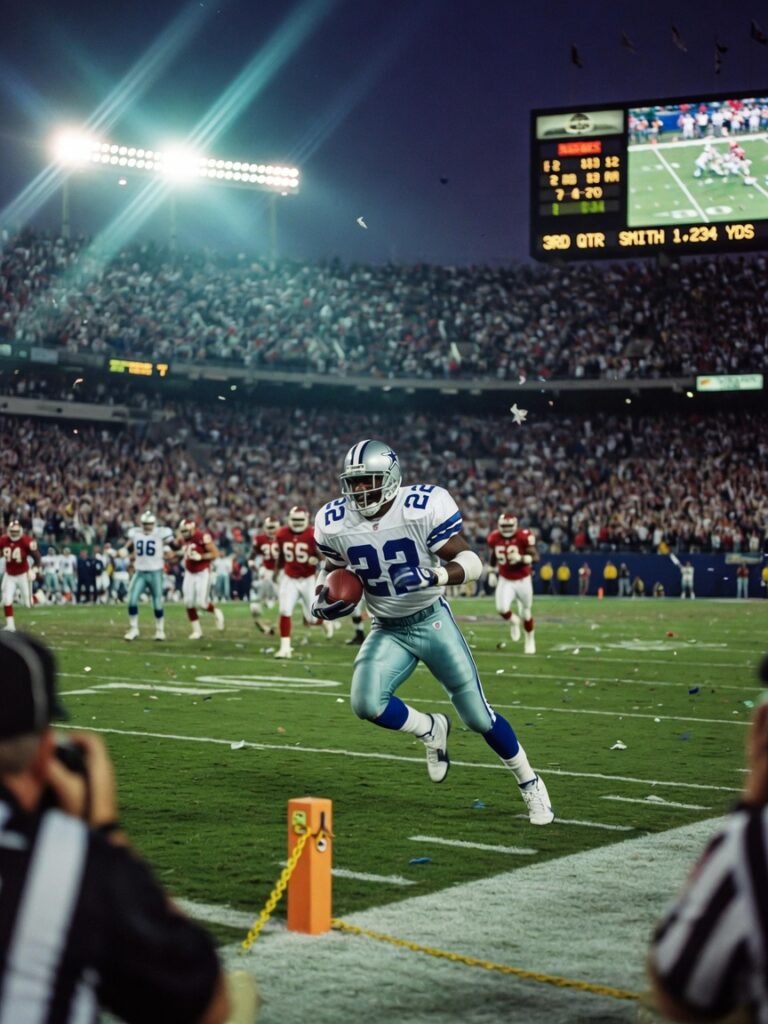
I have listened to the whispers, I have heard the casual mentions, the dismissive nods to a bygone era. They talk about Emmitt Smith, the Dallas Cowboys legend, and they reduce his monumental achievements to “durability” or “playing behind a great offensive line.” They say he was a product of his circumstances, a beneficiary of timing. And I sit here, I listen, and I tell you, America, it is an insult. It is a fundamental misreading of one of the most singularly driven, preternaturally focused athletes this game has ever known.
This wasn’t some happy accident, some fortunate confluence of talent and opportunity. No, my friends, what Emmitt Smith accomplished, what he *willed* into existence, was a declaration of destiny, etched in his mind long before his cleats ever touched an NFL field. We are talking about a man who didn’t just play the game; he *manifested* his entire unparalleled career.
I remember when the story first broke, when Michael Irvin, a man who saw greatness firsthand, a man who lived and breathed the cutthroat competition of the NFL, stood there and recounted the audacity of a rookie. Irvin, a third-year veteran then, a man who had scraped for four wins in two seasons with the Cowboys, was confronted by this fresh-faced kid from Pensacola. And what did Emmitt Smith say? “He told me he would become the NFL’s all-time leading rusher by the time his career was finished.” Michael Irvin, a legitimate NFL star, couldn’t believe it. He said he just wanted Smith to worry about winning one game. But Irvin, years later, when the prophecy had been fulfilled, admitted, “He said he wanted to win rushing titles, and he did that. He said he wanted to win MVPs, and he did that. His last goal, which I thought was a fantasy, was to become the all-time leading rusher in the NFL. And today he did that.”
A fantasy, Irvin called it. A fantasy for mere mortals, perhaps. But Emmitt Smith was never a mere mortal. I have watched this game for decades. I have seen the pretenders, the flashes in the pan, the one-hit wonders who thought their talent alone would carry them. And I have seen the true titans, the legends whose wills bent the very fabric of reality to their desires. Emmitt Smith stands in that pantheon.
This wasn’t a casual hope; it was a burning conviction. Think about this: January 25, 1987. A young Emmitt Smith, a high school phenom, sits in the Rose Bowl, watching Super Bowl XXI. He’s there because he’s the Gatorade National Player of the Year. He turns to his best friend, his high school quarterback Johnny Nichols, and he says, and I quote him directly from a recent ESPN interview: “Man, one of these days, I want to play in the Super Bowl. And I want to play in this stadium.” Six years later, not only is he playing in *the* Super Bowl, but he’s playing in *that very stadium*, the Rose Bowl, leading his Dallas Cowboys to a dominant victory in Super Bowl XXVII.
Do you understand the weight of that? Do you grasp the magnitude of speaking your destiny into existence, not just generally, but with such specific detail? This wasn’t a coincidence, America. This was a man setting his sights, drawing a line in the sand, and then systematically, relentlessly, unapologetically, *demanding* that the universe comply.
And it wasn’t just the Super Bowl. It was the details *within* the Super Bowl. He scored his first Super Bowl touchdown in that game, shrugging off defenders, fighting for every inch, a signature Emmitt Smith run. And he said, “Because remember, I’m a goal setter. I’ve got to score a touchdown in the Super Bowl. Why not? Everybody else is scoring one — let me be a part of this party.” A part of the party? No, Emmitt. You were the *life* of the party, the engine of that dynasty. He would go on to score five Super Bowl rushing touchdowns, more than any player in history. He’s the only player to score two touchdowns in two different Super Bowls. He was the MVP of Super Bowl XXVIII, carrying the ball 30 times for 132 yards and two touchdowns.
Now, let me address the naysayers, the revisionists who try to diminish his accomplishments. They point to the “Great Wall of Dallas,” the legendary offensive line. And yes, I will concede, having Larry Allen, Nate Newton, Mark Stepnoski, Erik Williams, and Kevin Gogan blocking for you is a gift from the football gods. But I watched those games. I watched Emmitt Smith. And I am telling you, America, it was never *just* the offensive line.
You could put a lesser back behind that line, and they would get yards. Many yards, even. But they would not get *Emmitt Smith* yards. They would not get the extra two, three, four yards after contact that Emmitt Smith routinely squeezed out of every single carry. They would not have the vision to find the crease that wasn’t there, the tenacity to break the arm tackle that should have brought him down, the relentless churn of his legs that simply refused to stop moving forward. He didn’t have the lightning speed of a Barry Sanders, nor the sheer brute force of a Derrick Henry. What he had was a combination of vision, balance, unparalleled toughness, and an indomitable will that turned every single carry into a personal crusade. He was a master of falling forward, a surgeon in traffic, and a battering ram at the goal line.
I remember watching him in the 1993 NFC Championship Game against the San Francisco 49ers. He separated his shoulder in the first half, and everyone, *everyone*, thought he was done. They said it was impossible to play with that kind of injury. But Emmitt Smith, the man who manifested his entire career, went back out there, willed himself through the pain, and carried the Cowboys to victory, accumulating 173 total yards and two touchdowns. THAT is not an offensive line. THAT is not just durability. THAT is a warrior, a legend, a man possessed by a vision of greatness that would not be denied.
And that vision culminated in the most untouchable record in modern football: 18,355 career rushing yards. A record that, I declare to you, will NEVER be broken in the current NFL landscape. Look at the active players. Derrick Henry, a phenomenal talent, is 32 years old, still over 5,000 yards behind. Saquon Barkley, a dynamic playmaker, is 29, nearly 10,000 yards shy. The game has changed. Running backs are devalued, committees are the norm, and longevity at that position is a cruel joke. No player will get the carries, the sustained health, or the unwavering organizational commitment that Emmitt Smith commanded through sheer force of his will and his performance.
When I hear the current Cowboys running back, Javonte Williams, speak about meeting Smith, he says, “They were trying to explain it and I said, ‘No, you don’t have to explain anything.’ I know who he is. It speaks for itself.” And Williams is right. It speaks for itself. But I am here to ensure that what it speaks is heard, truly heard, and not distorted by the revisionist history that seeks to diminish one of the game’s true giants.
Emmitt Smith wasn’t just a great running back. He was a prophet of his own destiny. He didn’t just dream of greatness; he *decreed* it. He didn’t just work hard; he worked with an unwavering focus on specific, audacious goals that others dismissed as fantasy. He set the targets, he visualized the path, and then he walked it, step by agonizing, glorious, record-breaking step.
This man didn’t merely *accumulate* yards; he *earned* every single one of those 18,355 yards through a combination of talent, grit, and an almost mystical self-belief. His record is not just a testament to his physical prowess; it is a monument to the power of the human will, a declaration that if you can truly envision it, if you can truly commit to it, then you, too, can bend the world to your purpose.
And that, America, is why Emmitt Smith’s legacy is not just about the numbers, not just about the rings, but about the profound, undeniable truth that he did not just become the greatest rusher of all time. He *willed* himself to be. And that, I tell you, is a lesson that transcends the football field and resonates with anyone who dares to dream beyond what others believe is possible. He didn’t just achieve greatness; he *commanded* it. AND THE LEAGUE ISN’T PREPARED TO EVER SEE IT AGAIN!