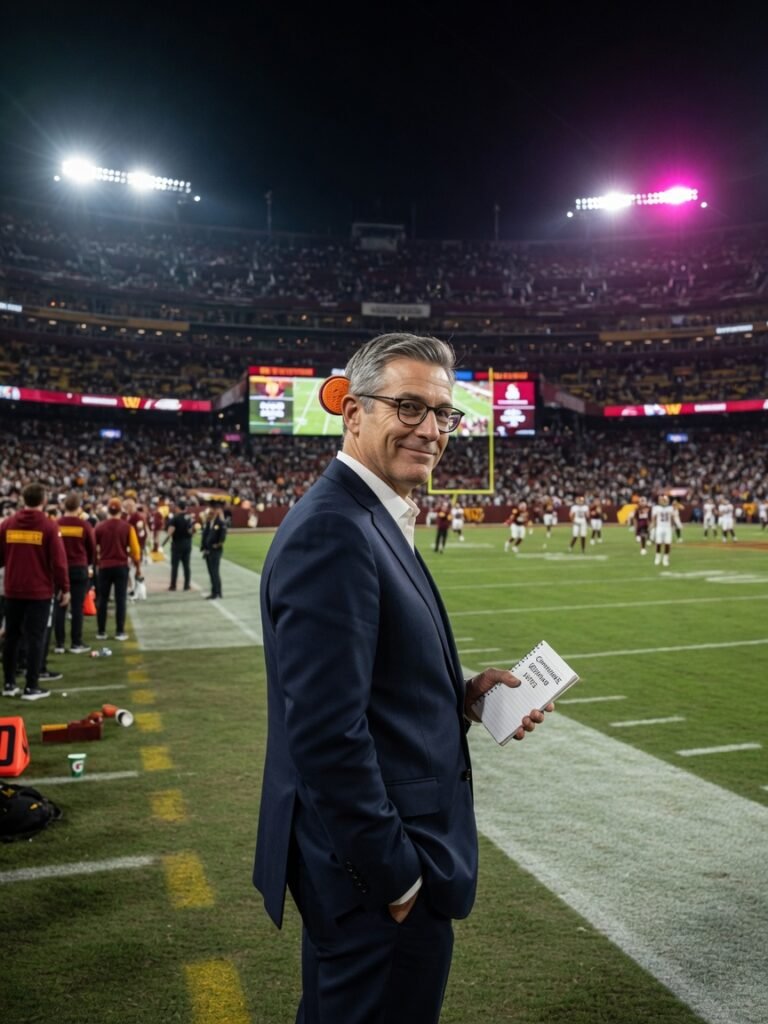
I gotta tell you, my stomach did a slow, unsettling flip when I first saw the headline. Not the gut-wrenching lurch you get when your team fumbles on the goal line in overtime, or the cold dread of watching a beloved quarterback get carted off. No, this was different. This was the specific, acidic churning you get when you realize the people in charge might be living in a completely different reality than you are. The Washington Commanders, a franchise that has been through more identity crises than a teenager in an indie film, is now entrusting its “rebrand” to a man whose previous triumph was… the Reese’s Oreo cookie.
I read it again, just to be sure I wasn’t hallucinating after too much late-night film study. Mark Clouse, the Commanders’ president, is leading the charge to restore the burgundy and gold, to give this team a “consistent look,” and he’s doing it by applying lessons learned from, and I quote, “combining chocolate and peanut butter.” My chest actually tightened. I stared at the ceiling for twenty minutes after I read that. Are we, the long-suffering fans of this cursed franchise, just a focus group for the NFL’s latest corporate experiment? Are our decades of loyalty, our emotional investment, our literal tears, just data points in some grand marketing strategy designed by the guy who once greenlit the Swedish Fish Oreo?
I mean, look, I’m not saying brand identity isn’t important. I’ve spent countless hours dissecting why certain teams connect with their fanbases on a primal, almost spiritual level, while others feel like a faceless corporation. I’ve screamed myself hoarse about the importance of tradition, of legacy, of *meaning*. But to equate the soul of a football team, a team that represents a city, a region, generations of family tradition, with a cookie flavor? That’s where I draw the line. That’s where I gotta call B.S.
Clouse, to his credit, lays out his philosophy with the kind of corporate precision that would make Don Draper nod approvingly. He talks about “rules of the road,” about “preserving core equities,” about “not changing too much at the same time.” He told the press, “What I find really important, if you’re going to market a brand of any sort, you need to know what your equity and your framework is to operate in. Or you end up with what a lot of brands do, which is just whatever seems cool or fun, I’m doing it. And whether or not it relates to the brand I have or not, who cares? We’re just going to have fun. But what happens is you wake up over time and you haven’t really built any equity.”
And you know what? On paper, if we were talking about a new line of breakfast cereals or a tech startup trying to find its niche, I’d probably agree with him. That’s sound marketing strategy 101. You establish your core, you build on it, you don’t chase every shiny new trend. But this isn’t about selling widgets or limited-edition snacks. This is about professional football. This is about a franchise that has, for decades, alienated its fanbase, endured a name change controversy that felt like a public execution, and frankly, has been an absolute dumpster fire on the field. You don’t fix that with a consistent shade of burgundy, no matter how “iconic” you think it is.
The problem, as I see it, is a fundamental misunderstanding of what “equity” means in the context of sports. For Oreo, equity is the “twist, lick, dunk” ritual. It’s the blue packaging. It’s the comfort of a familiar taste. For a football team, especially one like the Commanders, “equity” isn’t a color palette or a fight song, not anymore. It’s *winning*. It’s a competitive team. It’s a front office that doesn’t feel like a revolving door of bad decisions. It’s a coaching staff that inspires confidence, not dread. It’s a sense of pride that hasn’t been systematically stripped away by years of losing seasons, scandal, and a general air of incompetence that permeated the entire organization for far too long.
I’m picturing Clouse in his office, surrounded by 15-20 people – “food scientists to marketers to salespeople,” as the report says – all tasting different shades of burgundy, or maybe different helmet designs, like they’re trying to find the perfect blend of cocoa and cream. And he’s the guy, the one who “greenlights any new flavor.” He even admits he “gained 10 pounds” from tasting cookies every day. My mind immediately flashes to the scene in *Goodfellas* where Paulie tells Henry Hill, “Now, go home and get your shine box.” This whole thing feels like a corporate shine job. It’s an attempt to polish a turd, to make it look presentable, without actually changing what’s inside.
The Commanders’ “equity” was built in the 70s, 80s, and early 90s. It was built by Joe Gibbs, by The Hogs, by Super Bowl victories. It was built by a passionate fanbase that believed in something real. And then, slowly, meticulously, almost maliciously, that equity was systematically dismantled. You can’t just “restore” it by bringing back a spear logo and ensuring the burgundy is the *exact same burgundy every single time*. That’s like trying to rebuild the Roman Empire by painting all the old statues a uniform shade of white. It misses the point entirely.
This isn’t about the color blue of an Oreo package. This is about the deep, systemic rot that afflicted this franchise for decades under previous ownership. That’s a *Breaking Bad* level of toxicity, where the poison has seeped into every corner, every decision, every expectation. You can put a fresh coat of paint on Walter White’s house, but it doesn’t erase the meth lab in the basement or the bodies buried in the desert. The Commanders, for too long, were the sports equivalent of that house.
Clouse talks about “mystery” and “demand” for Oreos, pulling flavors after a brief period to create a buzz. “What flavor was next?” he asks. Are we, the fans, supposed to be excited about which shade of gold they roll out next year? Are we supposed to anticipate whether they’ll bring back the feather or a slightly different font? That’s not how you build a winning culture. That’s how you sell faddish, limited-edition junk food.
I remember watching an old interview with Bill Parcells, a guy who knew a thing or two about building a team from the ground up, about instilling a culture. He wasn’t talking about “core equities” or “brand consistency.” He was talking about toughness, about accountability, about finding players who loved football more than they loved anything else. “You are what your record says you are,” Parcells famously said. He didn’t say, “You are what your uniform color consistency says you are.”
This approach, while perhaps well-intentioned, feels like a superficial solution to a deep-seated problem. It’s like a doctor prescribing a new cologne to a patient with a raging infection. Yes, the patient might smell better, but they’re still dying inside. The Commanders need a healthy organizational structure, a stable coaching staff, smart draft picks, and consistent player development. They need to *win football games*. They need to show their fans, not just tell them, that things are different.
When Clouse says, “We want the same burgundy every time,” I hear a guy who genuinely believes that fixing the aesthetics will fix the soul. But I’ve been watching this game for too long, I’ve seen too many rebuilds and rebrands come and go, to buy into that. The real “equity” of a sports team is built on the field, in the trenches, in the locker room, not in a corporate boardroom analyzing cookie flavors.
I’m not saying Clouse is a bad guy, or that his intentions aren’t pure. I’m just saying his playbook, honed in the sugary world of snack foods, feels woefully inadequate for the brutal, unforgiving landscape of the NFL. You can’t twist, lick, and dunk your way to a Super Bowl. You gotta block, tackle, and score. And until the Commanders focus on *that* consistency, all the burgundy and gold in the world won’t make a difference to my churning stomach or my perpetually broken heart.