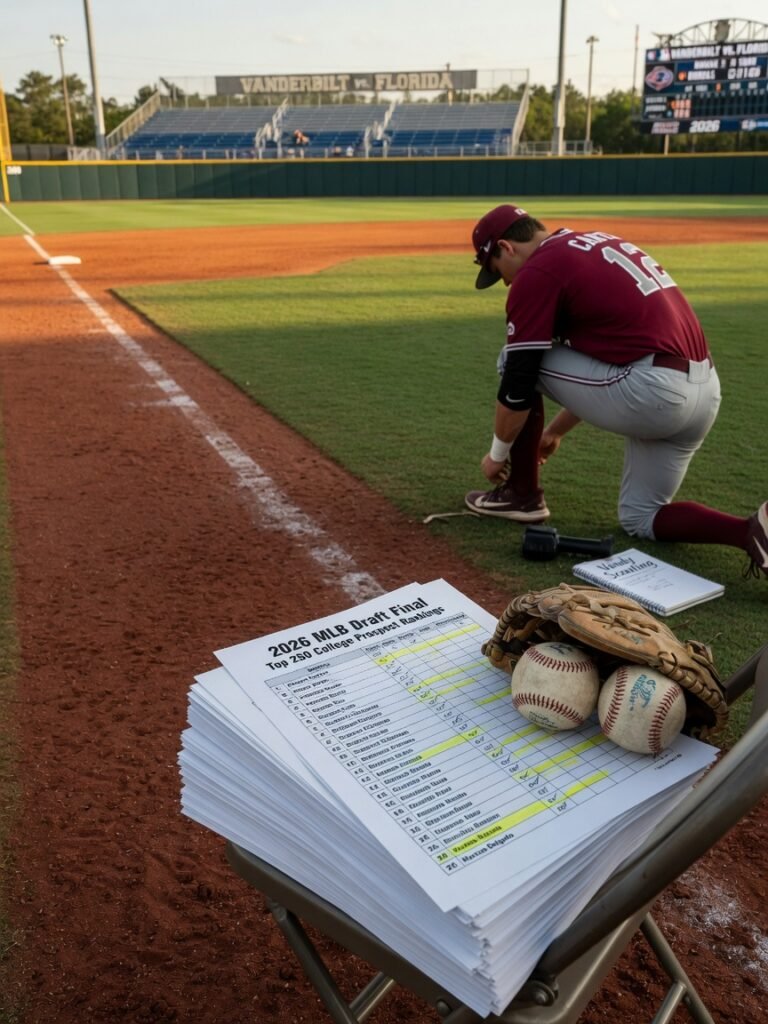
I just stared at my screen, dawg. My eyes, usually laser-focused, almost glazed over from the sheer audacity of it all. “2026 MLB Draft: Final Top 250 College Prospect Rankings.” FINAL. For a draft that’s still two full years away. Are we serious right now? Is this what passes for “analysis” in the corporate sports media landscape? Because to me, it looks like pure, unadulterated L-energy. It’s the kind of content designed to get clicks from desperate fanbases and agents, not to actually tell you anything real.
Let me break it down for you, because I know what you’re about to type in the comments. You’re thinking, “RyGuy, these are future stars! We need to know who to watch!” And I get it. The hype machine is powerful. But this isn’t hype; it’s a fantasy novel presented as a scouting report. FINAL rankings for a draft where half these kids will be playing a different position, or dealing with an injury, or have completely re-engineered their swing, or just plain been *nerfed* by the college game by the time 2026 actually rolls around.
This isn’t scouting; it’s astrology.
You want to know what I see when I look at a “Final Top 250” list for the 2026 MLB Draft? I see a thousand hours of video that won’t matter, a million data points that will be obsolete, and a whole lot of “experts” who are about to look foolish. It’s the equivalent of rating a high school freshman’s potential Super Bowl MVP odds. Like, cool, he’s got a cannon arm, but has he faced a blitzing defense that chose violence? Has he had to carry a team when the offensive line is cooked? Has he played in a game where the stakes were so high his lunch came up? No? Then put the rankings away.
I’m not buying the glitzy highlight reels from prep tournaments. I’m not falling for the “projectable frame” narrative. And I’m definitely not giving a single ounce of credibility to anyone who slaps the word “FINAL” on a list two years out. That’s not just an L; that’s a war crime against common sense.
The real talk from anyone who’s actually been in the trenches, not just behind a desk with a spreadsheet, is that projecting talent is a dark art, especially this far out. Just ask anyone who’s ever had to make those calls. Jim Callis, who’s forgotten more about prospects than these “experts” will ever know, once said, “Scouting is hard enough to project a player at 18 to what he’ll be at 22. Projecting a 16-year-old to 22 is even harder.” Now, imagine trying to do that for 250 college kids who are currently freshmen or sophomores, still figuring out how to do their own laundry, let alone consistently hit a 95 MPH fastball with movement. That’s the energy we’re dealing with here.
And let’s be honest, these lists are always heavy on the “aura” guys. You know the type. The five-tool phenom who looks like he was sculpted in a lab. The kid with the perfect swing mechanics, the effortless glide in the outfield, the cannon arm that makes scouts drool. He’s probably got a famous last name or was the top recruit in his class. I’m talking about the Ethan Holliday types, the kids with the pedigree and the polish. They’re all over these early lists, getting glazed like a Krispy Kreme donut.
Don’t get me wrong, I respect the talent. Ethan Holliday is a baller. He’s got the bloodline, the tools, the whole package. He’s probably a 99 OVR in 2K just walking onto campus. But is he the *final* top prospect? Is he even a *guarantee* to be a top-10 pick in two years? Absolutely not. I’ve seen too many “can’t miss” prospects miss. I’ve seen too many perfect swings get exposed by professional pitching. I’ve seen too many guys with all the physical gifts lack the one thing you can’t scout on a stat sheet: the absolute, unhinged, undeniable *dawg in him*.
Because that’s what separates the legends from the footnotes. It’s not just the raw power or the silky glove. It’s the guy who steps into the box in the bottom of the ninth, two outs, bases loaded, down by one, and he *wants* that moment. He thrives on it. He chooses violence. David Price, talking about Chris Sale, summed it up perfectly when he said, “He’s got that dawg in him… You can’t teach that.” You can’t put “dawg factor” in a prospect ranking, can you? You can’t measure “refusal to lose” with an exit velocity metric. But I promise you, that’s what wins championships. That’s what makes a career. And that’s what these early “final” rankings completely miss.
I’m looking for the guys who don’t have the perfect aura. The ones who might not look like a video game character but play like one. The grinder who hits for average, steals bases, plays every position, and makes the clutch play when it matters. The pitcher who might not throw 100 MPH but consistently gets outs with nasty movement and an ice-cold stare. The guys who elevate their game when the lights are brightest, not just when they’re padding their stats against a cooked mid-major pitcher.
These early rankings are built on a foundation of sand, shifting with every swing and miss, every growth spurt, every injury. How many of these “Top 250” guys are going to be battling for playing time by their junior year? How many are going to get caught up in the hype and forget to put in the work? Because being a top prospect, especially at the college level, is a whole different beast. Bryce Harper, who knows a thing or two about hype, once admitted, “It’s always going to be pressure. You’re always going to be under the microscope.” And that microscope gets a whole lot bigger when you’re being labeled a “final” top prospect two years out. It can break even the most talented kids.
I’m not saying these kids aren’t talented. They are. They’re elite athletes, and many of them will have great careers. But to stamp “FINAL” on this list now? That’s not just premature, it’s actively harmful. It sets unrealistic expectations, creates unnecessary pressure, and distracts from what really matters: the daily grind, the constant improvement, the relentless pursuit of being *him* when it counts.
So, when I see these “final” rankings, I just shake my head. I look past the polished stats and the glowing scouting reports. I’m looking for the kid who’s got a little dirt on his uniform, a chip on his shoulder, and an unshakeable belief that he’s the best player on the field, even if some “expert” ranked him 150 spots too low. Because those are the guys who prove everyone wrong. Those are the guys who make the headlines in 2026, not the ones who were already there in 2024.
Go ahead, @ me. Tell me I’m wrong. Tell me I don’t understand scouting. Your favorite prospect’s agent is probably already drafting the response. But I’m telling you, right here, right now: these “final” rankings are less about predicting the future and more about generating traffic. And if you’re buying into them this early, you’re getting cooked.
So, which of these “final” top prospects will actually be a bust, and who will be the real diamonds in the rough that these “experts” completely missed?