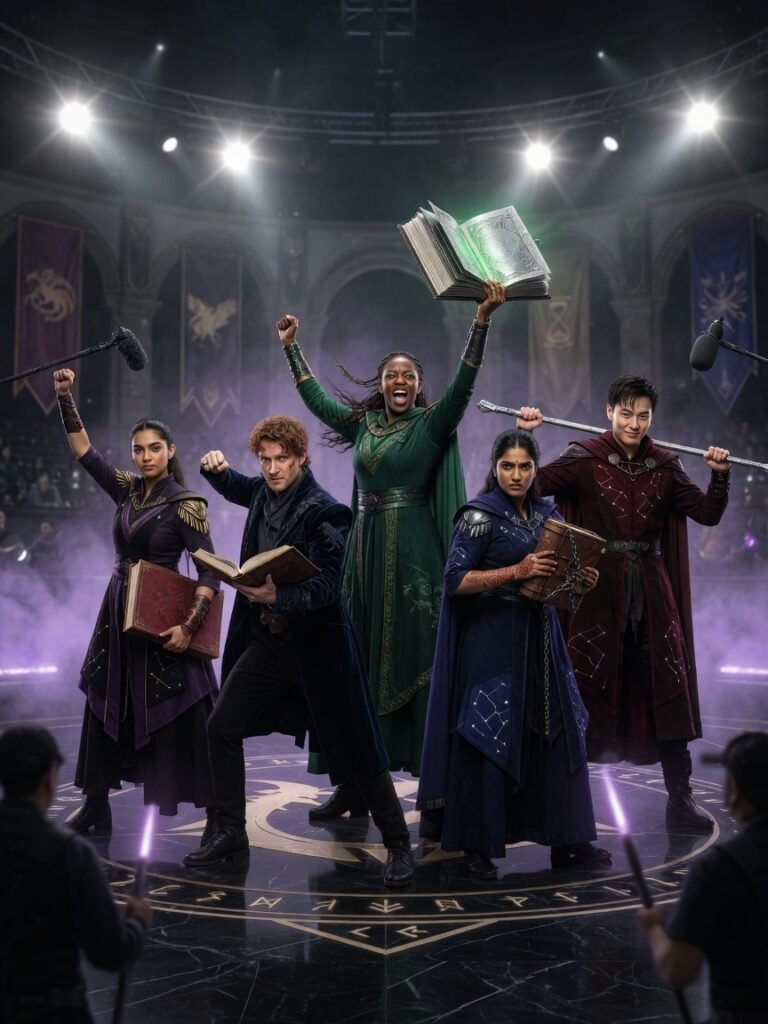
Alright, gather ’round, you lovely literary degenerates. Let’s talk about Harry Potter. Yeah, I said it. The Boy Who Lived. The scar. The spectacles. The cultural phenomenon that launched a thousand fan theories and a million theme park queues. And look, I get it. For an entire generation, those books *were* fantasy. They were the gateway drug, the first sip of magic that hooked millions on the genre. And for that, I’ll always give J.K. Rowling her due. She opened the door, and that’s no small feat.
But here’s the thing, and prepare yourselves, because this might be a massive shock to anyone whose entire personality is still tied to their Hogwarts house: Harry Potter is not the pinnacle of fantasy literature. Not by a long shot. It’s a perfectly enjoyable, well-paced, accessible series that does exactly what it sets out to do. But if you think it’s the *best* the genre has to offer, you’re like someone who thinks a perfectly good cheeseburger is the height of culinary achievement just because it was the first thing you ate after a juice cleanse. There’s a whole damn Michelin-star world out there, folks.
The primary source that landed on my desk makes a valiant effort to point out a few of these masterworks, and it’s a good start. But we need to go deeper. We need to talk about *craft*. We need to talk about *storytelling*. We need to talk about why some books don’t just entertain, they rewire your brain.
So, let’s peel back the layers of the real fantasy greats, the ones that tackle bigger ideas, build more intricate worlds, and force their characters through narrative crucibles that make Voldemort look like a grumpy school principal.
First up, the OG, the granddaddy of them all: **J.R.R. Tolkien’s *The Lord of the Rings***. Now, you might be thinking, “Rogue, this is obvious, everyone knows Tolkien.” And yeah, they do. But do they *understand* it? The source correctly points out the often-overlooked heroism of Samwise Gamgee. And that’s the key. While Frodo grapples with the metaphysical burden of the Ring, the true narrative engine, the beating heart of that story, is the relentless, selfless loyalty of a gardener. It’s not about prophecy or chosen ones; it’s about friendship, duty, and the quiet heroism of ordinary folk.
Tolkien, a philologist by trade, didn’t just write a story; he created an entire mythology, complete with languages, histories, and cultural nuance that makes other fantasy worlds feel like hastily drawn theme park maps. He wasn’t just telling a tale; he was digging into the very roots of human experience, the allure of power, the creeping dread of war, and the enduring strength of hope. As Tolkien himself wrote, “I desired to do for Middle-earth what other mythologies had done for their own lands.” And he did it. He created a world so meticulously detailed, so utterly believable, that it feels less like fiction and more like rediscovered history. The second act of *Lord of the Rings* isn’t about a chosen one training for a final battle; it’s about the slow, agonizing journey, the constant temptation, and the profound cost of carrying an impossible burden. It’s about the fact that even when you win, you still bear the scars. Try finding that kind of nuanced psychological depth in a wand duel.
Next, we journey into the sublime prose and philosophical depths of **Ursula K. Le Guin’s *The Earthsea Cycle***. The primary source nails it: magic here isn’t a weapon; it’s a language, a fundamental aspect of the world, woven into the very fabric of existence. And the story? It starts with a young wizard’s arrogance, not a hero’s destiny. Ged, like so many hot-shot protagonists, messes up. Royally. He unleashes a shadow, a part of himself, and the rest of the first book, *A Wizard of Earthsea*, is about him learning to live with, and eventually reconcile, his mistake.
This isn’t about defeating an external evil; it’s about internal reckoning. It’s about balance, responsibility, and the profound wisdom that comes from confronting your own darkness. Le Guin’s work is startlingly modern despite its age. It’s lean, poetic, and utterly devoid of the bloat that plagues so much contemporary fantasy. She tackles themes of identity, feminism, and mortality with a grace that few can match. Her dragons aren’t just beasts to be slain; they are ancient, wise, and integral to the world’s equilibrium. It’s a masterclass in how to build a magic system that feels organic and meaningful, not just a set of cool powers. Le Guin once said in an interview, “The only thing that makes life possible is permanent, intolerable uncertainty: not knowing what comes next.” This philosophy permeates Earthsea, where certainty is the enemy of wisdom, and true power lies in understanding, not control. *Stunning and brave* for a fantasy series to suggest the hero’s journey is about self-acceptance, not just vanquishing a dark lord.
Then there’s **Philip Pullman’s *His Dark Materials***, a series that starts with talking animals and kidnapped children and ends up wrestling with theology, free will, and the very nature of existence. The daemon concept, as the source points out, is brilliant. A physical manifestation of your soul, changing form until adolescence, then settling into an animal that reflects your true self. What an incredibly elegant way to explore identity and the transition from childhood to adulthood.
But Pullman doesn’t stop there. He takes a sledgehammer to organized religion and authoritarian control, exploring how institutions seek to control knowledge and suppress freedom of thought. Lyra isn’t a chosen one; she’s a chaotic, fiercely independent girl who stumbles into a cosmic war, driven by curiosity and a deep sense of loyalty. The series is a profound meditation on the power of stories, the importance of questioning authority, and the beauty of human connection. The narrative pushes into genuinely unexpected places, constantly expanding its scope without losing sight of its emotional core. Pullman, discussing his work, once said, “There are some stories that, if you tell them, you don’t want to make them into a moral lesson. But if the story is true and deep enough, then it will have moral implications.” *His Dark Materials* is exactly that: a story so true and deep that its implications resonate for years.
Now, let’s talk about the absolute narrative earthquake that is **George R.R. Martin’s *A Song of Ice and Fire***. If Harry Potter is a carefully constructed theme park ride, *Game of Thrones* (the books, mind you, not that final season dumpster fire) is a bare-knuckle brawl in a muddy pit, where the rules are fluid and no one is safe. This series didn’t just subvert fantasy tropes; it gleefully murdered them in cold blood. The chosen one? Dead. The noble hero? Beheaded. The moral compass? Constantly corrupted.
Martin stripped fantasy of its comforting certainty, revealing a world of brutal politics, moral ambiguity, and the horrifying consequences of human ambition. His characters are not good or evil; they are complex, flawed, and driven by conflicting desires. He forces you to empathize with people you despise and question the motives of those you admire. The “magic system” here is less about spells and more about the insidious, corrupting power of the Iron Throne. It’s a masterclass in character development and intricate plotting, where every decision has ripple effects that echo through hundreds of pages. The second act here is a dizzying dance of alliances and betrayals, where the protagonist isn’t a single person but an entire *kingdom* teetering on the brink. Martin famously said, “The most powerful weapon is the mind.” And in Westeros, minds are far more dangerous than dragons. Oh no… anyway, if you want a series that makes you genuinely fear for your favorite characters and question everything you thought you knew about storytelling, this is it.
Finally, for those who crave intricate world-building and magic systems that feel like actual scientific disciplines, we have **Brandon Sanderson’s *The Stormlight Archive***. If Tolkien built a mythology, Sanderson built an entire *universe* with its own physics, biology, and socio-political structures. His “hard magic systems” are legendary – they have rules, limitations, and consistent applications that characters can learn, exploit, and even break in clever ways. This isn’t just waving a wand and saying “Lumos.” This is understanding the fundamental forces of the cosmos.
But it’s not just the magic. Sanderson’s characters are deeply, beautifully flawed. Kaladin struggles with depression. Shallan battles dissociative identity disorder. Dalinar grapples with a brutal past. These aren’t just plot points; they are integral to their character arcs and how they interact with the magic and the world. It’s a profound exploration of mental health, trauma, and the arduous journey of finding hope and purpose. The sheer scale of the world, Roshar, with its highstorms, unique flora and fauna, and ancient mysteries, is breathtaking. Sanderson’s approach to storytelling is meticulous, building layers upon layers of lore and character development that culminate in genuinely epic, satisfying payoffs. He’s the architect of modern fantasy. When discussing his approach, Sanderson noted, “The most important thing for me is character. If I don’t care about the characters, it doesn’t matter how good the plot is.” And he proves it, time and again, in a series that is both intellectually stimulating and emotionally resonant.
So, look, Harry Potter is fine. It’s a fun ride, a great introduction. But it’s a starter kit, not the whole damn library. If you’re still clinging to it as the zenith of fantasy, you’re missing out on worlds far richer, characters far more complex, and narratives far more challenging and rewarding. These are the books that don’t just entertain; they expand your mind, provoke thought, and remind you that true magic isn’t about spells, but about the unparalleled power of a story well told.