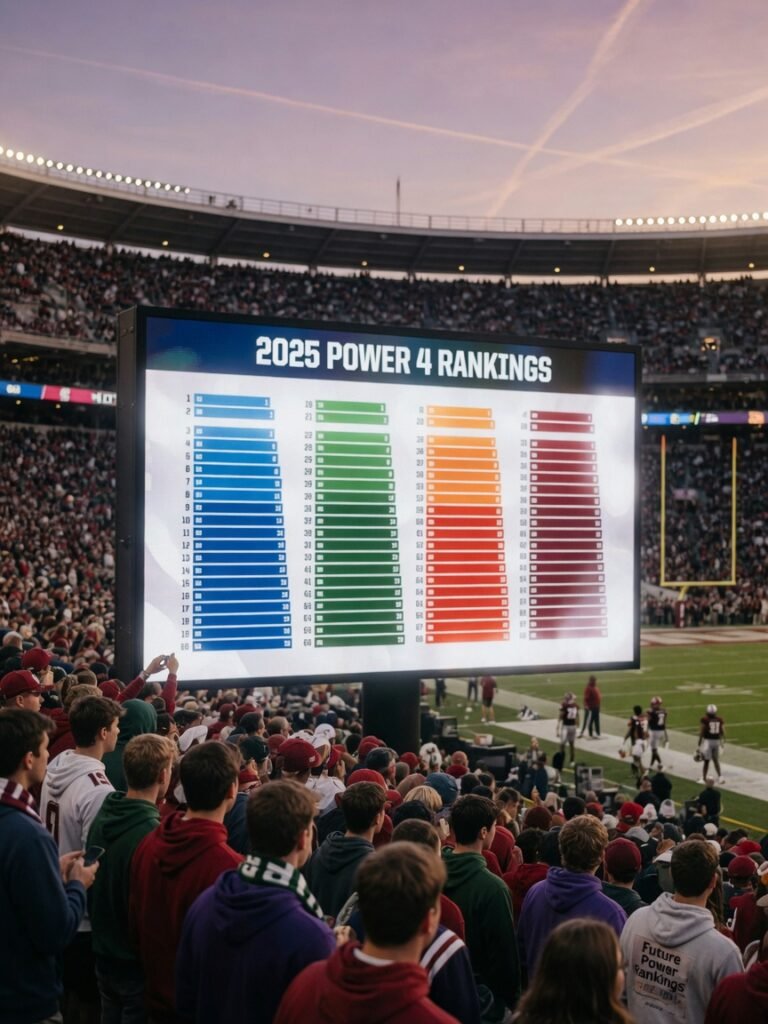
I’ve been staring at these future power rankings the way I stare at every attempt to lock down a sport that refuses to stay still for more than one season. Projecting college football through 2027 feels like trying to forecast the weather in a hurricane. Rosters turn over faster than a turnover chain gets passed around, and the pathways to a championship have cracked wide open in ways nobody fully predicted five years ago. I watched this league long before the transfer portal became the dominant force it is now, and I am telling you the assets that built a program in 2024 might be gone by 2026. The source material laid it out plain: players are year-to-year fill-ins, strong recruiting classes can shift trajectories, but holding those groups together long enough to matter is the real grind.
Boston College sits at 68 in this model, down from 47 in the prior version. That drop tells its own story about a program trying to claw out of a 2-10 hole with moves that mix desperation and calculation. They reached into Division II for Saginaw Valley State’s Mason McKenzie after he posted 942 rushing yards and 10 touchdowns the prior fall. They added Arkansas transfer Grayson Wilson and two high school quarterbacks. Bill O’Brien felt good enough about the lines in spring to say, “The defensive line is better.” That quote landed with me because it came from a coach who has seen both sides of roster construction at the highest levels. O’Brien is banking on transfers like KJ Sampson from Florida State, Kris Jones from Georgia, and Demetrius Ballard from Buffalo to anchor the edge, plus young tackles Micah Amedee and Cameron McGee for the long haul.
I keep coming back to the defensive line additions because they speak to the larger problem these rankings expose. Boston College lost key pieces to Power 4 schools—running back Turbo Richard to Indiana, wide receiver Reed Harris to Arizona State, guard Eryx Daugherty to Louisville. They countered with Kristian Phillips from Michigan State on the offensive line and Evan Dickens at running back. New general manager Kenyatta Watson brings Southern recruiting ties, which matters when your base is the Northeast and the portal rewards whoever pays fastest. O’Brien has said he does not want a transfer-reliant program, yet the offseason activity shows exactly that reality. This is not a knock on effort. It is a declaration that the old model of building through high school alone no longer sustains a Power 4 roster at this level.
The criteria used here—quarterback situation, offensive and defensive line outlook, roster management, star power, and coaching staff—cut through the noise. Quarterback outlook weighs multiyear stability against the annual chase for portal arms. Miami has proven it will spend whatever it takes each cycle, and that approach has already lifted their floor. Offensive and defensive line play decided the last College Football Playoff more than any skill-position highlight reel, so programs ignoring the trenches are gambling with their future ranking. Star power tracks All-Americans and award contenders because those names move the needle in recruiting and portal negotiations. Coaching staff stability separates the programs that adapt from those that keep cycling through the same mistakes.
I said before the 2025 season that Texas carried high expectations yet still missed the playoff for the first time since 2022. They have one more year in this window to deliver before the model shifts again. Oregon at No. 4, Notre Dame at No. 5, and Miami at No. 11 in the prior outlook all produced strong results, validating the emphasis on roster continuity and line play. Indiana at No. 20 kept exceeding every external forecast and captured a national title, which proves that smart portal work and quarterback development can compress timelines. The misses at Nos. 6-9 with Penn State, Clemson, LSU, and Tennessee show how quickly even established programs can slide when the lines do not match the hype or the quarterback room fractures. Wake Forest and Arizona at the very bottom exposed the cost of repeated roster mismanagement.
The dramatic language fits because the stakes are historical. A program that cannot manage its roster through 2027 risks sliding from national contender to permanent middle-tier status. Legacy is not just rings. It is the ability to keep talent in the building long enough for those players to become household names. When a team like Boston College reaches to Division II for its quarterback answer, the message is clear: the gap between the haves and the have-nots has widened even inside the Power 4. I have watched this league since before these current players were born, and the pattern repeats. Strong classes arrive, then the portal strips the best pieces before they develop cohesion. Coaching staffs that adapt—by prioritizing line depth and flexible quarterback rooms—climb. Those that do not become cautionary tales in the next iteration of these rankings.
Roster management sits at the center of every evaluation. The teams that treat the portal as a supplement rather than a crutch will hold their spots. Boston College added at the lines and running back while losing production elsewhere, which is the exact tightrope every athletic director walks. Quarterback rooms that feature both a high school prospect and a proven transfer give coaches options when injuries hit. Line play remains the separator because games are still won in the trenches. Star power draws the eyeballs and the NIL dollars, but without the other pieces it becomes decoration. Coaching staffs that recruit outside traditional footprints, like Watson’s Southern connections for Boston College, buy themselves margin.
I am done nibbling around the edges of these projections. The model reveals a sport where 2026 assets can vanish by 2027, and the programs that refuse to acknowledge that reality will keep sliding. Texas must convert its talent into playoff appearances before the window closes. Oregon and Notre Dame need to sustain the line dominance that carried them earlier. Miami’s willingness to pay for portal quarterbacks has already paid dividends and will continue to shape the top of these lists. Indiana’s title run proves that exceeding projections is possible when roster decisions align. The misses with Penn State, Clemson, LSU, and Tennessee serve as warnings that preseason optimism collapses without execution on the lines and at quarterback.
Boston College’s placement at 68 crystallizes the bottom end of this exercise. The defensive line upgrades and the search for a multiyear quarterback signal intent, yet the losses to higher bidders show how difficult it remains to hold a roster together. O’Brien’s measured optimism about the lines matters because it comes from someone who has rebuilt programs before. The addition of Phillips and Dickens offers incremental hope, but the broader challenge of competing for talent against schools with deeper pockets persists. This is what the future power rankings expose season after season: the programs that master roster management, protect their lines, and stabilize the quarterback position will occupy the top 25 through 2027. Everyone else will fight for relevance in a landscape that changes faster than any of us can fully chart.
The legacy implications stretch beyond one season. A program that drops from the middle of these rankings to the bottom risks losing recruits who see the trajectory and choose elsewhere. Star power evaporates when All-Conference candidates enter the portal after one disappointing year. Coaching staffs face pressure when the model keeps forecasting mediocrity. I have called out these dynamics in past columns about bold predictions that landed clean or missed badly, and the same principle applies here. Ownership of the truth is the only way forward. These rankings are not perfect, but they force every athletic department to confront the year-to-year reality that defines the sport right now.
The offensive line additions at Boston College, the defensive end transfers, and the quarterback search all represent calculated risks in a zero-sum environment. When McKenzie brings his dual-threat skill set north, the hope is that two years of eligibility create stability the prior regime lacked. When O’Brien points to the defensive line improvement, he is signaling that the foundation for 2026 and 2027 starts in the trenches. These are the details that separate programs that climb from those that linger at the bottom. I am swinging harder on this because the last stretch of analysis left too many questions unanswered, and the only path out is to confront the full picture of how rosters are built and broken in this era.