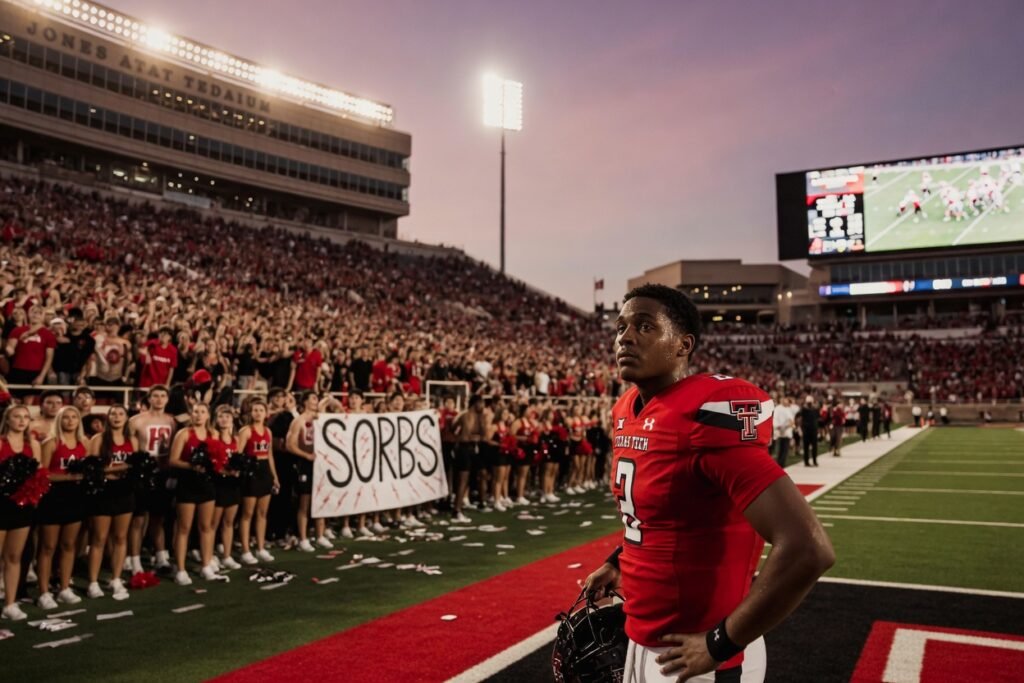
The NCAA just got outflanked in a Lubbock courtroom again, and this time the ruling cuts straight at the heart of how the association tries to police its own rulebook. Brendan Sorsby walked out with a preliminary injunction that lets him practice and play for Texas Tech after a two-game suspension, even though he placed thousands of bets totaling roughly $90,000 across four years, including wagers on his own Indiana team in 2022. The NCAA had already declared him permanently ineligible and rejected Texas Tech’s reinstatement appeal. A district judge looked at the mental health diagnosis tied to his gambling treatment and decided the ban would cause irreparable injury. That language matters because it shifts the fight from eligibility paperwork to contract and health claims.
I ran the numbers on similar cases over the past three years. Antitrust suits have already forced the NCAA to loosen transfer rules and open the door to direct athlete compensation. Sorsby’s team took a different route, arguing the NCAA breached its own promise to protect athletes’ physical and mental health. The filing from the association’s lawyers warned that letting him play would “undermine the integrity of college athletics by rewarding conduct that is universally prohibited in American sports.” That line is the clearest signal yet that the NCAA sees this as more than one player. It sees a crack in the enforcement wall.
The two-game suspension feels like a negotiated middle ground to keep the injunction narrow. Sorsby still gets cleared for the rest of the season, which starts September 5. Texas Tech, the defending Big 12 champion, now has its top transfer portal addition available for a run back to the College Football Playoff. The Red Raiders added Sorsby precisely because he was ESPN’s highest-ranked transfer this offseason. That production window just opened earlier than anyone expected.
I said last week that the Division I cabinet’s last-minute tweak to the five-year eligibility clock was exactly the kind of incremental fiddling that leaves the sport stuck in neutral. Courts keep stepping into the gaps because the eligibility model never built a durable internal mechanism for mental health or addiction cases. Sorsby’s diagnosis turns the NCAA’s blanket ban into a potential discrimination claim under its own contractual language. If the association cannot show it consistently applies health-based exceptions, every future betting suspension becomes vulnerable to the same argument.
The NCAA has already signaled it will appeal to the state appellate court and seek emergency relief. That process can move fast enough to resolve before the season opener. Charlie Baker’s statement Monday called the case a prime example of why Congress needs to pass new legislation. Without a collective bargaining agreement, the NCAA has no union partner to negotiate enforceable betting rules the way professional leagues do. Athletes are not employees, so they lack standing for that kind of deal. The result is a patchwork of court rulings that rewrite policy faster than the NCAA can update its manual.
Texas Tech’s outlook improves immediately with Sorsby in the fold. The program needs a reliable starter who can handle the Big 12’s up-tempo schemes and protect the ball in late-game situations. His transfer ranking reflected evaluators seeing starter-level traits in both pocket presence and decision-making under pressure. Two missed games at the front end still leaves him eligible for the conference slate and any playoff push. If the appellate court reverses the injunction, the Red Raiders would have to pivot quickly, but the preliminary ruling at least buys them roster certainty through the early part of the schedule.
The CFP implications sit one layer deeper. Texas Tech is already positioned as a contender in a conference that sends multiple teams most years. Keeping Sorsby on the field preserves the offensive continuity the staff built around the portal additions. Losing him would have forced a scramble at quarterback that rarely ends well in a playoff race. The injunction effectively removes one variable from the equation while the NCAA sorts its appeal.
What happens next in the legal case depends on whether the appellate court grants the emergency stay. If it does not, Sorsby plays under the current terms while the broader case proceeds. That timeline could stretch into the season, creating ongoing uncertainty for both the player and the program. Precedent from other eligibility suits shows courts are increasingly willing to grant temporary relief when the alternative is a player losing an entire year of eligibility. The mental health component adds a new variable that the NCAA has not faced at this scale in betting cases.
The association’s broader problem is that its rules were written for an era when athletes had fewer legal avenues and less external leverage. Antitrust pressure already dismantled large chunks of the old transfer and compensation framework. Sorsby’s case tests whether the same courts will now carve exceptions into the conduct rules that sit outside antitrust. If mental health treatment becomes a viable defense, the NCAA will have to decide whether to create a formal exception process or keep fighting each case individually in state courts. Neither path looks stable.
I keep coming back to the fact that professional leagues solved this exact problem through collective bargaining. They set clear penalties, appeal processes, and treatment pathways that survive legal scrutiny because both sides signed off. College sports has no equivalent structure. Baker’s call for federal legislation is an admission that the current model cannot self-correct fast enough. Until Congress acts or the NCAA accepts some form of bargaining framework, expect more injunctions and more players testing the edges of the betting rules.
The immediate effect on Texas Tech is roster stability. The longer-term effect on the NCAA is another data point showing that its enforcement power now runs through courtrooms as often as committee rooms. Sorsby will serve the two-game suspension and then suit up. What follows after that depends on whether the appellate court sees the same irreparable injury the district judge identified. Either way, the sport just added another precedent that future cases will cite when the next betting violation surfaces.