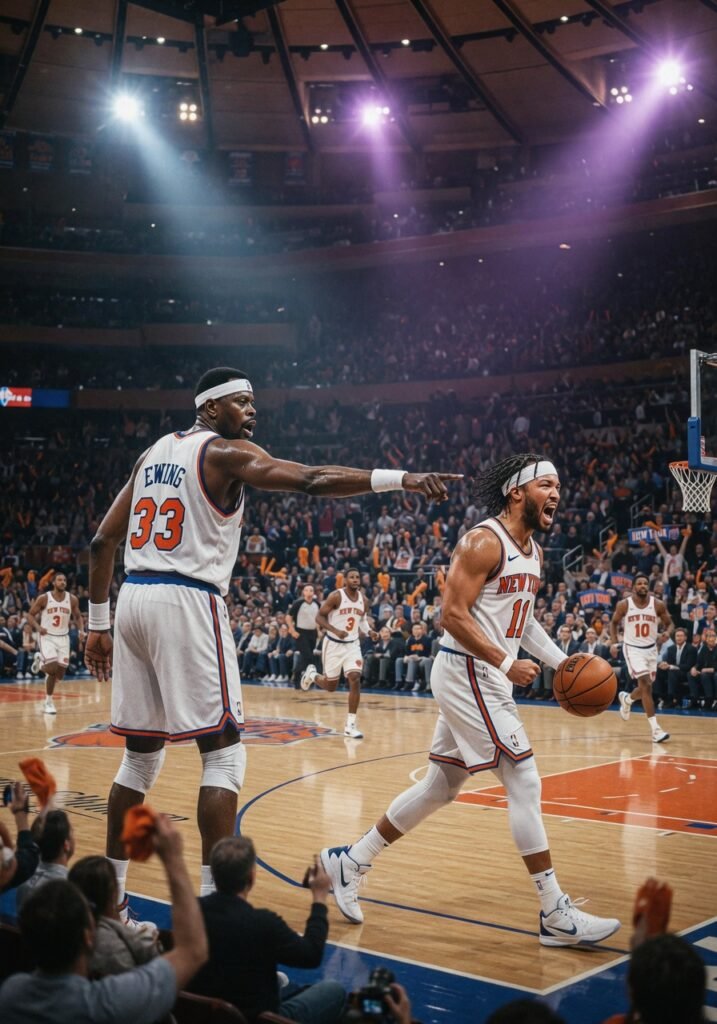
Patrick Ewing still feels that 1999 Finals loss like it happened last week, and the way he describes it makes clear how much unfinished business sits on the Knicks’ shoulders now. “That definitely hurt,” he told ESPN. “It hurt me more than the 1994 Finals loss to the Houston Rockets—the fact that I was not able to play.” Ewing watched from the sideline after tearing his Achilles in the Eastern Conference finals, and the undersized Knicks got swept aside by the Spurs in five games. Twenty-seven years later the franchise is back in the same spot, again facing a Spurs frontcourt built around a generational big man, this time Victor Wembanyama. The through-line from that 8-seed run to Jalen Brunson’s current group is not nostalgia; it is the same requirement that every rotation player accept a reduced role so the offense can function at playoff speed.
I watched the 1999 tape again after the Knicks clinched the East. Jeff Van Gundy’s defensive shell forced opponents into contested midrange shots while the offense lived on second-chance points and deliberate screening actions that created just enough space for Allan Houston and Latrell Sprewell. The current Knicks have revived pieces of that approach. They post the league’s best defensive rating in the playoffs at 105.8, achieved largely by switching one through four and keeping a big anchored near the rim. Brunson initiates most actions from the elbow or deep in the half-court, mirroring the way Charlie Ward and Chris Childs operated in 1999, except Brunson finishes at the rim more often and draws fouls at a 28 percent rate on drives. That single change alters the entire spacing math.
Larry Johnson sees the overlap clearly. “I’ve just been waiting because we were bad for a long time,” he told ESPN. “Instead of coming to the Knicks, Kevin Durant went to Brooklyn. And of course, LeBron did his little thing. It was a while to get stars to come here. Amar’e, and then we got Carmelo. But I don’t think we were ever close to winning the chip. I’m thinking the time is now, even if they lose this Finals, they’re still on the verge of winning the chip.” Johnson is right that the franchise spent two decades chasing the wrong kind of star power. The 1999 group succeeded because the stars who did arrive—Ewing until the injury, then Houston and Sprewell—accepted defensive assignments that did not always show up in the box score. Brunson does the same. He is guarding the opponent’s primary ball-handler for stretches while still leading the league in clutch-time points per game. That dual responsibility is the exact trait the 1999 Knicks needed once Ewing went down.
The personal thread makes the comparison sharper. Brunson was a toddler in the locker room during the 1999 run because his father Rick was on the roster. The alumni who have filled courtside seats this postseason—Ewing, Johnson, Houston, Sprewell, John Starks—have said they recognize the same selflessness in the current point guard. When Houston hit the running jumper against Miami in the first round of 1999 or when Johnson converted the four-point play against Indiana, those moments worked because teammates had already committed to the extra pass or the extra rotation. Brunson’s 12-game winning streak, including seven straight road playoff wins by double digits, rests on identical habits. The numbers show the Knicks rank first in assist-to-turnover ratio during that streak at 2.8, a figure that only appears when five players on the floor treat the ball as a shared resource rather than a scoring vehicle.
The 1999 Knicks reached the Finals by eliminating the Heat, Hawks, and Pacers in series that each went at least six games. They did it without home-court advantage after the first round. This year’s team has replicated the road dominance while adding a layer of three-point volume the older group lacked. Houston and Starks combined for 4.1 made threes per game in the 1999 playoffs; the current backcourt of Brunson and his running mate average 6.4. The extra spacing opens driving lanes that Van Gundy could only dream of, yet the defensive identity remains intact. Opponents are shooting 41 percent on shots within five feet against New York in the playoffs, the lowest mark since the 2014 Spurs.
Ewing’s final observation captures the stakes. “You see the way the city is reacting right now,” he said. “They might burn the city down.” That reaction is not simply about ending the drought since 1973. It is about validating the specific brand of basketball the franchise has chased twice across three decades: physical, sacrificial, and built around a point guard who treats winning possessions the same way he treats scoring possessions. The Spurs series will test whether that formula holds against Wembanyama’s length. In 1999 the Spurs used David Robinson’s help defense to erase drives; the current Spurs will try the same with Wembanyama’s 8-foot-2 wingspan. The Knicks’ answer will come from the same place it came in 1999—five-man rotations that close out on shooters without leaving the rim exposed.
The alumni presence at the Garden this postseason functions as living proof that the 1999 group never stopped measuring the franchise against its own standard. They saw the failed Carmelo experiment, the Porzingis trade, the failed KD pursuit. None of those moves produced a Finals trip. Brunson’s arrival did, and it did so without requiring the Knicks to abandon the defensive principles Van Gundy installed. That continuity is the real connection between eras. The 1999 team proved an 8-seed could reach the Finals if every player accepted a role smaller than his talent suggested. The 2026 Knicks are attempting the same calculation with a point guard who grew up inside the locker room where the equation was first solved. The Spurs stand in the way again, but the blueprint has not changed.
The series opens Friday in San Antonio. If the Knicks can force Wembanyama into foul trouble the way they once forced Robinson to guard smaller forwards, the outcome tilts. If they cannot, the same five-game result from 1999 could repeat. Either way, the thread from Ewing’s sideline view to Brunson’s leadership is now visible in real time. The franchise is finally asking the same question it asked in 1999 with the personnel built to answer it.