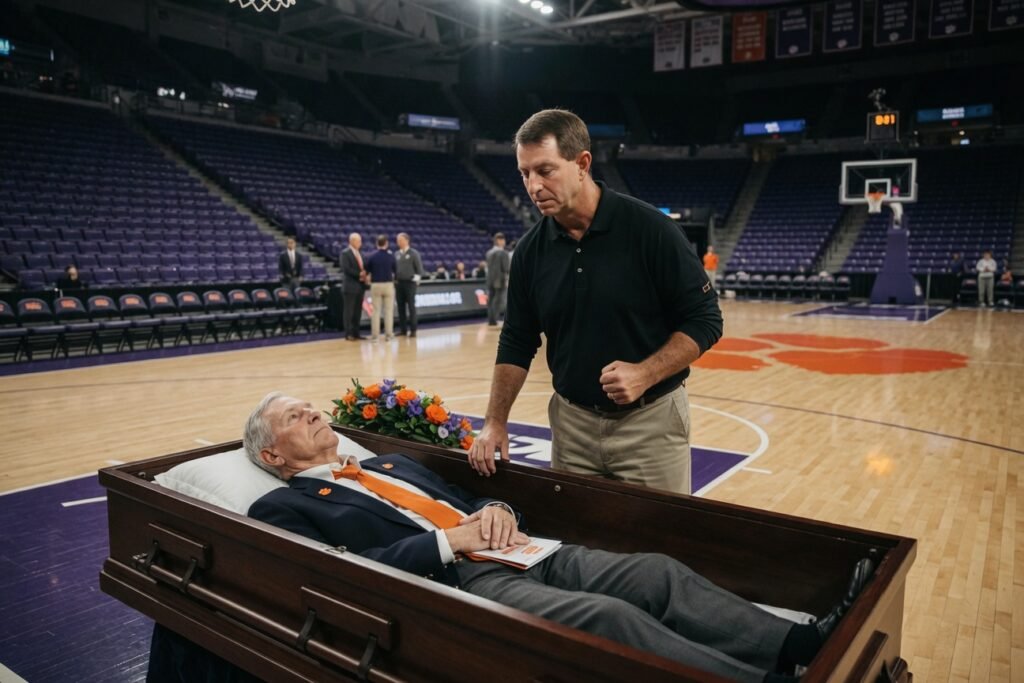
I got the call about Terry Don Phillips the same way these gut-punch stories always land—scrolling box scores after the kids were finally down, the fridge humming in the dark, and suddenly Clemson’s entire athletic rise flashing back like a highlight reel nobody asked for. Phillips was 78, hospice after a decade of dementia, and the official release hit like the final buzzer on a season you weren’t ready to close. He hired Dabo Swinney when the rest of the world was ready to move on, and he hired Brad Brownell when Clemson basketball was still searching for an identity. That dual bet turned the Tigers into something nobody saw coming, and now the guy who made both calls is gone.
I’ve been riding a stretch where the takes have been landing clean—Jayhawks flattening West Virginia, the North Carolina run that nobody scripted right, even that Aaron Judge walk-off that felt like pure theater. This one feels different. It’s not about a game. It’s about the man who decided the games mattered enough to back the right people when the criticism was loudest. Swinney laid it out last August at ACC media days, the night after that 6-6 finish against South Carolina. He thought he was walking into his own funeral. Instead Phillips sat him down and said the words that changed everything.
“I go from thinking I’m getting fired to Terry Don Phillips telling me how much he believes in me,” Swinney remembered. “He said to me, ‘Hey there’s going to be a lot of criticism and there’s going to be a lot of this and that, (but) I want you to keep doing what you’re doing. I want you to know that I’ve got your back. I believe in you more now than even when I hired you.’” That’s the line that still rattles around my head. Most athletic directors fold when the message boards turn savage. Phillips doubled down. Two national titles later—2016 and 2018—and Swinney sitting at 187-53, the receipt is framed on every wall in Death Valley. But the real story is what that same philosophy did for the basketball program sitting right across the street.
Brownell walked into Clemson in 2010 with a 9-21 roster and a fan base that treated hoops like an afterthought between football Saturdays. Phillips didn’t blink. He let Brownell build. The numbers tell the tale without needing hype: Brownell became the winningest men’s basketball coach in school history, dragging the Tigers into the NCAA Tournament multiple times and turning them into an ACC team that could actually steal games from the blue-bloods. Phillips’ decade at the top delivered 13 conference titles across eight sports, 57 top-25 national finishes, and the kind of sustained excellence that makes you forget how thin the margins were when he arrived. The basketball side doesn’t get the same headlines as Swinney’s rings, yet it’s the same DNA—patience when the results were ugly, resources when the program finally clicked.
I keep coming back to that Swinney moment because it explains why Phillips mattered beyond one sport. In college athletics the easy play is always to fire the coach after a bad loss and chase the next hot name. Phillips treated the job like it was his own reputation on the line. He told Swinney he believed in him more after the 6-6 season than on the day he hired him. That’s not corporate-speak. That’s the kind of loyalty that turns a program from pretender to powerhouse. Brownell benefited from the same culture. No panic moves when the early seasons dragged. Just steady support while the pieces came together. You see the difference today—Clemson basketball isn’t an annual doormat anymore. They compete. They recruit. They win games that used to be automatic losses. Phillips’ fingerprints are all over that shift.
The stomach punch for me is realizing how rare that kind of AD actually is. I’ve watched too many programs eat their own coaches alive the second the narrative turns. Phillips served ten years and left with the kind of résumé that makes you wonder why more schools don’t copy the model. Five different women’s sports claiming ACC titles during his run. Fourteen top-10 national finishes. The man didn’t just survive the pressure; he used it to build something that outlasted him. Dementia took the last decade, but the work he put in from 2002 to 2012 still echoes every time Swinney takes the field or Brownell draws up a late-game set.
My own ledger on these stories keeps growing. I’ve written before about redemption arcs that refuse to die—the Knicks going all-in and watching it pay off in real time, the tennis bracket that looked dead on arrival until the right player caught fire. Phillips belongs in that same column. He didn’t just hire coaches; he protected the process when everyone else wanted the easy out. Swinney’s two titles are the obvious payoff, but Brownell’s climb to the top of the Clemson wins list is the quieter validation. Both happened because one athletic director decided belief mattered more than the next press release.
That approach feels almost foreign now. College sports move at Twitter speed. One bad season and the search firm is already on the phone. Phillips operated like the long game was the only game worth playing. He watched Swinney go 19-14 early, heard the noise, and chose to steady the ship instead of torching it. Same with Brownell. The results speak louder than any apology tour I could write. Clemson football became a national brand. Clemson basketball became respectable and then competitive. The entire athletic department posted numbers that still stand as benchmarks. All of it traces back to the same guy who sat in that office after the South Carolina loss and refused to blink.
I’m sitting here thinking about what it costs to be that kind of leader. The criticism Phillips absorbed during the lean years never made the highlight reels. The board meetings, the donor calls, the internal second-guessing—he absorbed it so his coaches could keep coaching. That’s the part that lingers. We celebrate the rings and the tournament bids, but the foundation was laid by a man who treated loyalty as a competitive advantage. Brownell’s teams don’t reach the level they have without that runway. Swinney doesn’t become the winningest coach in school history without the same protection. Phillips gave both of them the one thing most administrators withhold when the heat rises: time.
The dementia diagnosis came more than a decade ago, so the final years were quiet by necessity. Still, the announcement lands with weight because the legacy is so concrete. Clemson didn’t just get better under Phillips; it got fundamentally different. The football program went from ACC middle class to national champion. The basketball program went from afterthought to consistent participant in the conversation. That kind of transformation doesn’t happen by accident. It happens when the athletic director decides the coaches he chose deserve the same fight he would want for himself.
I keep circling back to Swinney’s words because they capture the man better than any stat line. Phillips believed more after the losses than before the hire. That’s the rarest quality in the business. It’s also the quality that turned two separate programs into winners. Brownell’s record climb and Swinney’s championships are the public proof. The private proof was a single conversation in an office after a 6-6 season when every instinct told most people to move on. Phillips chose to stay. That choice still shapes everything Clemson touches in both football and basketball. The man is gone, but the standard he set is still running the show.