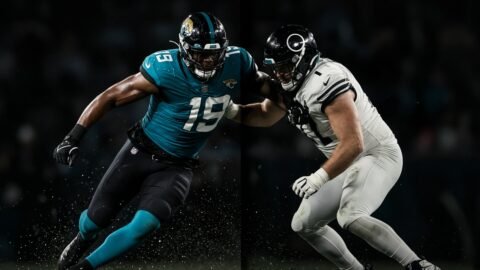
Throwing four interceptions on Sunday Night Football and walking out of Soldier Field with a 27-24 win is the kind of statistical crime scene that should get a franchise audited by the league office. Yet here sit the 7-2 Chicago Bears, heading into their bye week on a four-game winning streak without trailing for a single second across that stretch, while Caleb Williams talks like a guy who just unlocked an infinite-ammo cheat code in Madden.
Before Sunday night against the Tampa Bay Buccaneers, Chicago was 5-43-1 in franchise history when its quarterback threw four or more interceptions, and the last time the Bears survived a four-pick disaster was Todd Collins in 2010. Williams handed the football to Tampa Bay four times, the Bears coughed up five turnovers total after receiver Luther Burden III lost a late fourth-quarter fumble on a play that left him with a concussion, and Chicago still never trailed, becoming only the third NFL team in the past 20 seasons to win a five-turnover game wire to wire.
The box-score truthers want to hang a fraud banner on Halas Hall this morning because Williams finished 22-of-37 for 279 yards, two touchdowns, four picks, and a 61.5 passer rating. Even Ben Johnson looked terse and visibly irritated at the postgame podium after watching his offense turn a 14-0 first-quarter sprint into a four-hour street fight. I view this chaos from the exact opposite angle: surviving a career-worst meltdown while still ripping a 38-yard dagger to tight end Colston Loveland late in the fourth quarter proves Williams has the exact psychopath gene Chicago has lacked under center for a century.
Sixty-Six Percent Blitz Rates Expose the Protection Math
You cannot evaluate four interceptions in a vacuum without looking at how Tampa Bay attacked the line of scrimmage. The Buccaneers blitzed Williams on 66 percent of his dropbacks according to ESPN, the third-highest blitz rate he has faced in his career. When a defense sends extra bodies on two out of every three snaps, it forces the quarterback and offensive line to solve protection math before the third step of the drop hits the turf.
“They sent the same blitz a couple of times, and they got through, and that’s what happens,” Williams told ESPN after the game. “When a defense sends a similar blitz or sends a blitz over and over, that just means that they’re getting through. That means they’re going to keep going until we stop it. We have to find ways to get better. … And then when it does happen, I have to be the big eraser.”
That quote exposes the actual schematic breakdown on Sunday night. Williams entered the game with one interception all season and just four picks across his previous 15 regular-season starts combined dating back to November 2025. He did not forget how to read a coverage shell overnight.
“It’s frustrating,” Williams said, via Sports Illustrated. “Two of them tried to be throwaways, one of them I made a dumb decision, and then the last one got tipped up in the air.”
Trying to play hero ball and dirt throwaways while free runners are closing down your throwing lane is how two dead plays turn into live turnovers. On top of that, Chicago managed just 72 rushing yards all night, leaving Johnson’s play-action menu nerfed and allowing Tampa Bay to pin its ears back without respecting the run. When repeated overload pressures get home untouched, the fix belongs in the protection slides and hot-route sight adjustments during the bye week, not in putting a muzzle on the quarterback.
A Gunslinger With Amnesia Beats a Checkdown Coward
Most quarterbacks who throw three first-half interceptions spend the rest of the night staring at their running back’s shoelaces and praying for the clock to run out. Williams came out firing early with a 9-yard touchdown strike to Rome Odunze and a 56-yard bomb to Burden, who racked up seven catches for 97 yards before exiting, and then watched the wheels come off. The only reason Chicago held a 24-13 third-quarter cushion was cornerback Jaylon Johnson jumping a Baker Mayfield pass and returning it 67 yards for a pick-six while Chicago’s defense held Mayfield to 243 yards, two interceptions, and a 54.6 rating.
Then Bucky Irving punched in his second touchdown of the night from six yards out after Burden’s fumble, Mayfield scrambled in for the two-point conversion to tie it at 24-24 with 2:51 left, and the entire stadium waited to see if Williams was cooked. Instead, with the season’s momentum hanging in the balance, he stood in and lasered that 38-yard strike to Loveland down to the Tampa Bay 16-yard line so Cairo Santos could drill a 38-yard walk-off field goal as time expired.
“I’m going to throw until I can’t throw anymore,” Williams told ESPN. “That’s how I live. I work my tail off to be in this position. I’ll never not throw the ball. I could throw 100 picks in one game. If it comes down to it, I’m going to throw that pass that I did to Colston, or if it’s a tighter window, I’m going to rip it in there. That’s how I grew up. That’s who I am. I don’t get gun shy. That’s not me, that’s not my identity, that’s not who I am. With that, I’m going to keep grippin’ it, keep rippin’ it, and Coach calls it, it’s time to go make a play.”
I love every single syllable of that defiance. For decades, Bears fans have suffered through robotic game managers with zero aura who threw for 140 yards, protected their completion percentage, and lost 17-10 whenever the defense failed to score for them. Give me the guy with short-term memory loss who throws four picks and still hunts the deep intermediate seam with the game on the line.
“So I’ve been through it,” Williams said to ESPN, referencing the two prior three-interception games of his career. “I’m happy that I’ve been through it before. I’m not going to get gun shy. I’m not going to shy away from it. I have to find ways to get better. … The other two times, we didn’t win the games. This time, it’s a W.”
Johnson has this bye to install blitz-beaters that punish defenses for sending that kind of pressure, and the rest of the NFC just lost its best chance to hand Chicago a third loss.