Thirty-five thousand, eight hundred and twenty-three dollars is the cheapest guerrilla marketing campaign in modern NFL history, and Chicago Bears quarterback Caleb Williams isn’t even taking a cut of the equity.
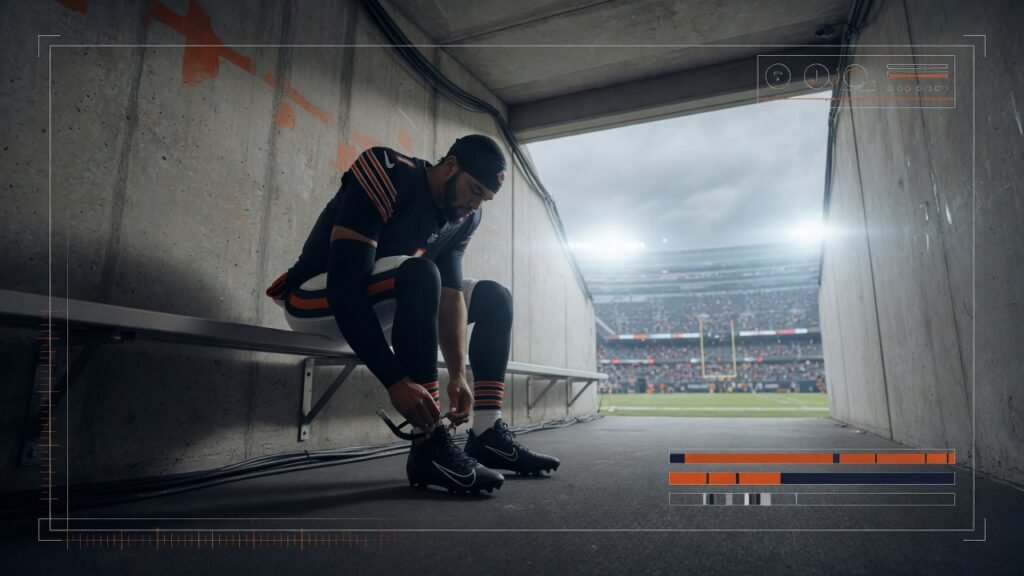
After sitting out Weeks 3 through 5 with a hamstring injury, the third-year passer returned in Week 6 against the Atlanta Falcons wearing black Caddix cleats with a visible gray logo. Because the NFL only holds on-field footwear partnerships with Nike, Adidas, and Under Armour, league headquarters hit Williams with an $11,941 uniform violation. Four days later, on Thursday night against the New England Patriots, he laced up the exact same unapproved pair, triggering a doubled repeat-offender fine of $23,882. Now, heading into Monday night’s clash against the defending Super Bowl champion Seattle Seahawks, I view this entire standoff as a brilliant mechanical calculation disguised as a dress-code rebellion.
Most players of his draft status land a shoe endorsement, yet Williams has operated as a footwear free agent since entering the league in 2024. He wore Nike cleats during his first two seasons, has frequently worn New Balance too, and actually wore all-white Caddix cleats during the 2026 preseason and the first two regular-season games without drawing a flag because the logo wasn’t prominent. Switching to the black pair with the contrasting gray mark after three weeks on the sideline looks to me like a deliberate choice, not an accident.
The Biomechanics of a Three-Step Drop Outweigh a League Invoice
To understand why a franchise quarterback would invite escalating fines from Park Avenue, look at the kinetic chain of an NFL passing play after a soft-tissue injury. When a quarterback returns from a hamstring strain, the primary structural vulnerability occurs during sudden deceleration and rotational planting on synthetic turf or chewed-up grass. Standard molded studs lock the foot into the surface, transferring the rotational torque directly up into the ankle, knee, and hamstring tendons.
“It’s something that focuses on when you plant on the hard plants on turf or grass, they call them SmartStuds, and they move when you move,” Williams told reporters when explaining his refusal to switch back. “They take tension off of your tendons, your joints and all of that. … I’m focused on being able to be out here for the guys. And if that can give me a small percentage up and it works, then that’s what I’m gonna do.”
I care about what happens when that back foot hits the turf at the top of a drop, and the efficiency metrics since Williams returned in the black cleats are undeniable. Across the wins over Atlanta and New England that pushed Chicago to 5-2, Williams completed 75.4% of his passes (52-of-69) for 613 combined yards, three touchdowns, zero interceptions, and a 116.4 passer rating. He went 30-of-36 for 305 yards against the Falcons, then followed it up by going 22-of-33 for 308 yards and two scores on a short turnaround against the Patriots. When a quarterback posts back-to-back 300-yard outings with zero turnovers immediately after a three-week hamstring absence, his base in the pocket is completely stable.
The NFL operations department and traditionalists in league offices argue that the rule is simple: Caddix cleats have passed NFL health and safety testing, meaning Williams can wear the exact same shoe for zero dollars in fines if his equipment manager simply blacks out or tapes over the gray logo. That is a fair point on paper, and even Caddix CEO Jack Rasmussen told Front Office Sports on Saturday that hiding the logo “makes sense” as a practical option to avoid cameras while keeping the cleats on the field.
How a Four-Person Startup Turned Park Avenue Into a Billboard
Yet covering the logo misses the structural leverage Williams and the players around him are building against the league’s apparel triopoly. By leaving the gray mark exposed in prime time, Williams forced the NFL’s fine schedule into the public ledger, turning a $35,823 payroll deduction into a heap of earned media for a four-person startup founded in 2024. Rasmussen has already pledged that the company will reimburse Williams, erected a supportive billboard in Chicago, and noted that player adoption across the league has surged from roughly 40 players in early reports to close to 100 NFL players wearing the brand today.
Even veteran quarterbacks on rival rosters are lining up to subsidize the defiance. Cincinnati Bengals quarterback Joe Flacco, an advisor and investor in Caddix who has worn the cleats since 2024 alongside 49ers fullback Kyle Juszczyk and company collaborator Tom Brady, stepped up publicly to back the Bears passer.
“If Caleb gets fined again for wearing Caddix, I’ll pay the fine myself,” Flacco said in a statement to ESPN. “I’ve worn these cleats for years, and I know firsthand the difference they make. When you’re playing at this level, you need equipment you can trust. This isn’t about making a statement or breaking the rules just to break them. It’s about wearing gear that works for you and helps keep you safe on the field. If Caleb believes in Caddix the way I do, I’m happy to stand behind him.”
My read on the league’s dilemma is that the NFL has priced its own exclusivity protection way too low to deter a quarterback playing at a 116.4 passer rating clip… especially when outside money is eager to cover the tab. The league charges $5,971 for a foreign substance or an unapproved visor, and starts unauthorized logo violations at $11,941. For Nike, Adidas, and Under Armour, watching a growing number of players migrate to a safety-certified competitor while a marquee third-year star turns the fine process into a weekly viral campaign is a nightmare return on their licensing fees.
“From a safety metric perspective, Caleb’s cleats are one of the safest pairs players can wear,” Rasmussen told ESPN. “Regardless if this is a marketing fine or not, I’m happy to pay it.”
I will be watching two specific checkpoints over the next nine days: first, whether the gray logo remains untouched on the Lumen Field turf in Seattle on Monday night, and second, the November 10 appeal hearing where Williams and the league formally square off over the Week 6 fine.