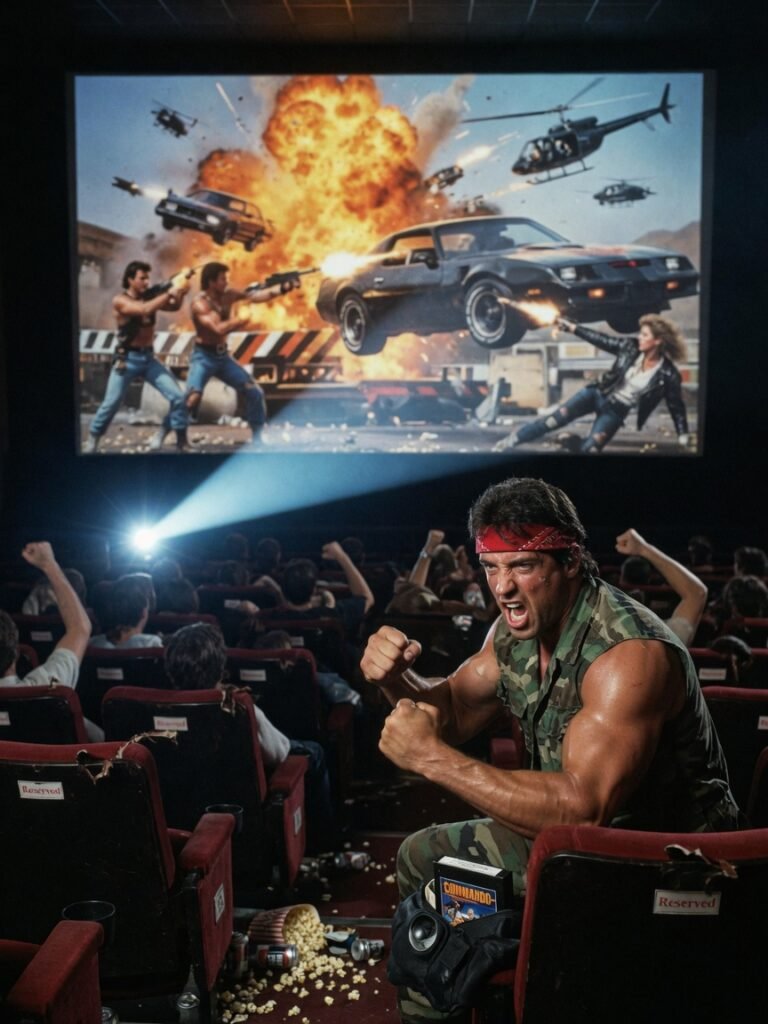
There’s a dangerous lie whispered in the hallowed halls of film criticism, a disservice that’s been propagated for decades, and it’s time THE CHAMPION calls it out: the idea that “mindless” action is somehow lesser. What a load of garbage! “Mindless” isn’t a pejorative; it’s a badge of honor for films that achieve a singular, perfect goal – pure, unadulterated cinematic joy. These aren’t films that ask you to *turn off* your brain; they ask you to *engage a different part* of it, the primal, adrenaline-fueled core that just wants to see something explode beautifully, a hero deliver an impossible one-liner, and justice served with extreme prejudice. The 1980s perfected this art form, and anyone who calls these masterpieces of mayhem “just action” is missing the entire point.
Let’s be crystal clear: we’re not talking about the thought-provoking sci-fi satire of *RoboCop* or the intricate narrative architecture of *Die Hard*. Those are phenomenal films that layer their action with deeper themes. No, we’re celebrating the lean, mean, unpretentious machines of destruction that defined a decade. They are the cinematic equivalent of a perfectly executed powerbomb – direct, impactful, and utterly satisfying.
Take *Commando* (1985), for instance. This isn’t just a movie; it’s a meticulously crafted symphony of excessive violence and one-liners that became the blueprint for an entire subgenre. Arnold Schwarzenegger’s John Matrix, a retired special forces colonel, is forced back into action when his daughter is kidnapped. The plot is thin as tissue paper, but that’s its strength. It clears the stage for an escalating ballet of explosions, impossible body counts, and Arnold’s utterly charming, stone-faced delivery of lines like, “Let off some steam, Bennett.” The film understands its assignment: deliver maximum impact with minimal fuss. Every prop, every character, every scene exists solely to propel Matrix towards his next absurdly over-the-top kill. It’s a masterclass in controlled chaos, a film that knows exactly what it is and leans into it with gleeful abandon.
Then we have Sylvester Stallone, another titan of the era, who delivered his own brand of “mindless” perfection. While *First Blood* was a raw, psychological drama, its sequels, especially *Rambo III* (1988), fully embraced the spectacle. The first sequel, *Rambo: First Blood Part II*, still carried some of the weight of its predecessor, but by the third outing, Rambo was an unstoppable force of nature, a one-man army in Afghanistan. Stallone himself, reflecting on the series, once admitted, “Rambo III was kind of an aberration. We were trying to make it more like a Western.” And he’s right! It’s less about the trauma of war and more about a lone warrior taking on an entire Soviet army with a bow and arrow. It’s pure myth-making, a larger-than-life hero against impossible odds, stripped of any pretense of realism. It’s the kind of film where you cheer, not think, and there’s absolutely nothing wrong with that. In the pantheon of Rambo, *First Blood* is the nuanced drama, *Part II* is the explosive evolution, and *Rambo III* is the glorious, unhinged action cartoon.
And let’s not forget the glorious, chaotic mess that is Stephen King’s sole directorial effort, *Maximum Overdrive* (1986). Machines come alive and kill people – that’s the premise. It’s ridiculous, it’s campy, and it’s utterly compelling in its earnest absurdity. From the murderous soda machine to the sentient big rigs, King’s vision is unfiltered, unpolished, and undeniably *fun*. It’s a film that exists outside the bounds of conventional good taste, a raw, punk-rock explosion of practical effects and AC/DC needle drops. King himself has been candid about the film’s origins, famously stating, “I was a cokehead when I made that movie and I didn’t know what I was doing.” That honesty, that raw, uninhibited creative energy fueled by… well, *stuff*, is precisely what makes *Maximum Overdrive* a quintessential “mindless” classic. It’s a singular, wild ride that never pretends to be anything more than killer trucks and gratuitous violence, and it’s all the better for it.
The beauty of these films isn’t their intellectual depth; it’s their visceral impact. They spoke to an era of heightened geopolitical tension, a desire for simple heroes and clear villains, and a collective need for pure escapism. When Arnold Schwarzenegger declared, “I just wanted to be the best, and I wanted to be the first. And I wanted to be the biggest” in reference to his career, he wasn’t just talking about box office; he was articulating the ethos of 80s action – to be undeniably, aggressively *more*. These films weren’t trying to win Oscars for their screenplays; they were trying to win the hearts of audiences with explosions, car chases, and heroes who could kick down doors and deliver a perfect quip.
From Chuck Norris’s stoic vengeance in *Missing in Action* to Patrick Swayze’s zen bouncer in *Road House*, the 80s understood the assignment. These films are cultural artifacts, perfectly preserved capsules of a time when action was loud, proud, and gloriously uncomplicated. They remind us that sometimes, the greatest storytelling isn’t about complex narratives or deep psychological dives, but about the pure, unadulterated thrill of the ride. And for that, they deserve our highest praise.
VERDICT: WATCH. These films are essential viewing for understanding the foundations of modern action and the pure, unpretentious joy of cinematic escapism. 9/10 – they achieve exactly what they set out to do with unmatched swagger and style.