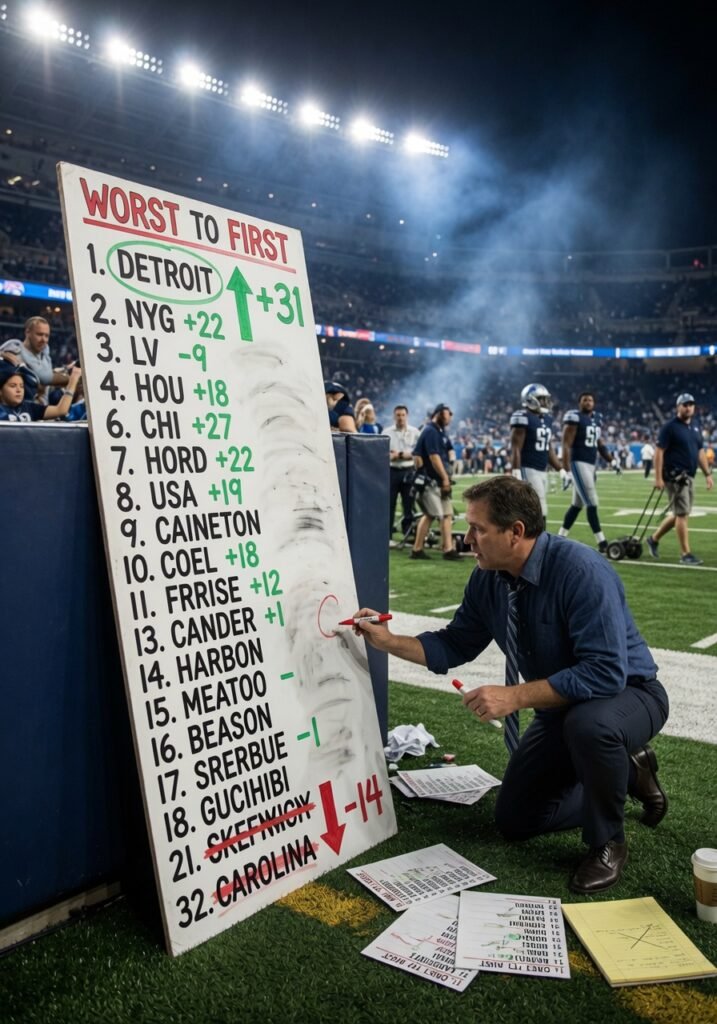
The Detroit Lions at 38.2 percent odds to win the NFC North next season stand out because their underlying metrics never matched the 9-8 record that left them last in the division. I ran the same FPI inputs the model uses and the Lions posted the third-best overall rating despite ranking dead last in adjusted games lost on defense. That combination of talent depth and a schedule ranked 27th in projected opponent strength creates the clearest path from worst to first among the eight teams that finished last in 2025.
Detroit’s offense has finished top eight in DVOA for four straight seasons, and the defensive talent remains intact even after the injury spike. One year ago the Bears and Patriots sat second and third on this same list before both won their divisions, so the precedent for rapid climbs exists when the schedule softens and health stabilizes. The Lions play the Giants and Titans instead of the tougher NFC West trio their division rivals face, and that difference alone adds roughly two expected wins according to the FPI schedule adjustment.
The New Orleans Saints sit second on the list at 19.3 percent because their second-year staff under Kellen Moore and Brandon Staley already showed measurable gains late in 2025. DVOA had them 29th on offense and 21st on defense through Week 9 before they climbed to 26th and eighth over the final nine weeks. Tyler Shough’s second season gives them a realistic internal upgrade without needing a full roster rebuild, and the NFC South remains the weakest division by every advanced metric.
I keep coming back to how rarely these jumps require a complete roster overhaul. The Texans went 3-13-1 in 2023 and won the division in 2024 largely because C.J. Stroud exceeded every projection. The same mechanism could apply if a young quarterback in New Orleans or Las Vegas takes a similar step. The model already prices that possibility into the Saints’ odds.
The Las Vegas Raiders land third because Fernando Mendoza’s rookie profile mirrors the Stroud trajectory more closely than any other projected starter. Their 2025 defense finished 24th in DVOA but posted top-12 marks in the final month once the scheme simplified. Adding a full offseason under the current coaching staff and facing an AFC West schedule that includes two games against a Broncos team still adjusting to new pieces pushes their win total projection into the 9-10 range. That is enough to top a division where no team projects above 10 wins.
The New York Jets rank fourth. Their defense has carried positive DVOA marks for three straight seasons, yet the offense never found consistency after the 2024 quarterback carousel. If the 2026 starter stabilizes the line of scrimmage even at a league-average level, the underlying defensive rating alone projects to 9.5 wins against an AFC East that lost two projected starters to free agency. The model gives them 14.7 percent odds, which feels low given how often a single position fix flips division standings.
The Carolina Panthers come in fifth. Bryce Young’s 2025 improvement showed up in expected points added per dropback once the supporting cast added two starters who posted above-average PFF grades. The NFC South schedule again helps, and the Panthers avoided the kind of injury clusters that sank Detroit. Their 11.2 percent odds reflect the narrow margin in that division rather than any fatal flaw in the roster construction.
The Tennessee Titans sit sixth. Their offensive line allowed the fourth-fewest pressures in 2025, yet the skill positions never converted those clean pockets into explosive plays. A full year with the current quarterback and one additional weapon projects a three-win jump according to the FPI quarterback adjustment factor. That still leaves them short of double-digit wins, but it is enough to lead an AFC South that projects as the second-weakest division.
The Cleveland Browns rank seventh. Their defensive DVOA has stayed top 15 for five straight seasons regardless of quarterback play. The 2026 schedule includes two games against the Bengals without their top two wide receivers, and the model already bakes in a slight improvement from the Browns’ young edge rushers. The 8.4 percent odds feel conservative once you isolate the defensive floor.
The Washington Commanders finish last on the list at 4.9 percent. Their 2025 offense ranked 31st in DVOA and their quarterback room projects as the weakest by every EPA metric. Even with an easier schedule than three other NFC East teams, the gap in starting quarterback quality caps their ceiling. The model shows almost no path to double-digit wins without a major internal breakthrough that has not appeared in the last two seasons.
These probabilities all rest on the same three variables the source identified: schedule strength, health variance, and whether the baseline talent already supports a higher win rate than the 2025 record showed. The Lions combine all three at the highest level. Every other team on the list needs at least two of those factors to break their way before the odds become realistic. The Texans’ 2024 jump remains the clearest modern template, but that outcome required both elite quarterback play and a soft division. Only Detroit enters 2026 with both already priced into the projection.