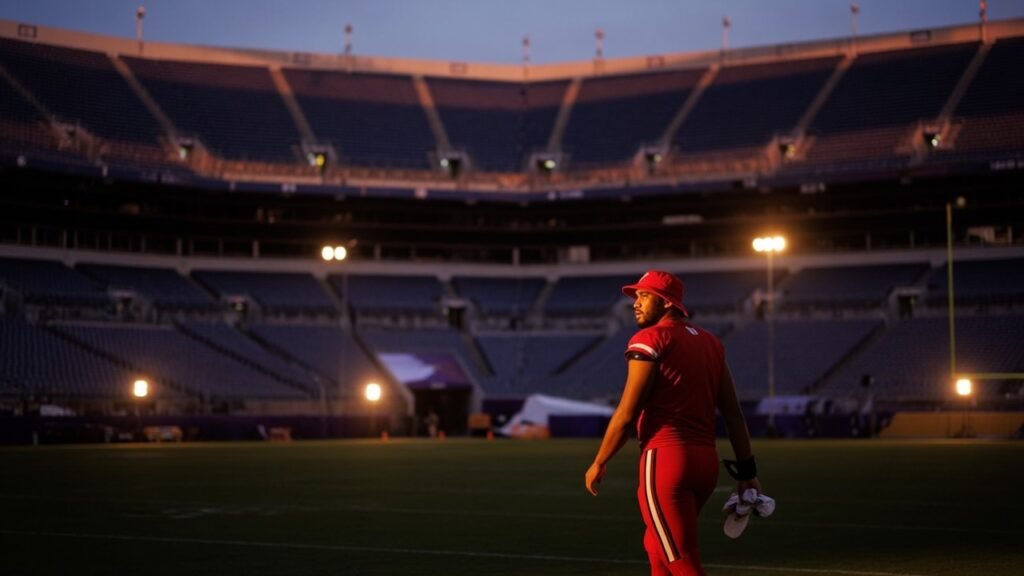
The boos hit Tua Tagovailoa the second he left the Falcons sideline Friday night at Hard Rock Stadium, and they got uglier when he stepped into the huddle. One-third of a building, already half-empty for a preseason finale, decided the man who spent six years as their franchise quarterback needed a chorus of rejection on the way out.
I heard it. I watched it. And I keep coming back to the same hard truth: those fans were booing their own receipts.
Tua went 7 of 8 for 95 yards in the first quarter, marched Atlanta 60 yards for the opening touchdown, hit Kyle Pitts for 37, and still got treated like the villain in a divorce he did not file. The Falcons won 17-12. He fumbled a snap. Then he stood at the podium and refused to return fire.
“Those are probably some of the best six years of my life, being able to play for Miami, being able to play in front of the crowd,” he said. “So, regardless of the reaction, I love the city. We have a home out here. We still have our house and whatnot, but I mean, it is what it is.”
That is the line that should live longer than the boos. He still owns property in the market that just tried to run him out of town on a rail.
The $99 Million Ghost They Cheered Into Existence
Miami released him in March and ate an NFL-record $99.2 million in dead money. Two years earlier they had handed him the extension that made him the highest-paid player in franchise history, four years and $212.4 million. They drafted him fifth overall in 2020. They rode the peaks when he led the league in passer rating, then yards, then completion percentage. They made the playoffs twice. Then the final two seasons went 15-19 in the games he started 25 of 34, the head injuries stacked up, the 2025 interceptions piled on, and the wrong quotes landed at the wrong time. He got benched after the Steelers loss in Week 15.
I am not here to pretend the last two years were pretty. He said it himself: “I wasn’t playing up to the standard that I had been playing in years past, so I understand. You have to be real with yourself.” That is ownership. The front office owned the other half when they cut him and still wrote the checks. The crowd Friday night only owned the noise.
Booing a quarterback who is competing for a job on a one-year veteran-minimum deal in Atlanta while your own cap is still bleeding from the contract you gave him is not accountability. It is theater for a sparse house that already checked out. The Dolphins rested starters. The product on the field was mostly backups. And the loudest sound in the building was reserved for the guy wearing the other jersey who still keeps a house in South Florida.
Class Under Fluorescent Lights Is Still Class
Kevin Stefanski talked about how Tua compartmentalized the emotion. I saw something simpler. He took the first series, scored, absorbed the next wave of boos, mishandled a snap, and still left the night calling it “a cool homecoming, if you will.” He talked to former teammates during the game. He stuck around after. He did not invent a grudge for the cameras.
That is the part Miami cannot rewrite. The franchise got two playoff berths, a Pro Bowl season, and the highest-paid quarterback in its history out of the marriage. When the body and the production slipped, they paid the dead-money freight and moved on. Fair business. The fans who showed up Friday decided the final chapter needed humiliation. Tua declined to write it that way.
I have watched enough of these returns to know the script. The ex comes back, the building gets loud, somebody says something bitter, and everybody pretends it was pure. This one broke the pattern. The boos were real. The grace was realer. And the empty seats told on everybody.
He is 28, on a minimum deal, fighting Michael Penix Jr. for the keys in Atlanta while Miami carries nearly a hundred million in dead cap and a stadium that could not fill itself for the funeral. No regular-season rematch is on the schedule. This was the only night he had to walk back into that tunnel as a visitor.
He walked out still loving the place. The place booed him for the privilege. That ledger does not balance the way the loudest section thinks it does. The house he still owns sits there as the quiet proof.