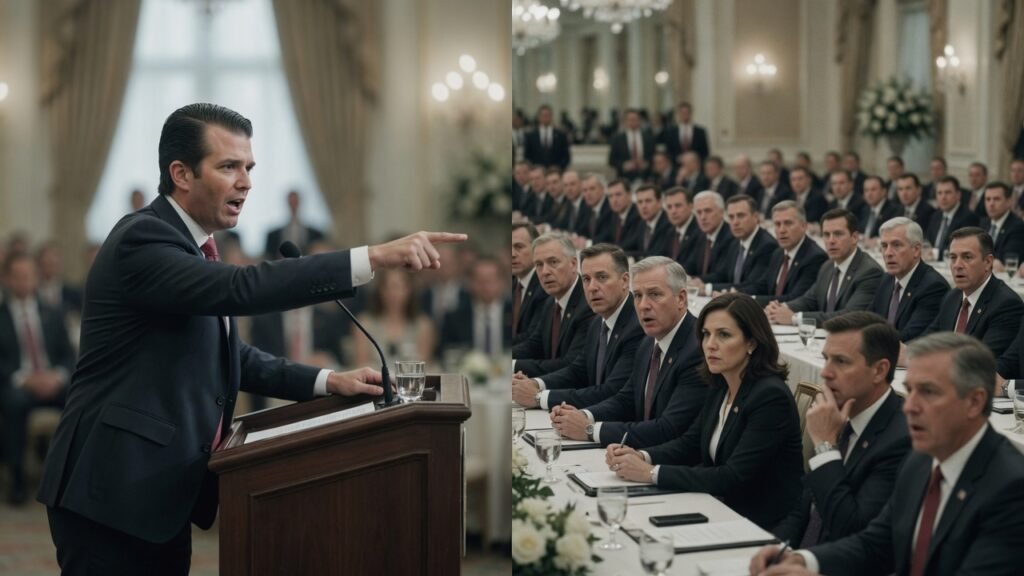
The sportsbooks spent a decade building their walls, and Donald Trump Jr. just walked into a closed room full of Republican attorneys general and called those walls a monopoly.
I have been watching this fight for months, and the March retreat at the Ritz-Carlton in New Orleans is the moment the quiet war over prediction markets stopped being quiet. Trump Jr., according to four people familiar with the exchange reported by the New York Times, told those AGs they were being led astray by a “vested interest” — gambling firms protecting their “monopolies” by attacking the markets. He framed the platforms as a sophisticated financial tool already under federal oversight, not something for state prosecutors to police. His spokesperson later said the exchange lasted roughly a minute of an hour-long Q&A and that he does not interface with the federal government on behalf of any company he invests in or advises. Kalshi says he advises on marketing, not regulation.
Fine. I still heard the gunshot.
Twenty States, One Federal Shield, and a Tax Gap That Screams
Roughly twenty states are locked in litigation over whether prediction markets count as illegal gambling under state sports-betting statutes. Forty-four states signed a letter branding the platforms a “new form of casino.” The American Gaming Association says states and tribes have already missed more than a billion dollars in tax revenue. The Tax Foundation put the upside of taxing these markets like sportsbooks at least two billion a year.
North Carolina just drew the map everyone else is staring at. The White House Office of Intergovernmental Affairs shared the federal government’s position on state regulation with North Carolina lawmakers while the state worked through related legislation. The budget signed July 7 landed a six percent tax on prediction markets’ net trading fee revenue against a twenty-three percent hit on sportsbooks. Former legislator and Kalshi lobbyist Jim Harrell helped shape the language. Kalshi has already cited the North Carolina approach in federal court filings.
I do not need a lobbyist’s memo to read that differential. Six versus twenty-three is a statement about which product the federal structure wants alive.
President Trump posted on Truth Social on May 26 backing exclusive CFTC authority so the markets “will thrive,” and he labeled the critics “SCUM.” The CFTC under Chair Michael Selig has sued roughly nine states and intervened hard. Volumes tell the rest. Trading on these platforms virtually quintupled from about five billion to twenty-four billion in a stretch that ran from late 2025 into spring 2026. Kalshi’s sports share has sat near seventy percent at points. Industry lobbying hit at least $1.84 million in the first quarter of 2026 alone.
Trump Jr. joined Kalshi as a strategic adviser in January 2025 with more than three hundred thousand dollars in shares. He later connected to Polymarket through 1789 Capital. The shares multiplied as valuations climbed. I am not pretending that equity sits in a vacuum. I am also not pretending the Commodity Exchange Act suddenly rewrote itself because a famous last name landed on a term sheet.
The Monopoly Charge Cuts Both Ways
Here is what I keep coming back to as someone who actually prices games for a living. Traditional sportsbooks built their legal foothold state by state, paid the higher tax rates, funded the integrity deals, and now watch event contracts siphon handle under a federal umbrella they cannot match. They call it regulatory arbitrage. The platforms call it preemption. Courts have split — wins for the platforms in the Third Circuit and certain districts, adverse rulings elsewhere. That split is the entire game.
I said this when the first cease-and-desists started flying: if the CFTC holds the line, sportsbooks lose pricing power on the exact events that drive weekend handle. Super Bowl props. election-night sides. award shows. The same liquid markets bettors already treat as sharper than half the books. Retail traders on Kalshi have lost more than five hundred million since launch according to one Roosevelt Institute analysis. That number does not scare me. Volume does. Money flows toward the cleaner price, and right now the cleaner price is living under federal designation.
The attorneys general who signed that forty-four-state letter are defending tax base and consumer statutes. I get the job description. I also get the math. When one product pays six percent and the other pays twenty-three, the cheaper pipe wins the customer. North Carolina already proved the political class understands that trade.
Trump Jr. spent one minute naming the vested interest. The White House spent political capital reinforcing federal primacy in a state that then wrote the softer tax. Those are not the same act, and the dossier is clear they ran on separate tracks. Together they still tell every sharp the same thing: the monopoly fight is no longer theoretical.
I have priced enough lines to know when a market structure is shifting under my feet. Prediction markets are not a sideshow attached to the sportsbook menu. They are competing for the same dollar with a different regulator, a different tax rate, and a White House that has already drawn the jurisdictional line in public. Twenty states in court. Forty-four on a letter. Six percent versus twenty-three. The handle is already voting.