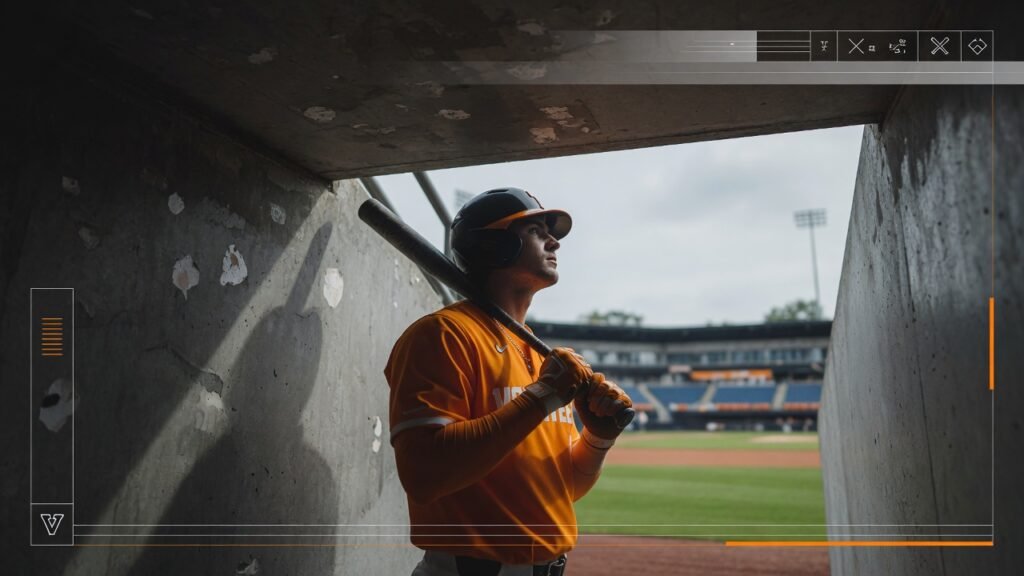
Cole Koeninger hit .436 with 10 home runs, 14 doubles, and 32 RBI as a high school senior. On the mound he went 12-1 with a 1.14 ERA and 130 strikeouts in 73.2 innings, including a one-hit shutout with 16 punchouts in a playoff elimination game. He is the No. 1 name on Prep Baseball’s On Campus Rankings for Fall 2026. Sean Dunlap, who hit .473 with a 1.500 OPS and earned Prep Baseball Indiana Player of the Year, sits at No. 2. Both are Tennessee Volunteers. That is not a coincidence. That is the board.
Shooter Hunt’s list of the top 150 high school talents now headed to college rosters landed after the MLB Draft signing deadline, and it does more than rank tools. It maps power. The SEC claimed 74 of the 150 spots, including 20 of the top 25. Tennessee, LSU, and Texas each put 10 players on the board. Vanderbilt had eight. Stanford, Miami, and Arkansas took six apiece. The 10 most-represented programs accounted for 70 of the 150. I ran those shares twice because the concentration is the entire story.
The Blue Bloods Did Not Stock Up. They Closed the Door.
College baseball has spent years selling the idea that the transfer portal flattens the field. Hunt’s rankings say the opposite. When the top of the high school class funnels this hard into the same handful of dugouts, the portal becomes a secondary market for the leftovers, not a great equalizer. Mid-tier high school signees already carried a discount once NIL and the portal matured. This list makes the discount official.
Look at the top 10. After the Tennessee pair comes Blake Bowen (Oregon State), Archer Horn (Stanford), James Tronstein (Vanderbilt), James Clark (Duke), Logan Schmidt (LSU), Ethan Bass (South Carolina), Joseph Contreras (Vanderbilt), and Grayson Willoughby (Kentucky). That is elite talent, and most of it is already sitting inside programs that win or contend every spring. Willoughby went 12-0 with a 0.67 ERA and 96 strikeouts, touched 100 mph at the Draft Combine, and just won back-to-back KHSAA titles. Contreras has touched 99 with a slider that sits 88-90. Schmidt sits 91-95 with a standout changeup. These are not developmental projects. They are immediate impact pieces landing in systems built to accelerate them.
Bowen is the clearest illustration of what still travels. His high school coach, Brett Kay, called him “the best athlete we’ve ever had” and later added, “He’s the best athlete I’ve ever coached. You could see what he’s capable of, and the things that he does are pretty special on the field and he’s got a chance to be a high draft pick.” Bowen himself framed the value proposition without the scouting jargon: “I just think I’m an athlete on the field, and baseball is not just hitting. So, I can run the bases, I can be in the outfield and just be an athlete overall. An 0-0 day or an 0-4 day, I can still impact the game some way or another.” That is the profile programs like Oregon State still chase when they cannot outbid the SEC on pure volume. He also talked about reading lazy pitchers and stealing bases to flip momentum. The mechanism matters. Athleticism that shows up on both sides of the ball and on the bases is harder to portal-replace than a pure bat.
Tennessee’s full haul underlines the point. Beyond Koeninger and Dunlap, the Vols put Gannon Grant (No. 25), Jack Dugan (No. 41), Gary Morse (No. 46), Cooper Shrum (No. 66), Shawn Sullivan (No. 73), AJ Curry (No. 87), Drew Christine (No. 120), and Jaxson Wood (No. 136) on the list. Their 2026 high school class already ranked No. 3 nationally by Baseball America and Perfect Game. Adding the top two on-campus names is how you turn a strong class into a roster that can absorb attrition and still reload.
Everyone Else Is Negotiating From Behind
I keep coming back to the 70-of-150 figure for the top 10 programs. That share leaves 80 names for everyone else, and a huge slice of those 80 still land at the next tier of SEC and blue-blood programs. Oklahoma State put five on the board. Michigan highlighted three. Those are real wins. They are also not the same as owning the top of the board. When 20 of the top 25 freshmen are SEC-bound, the non-SEC programs that miss on their top targets do not simply “reload in the portal.” They shop a thinner market against the same programs that just locked down the high school headliners.
The players who turned down pro money or went unsigned are making a rational bet on development and draft stock in two or three years. The programs that collected them are making a different bet: that early campus talent still compounds faster than portal volume when the talent is this good. Hunt’s rankings favor the second bet. James Tronstein hit .548 with a 1.000 slugging percentage and 10 home runs as Prep Baseball’s California Player of the Year. Ethan Bass posted a 1.519 OPS with 12 home runs, 21 steals, and a 47-to-16 walk-to-strikeout mark while rewriting the Glenbrook North record book. Those are not depth pieces. They are middle-of-the-order and middle-of-the-diamond starters on day one.
The competitive-balance conversation in college baseball usually circles NIL, the portal, and conference realignment. Fine. This list is cleaner evidence. When nearly half the top 150 freshmen and four-fifths of the top 25 walk into one conference, the sport is not democratizing. It is stratifying. Tennessee taking one and two is the loudest single data point. The 74 SEC names are the structural one. Everyone else is left arguing over the remaining board while the blue bloods start fall ball with the best athletes already in the building.