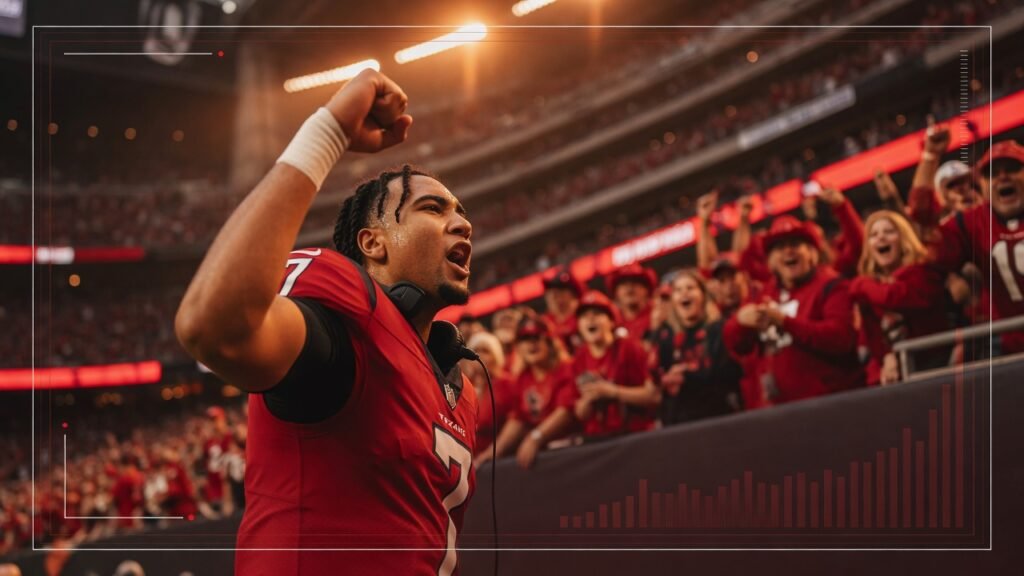
C.J. Stroud just chose the most expensive bet of his career, and Houston let him walk to the table with a smile. The Texans and their quarterback tabled a long-term extension until after the 2026 season, sources told ESPN’s Adam Schefter and Ian Rapoport, ending a spring of “productive talks” that never closed the gap on overall value. Stroud, 24, will play out the final year of his four-year, $36.28 million rookie deal and then the already-exercised $25.9 million fifth-year option in 2027. That is two full seasons of team control left, and both sides decided the market is still moving too fast to lock anything in now.
I keep coming back to the structure. Houston already paid Will Anderson Jr. roughly $50 million a year, the highest non-quarterback deal on the board. A dozen starters sit at $50 million-plus AAV. Patrick Mahomes reset the ceiling near $63-64 million in new money this spring. Waiting one more offseason, with the salary cap still climbing, could push Stroud’s next deal another $10 million per year higher if he delivers. Nick Caserio said it plain earlier this month: “If we don’t get it figured out before the season starts, then it’ll be something we address in the offseason.” They made a run. They stopped. That is not failure. That is arithmetic.
The Production Dip Is the Real Negotiating Table
Stroud’s rookie tape still sells. In 2023 he threw for 4,108 yards, 23 touchdowns and five interceptions, ranked sixth in expected points added per dropback, won Offensive Rookie of the Year, and dragged Houston back to the playoffs for the first time since 2019. Career record through three seasons sits at 28-18. Three straight wild-card wins. Three straight Divisional exits.
Then the numbers cooled. 2024 brought 3,727 yards, 20 touchdowns, 12 interceptions and 52 sacks. Last season he finished with a career-low 3,041 yards, 19 touchdowns and eight interceptions across 14 games after missing three with a concussion. The playoff ledger across those two games: two touchdowns, five interceptions, six sacks. Completion rate for the year sat at 64.5 percent with a 92.9 rating. Career marks through three seasons: roughly 10,876 yards, 62 touchdowns, 25 interceptions, 63.8 percent completion, 93.5 rating.
Those are still winning numbers for a young quarterback, but they are not the $55-60 million conversation Dak Prescott, Josh Allen, Joe Burrow and the rest of that tier are having. Stroud’s agent, David Mulugheta, knows the difference between a one-year spike and a three-year body of work. Betting on himself means proving 2023 was the floor, not the peak. If he posts another OROY-level season, the Texans will be writing the check they already signaled they are willing to write. If the yards stay down and the turnovers climb, Houston still holds the option through 2027 and can negotiate from a place of calm instead of panic.
Caserio called the spring discussions productive and said Stroud’s offseason was “probably the best offseason he’s had since he’s been here.” Attitude, consistency, mindset. That language tells me the relationship is intact. The pause is about price, not trust.
Cap Space and the 2027 Option Buy Houston Time
Houston’s willingness to enter the $50 million-plus AAV club for Stroud was never the question. The question was whether to pay the rising market now or let the rest of the league keep pushing the top of the board higher. A $70 million AAV deal is already being floated as possible next spring if the production returns. That is the leverage play. Stroud is guaranteed to stay through 2027 either way. The Texans keep short-term flexibility under the cap while their young core is still cheap. Anderson is paid. The rest of the supporting cast can be managed without a massive quarterback number landing in 2026.
I watched enough of last year’s Divisional tape to know the sacks and the five interceptions were not all on the quarterback. Protection, route timing, and play-calling all shared the bill. A cleaner pocket and healthier supporting pieces in 2026 change the EPA picture fast. That is the mechanism both sides are pricing. Stroud gets the chance to reset the narrative with the ball in his hands every Sunday starting against Buffalo. Houston gets another year of data before it commits nine figures in guarantees.
The amicable tone matters. Schefter and Rapoport both framed it as mutual preference, not a standoff. “Both sides agreed they now prefer to wait until after this season to work out a long-term deal.” That sentence is the entire story. Neither side needed the deal done this week. Stroud still sees his long-term future in Houston. The franchise still sees him as the guy who ends the Divisional-round ceiling.
Sunday against the Bills is the first real data point of the bet. Everything after that is negotiation by production. The fifth-year option already bought Houston the calendar. Stroud just bought himself the chance to raise the price.