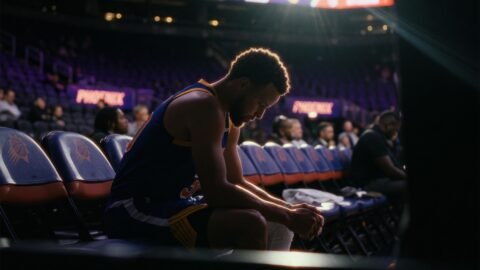
Forty-five minutes into a glorified fan festival at Chase Center on Sunday night, the entire air supply of the Bay Area vanished into the rafters. Stephen Curry planted his right foot against reserve guard De’Anthony Melton on the wing, his sneakers squeaked against the hardwood, and the 38-year-old centerpiece of the Golden State Warriors empire grimaced, pounded the basketball into the floor, and limped down the tunnel. Seventy-two hours before opening night in Los Angeles against the Lakers, the franchise’s meticulous autumn preservation plan collided with reality.
Steve Kerr tried to douse the five-alarm fire before the reporters could even file their leads. “Always, always,” Kerr told the San Francisco Chronicle’s Luca Evans when asked if his heart skipped a beat, before offering the company line: “He’s fine. I went and talked to him after, after he went downstairs, and I went in the training room. He’s doing fine.”
I look at that training-room damage control and see an organization whistling past a graveyard. When a guard entering his 18th NBA season, who turns 39 in March, suffers a non-contact right ankle sprain after barely breaking a sweat in October, “fine” is a prayer disguised as a medical update.
The 18-Minute Bubble Wrap Plan Failed Before Game One
Examine the evidence of how Golden State arrived at Sunday night. Last season was an unmitigated disaster for Curry’s lower half and the Warriors’ championship aspirations. Curry played just 43 games in 2025-26, missing 27 straight contests across more than two months with persistent bone bruising, swelling, and patellofemoral pain syndrome in his right knee. Without their offensive engine, the Warriors crashed out of the play-in tournament at Phoenix and watched the playoffs from their couches.
To prevent a repeat, Kerr and the Warriors medical staff spent the entire 2026 training camp treating Curry like museum glass. They lightened his practice reps and held him under 18 minutes per game in the preseason, the lowest exhibition workload of his career, where he averaged 13 points while shooting 41.9 percent from three (13-of-31). Last week, Curry laid out his availability target to the San Francisco Chronicle, aiming for at least 65 regular-season appearances: “It’s a number, just, makes sense. Means you were pretty available all year. And then, I hope that it’s more, because, you’re not dealing with any other injuries. It’s the maintenance plan, rather than like, a legitimate injury.”
My problem with that maintenance plan is the biomechanical trap staring Golden State in the face. Both injuries are on the exact same right leg. When a movement shooter who relies on violent, high-velocity deceleration off pin-downs and split actions spends months babying patellofemoral pain in his right knee, the kinetic chain down to that right ankle absorbs every ounce of compensatory stress. Curry did not even make it to the 82-game marathon before a routine one-on-one rep against Melton in an open scrimmage sent him to the locker room.
A $116 Million Gamble on a Compromised Right Leg
Kerr, teammate Gui Santos, and the Golden State locker room have already planted their flag on the optimist’s defense: that avoiding the right knee makes Sunday night a harmless footnote, and Curry’s toughness guarantees a quick bounce-back. “Of course we were scared,” Santos told NBC Sports Bay Area. “But it’s Steph. He’s tough. He’s going to be good. Tomorrow he’s going to wake up and be good.” Even Kerr leaned into the relief via the Mercury News, noting it was “just an ankle for him, not the knee.”
That collective sigh of relief ignores the financial and schematic tightrope Golden State walked onto last month. In September, the Warriors signed Curry to a two-year, $116 million extension, even with Curry taking $20 million less than the maximum offered. Golden State’s half-court offense still demands that Curry run miles of off-ball relocation every night to bend two defenders toward the logo and create four-on-three advantages on the backside. If a sprained right ankle robs a 38-year-old guard of a fraction of his lateral separation, opposing perimeter defenders can top-lock him without help, suffocating the spacing for the entire roster.
Even when Curry was healthy enough to suit up for those 43 games last year and put up 26.6 points and 4.7 assists per night, the margin for error in the Western Conference left Golden State in the lottery after Phoenix eliminated them. The franchise has zero cushion to absorb another slow ramp-up… or a lingering ankle tweak that forces him to favor that previously bruised right knee.
Wednesday Night in Los Angeles Exposes the Truth
A team source reiterated to ESPN’s Anthony Slater that the tweak is “not serious,” yet Curry’s status for Wednesday night’s season opener against the Lakers remains officially undecided. If an injury in a fan scrimmage leaves your availability in question days before the curtain rises on the season, you are already behind the eight ball.
My verdict on Golden State’s 2026-27 title window comes down to what happens when the ball goes up in Los Angeles on October 21. Kerr can tell every microphone in San Francisco that his superstar is doing fine downstairs in the training room. Either Curry steps onto the floor against the Lakers on Wednesday night and proves his right leg can survive full-speed NBA perimeter defense, or that 65-game maintenance goal starts evaporating before the first week of the season is in the books.