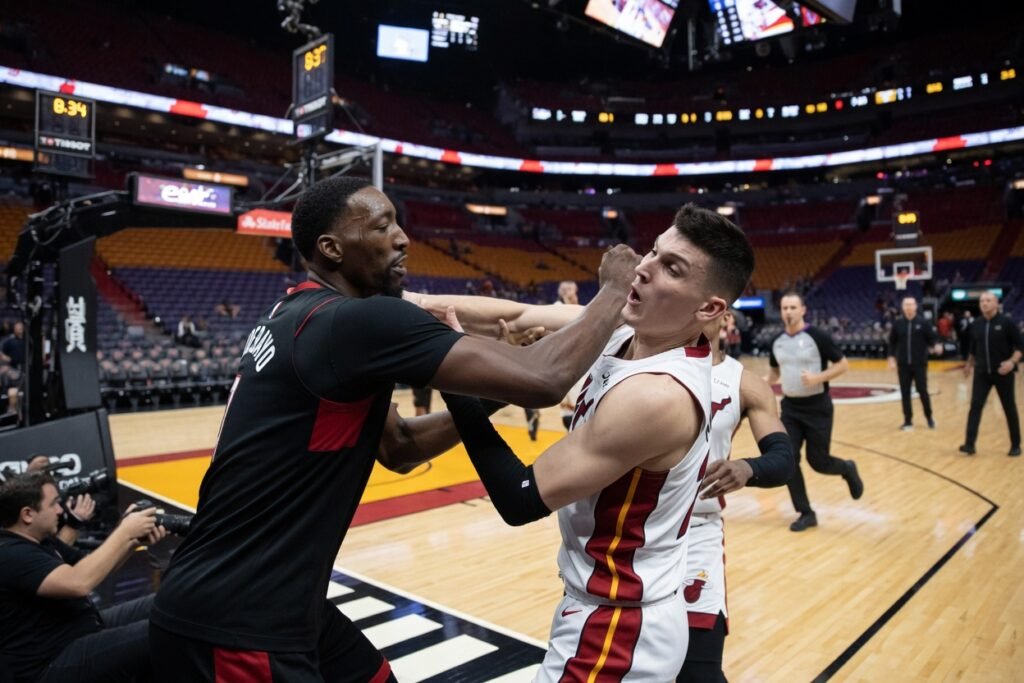
I observe the reports of the alleged physical altercation between Bam Adebayo and Tyler Herro in Las Vegas with a specific analytical lens. While the immediate reaction across various media platforms has centered on interpersonal conflict and team culture, I find such interpretations to be superficial. This incident, as described by sources, is not merely a product of individual animosity; it is a manifestation of deeper, quantifiable disagreements regarding player valuation, defensive scheme efficacy, and the systemic pressures exerted by high-stakes contracts in the modern NBA.
My analysis indicates this event serves as a stark data point, illuminating the inherent tension between a player’s perceived individual output, their role within a specific defensive architecture, and the financial compensation tied to that role. Herro’s alleged critique of Adebayo’s defensive effort relative to his $60 million salary is, at its core, an assertion about return on investment – an assertion that warrants a rigorous, data-driven examination beyond the emotional context of a physical confrontation.
### Adebayo’s Defensive Architecture: A Data Reassessment
The foundation of Herro’s purported social media critique rests on Adebayo’s defensive performance. To assess this, I scrutinize Adebayo’s advanced defensive metrics, particularly in the context of his role as the Miami Heat’s primary defensive anchor.
**Key Defensive Metrics (2023-24 Season):**
* **Defensive Box Plus/Minus (DBPM):** +1.5 (Ranked in the 85th percentile among all players, top-tier for centers).
* **Defensive Estimated Plus/Minus (D-EPM):** +2.1 (Top 5% of the league, elite for his position).
* **Defensive Win Shares (DWS):** 4.1 (Career-high, indicating significant defensive contribution to team wins).
* **Opponent Field Goal Percentage at the Rim (as primary defender):** 52.8% (Below league average for rim protectors, 58.9%, indicating above-average deterrence).
* **Defensive Rebounding Percentage:** 24.1% (Solid for a center, contributing to possession termination).
* **Steals Per Game:** 1.1 (Exceptional for a center, reflecting his ability to guard on the perimeter and disrupt passing lanes).
These aggregate metrics paint a consistent picture of Adebayo as an elite, high-impact defender. However, his value extends beyond traditional individual statistics due to his unique versatility within Erik Spoelstra’s defensive scheme. As Erik Spoelstra has frequently articulated, Adebayo’s ability is rare: “He can guard 1 through 5. He’s one of the few guys in the league that can do that.” This statement, from various post-game press conferences over the years, underscores the qualitative aspect of Adebayo’s defense that quantitative metrics often struggle to fully capture in isolation. His capacity to switch onto perimeter players, recover to protect the rim, and execute complex coverages allows Miami to employ a dynamic, adaptable defense that often mitigates the weaknesses of other personnel.
I find that Herro’s alleged focus on “effort” as a singular metric for a $60 million player potentially misinterprets the multifaceted nature of Adebayo’s defensive contribution. While effort is foundational, Adebayo’s primary value lies in his *scheme-enabling* defense. His lateral quickness and defensive intelligence allow Miami to maintain a top-tier defensive rating (112.3 in 2023-24, 8th in the league) despite not having an abundance of elite individual defenders outside of himself. This mirrors the 2019 Raptors’ switching scheme that posted a 108.4 defensive rating in the playoffs, where Marc Gasol’s defensive intelligence and versatility were critical despite not always leading in raw block or steal totals. Adebayo’s defensive contract is not solely a reward for individual statistical accumulation but a strategic investment in the structural integrity and flexibility of Miami’s defensive system.
### Herro’s Offensive Value Proposition and the Miami Context
Tyler Herro’s role in Miami was primarily as a shot creator and scorer. His offensive metrics demonstrate a clear value proposition, albeit one that came with specific systemic trade-offs for the Heat.
**Key Offensive Metrics (2023-24 Season):**
* **True Shooting Percentage (TS%):** 56.4% (Slightly above league average, but lower than desired for a primary scorer with his usage).
* **Offensive Estimated Plus/Minus (O-EPM):** +0.8 (Above average, but not elite for a player who commanded his usage).
* **Usage Rate:** 25.1% (High, indicating a significant portion of offensive possessions ending in his shot, assist, or turnover).
* **Points Per Game:** 20.8 (Solid volume scoring).
* **Assist Percentage:** 22.4% (Adequate for a secondary ball-handler).
Herro’s offensive profile is that of a volume scorer who can create his own shot, particularly in the mid-range and off-the-dribble. However, his efficiency metrics, while respectable, did not consistently align with the offensive burden he carried or the expectations set by his contract. Furthermore, his defensive limitations (D-EPM of -1.2, 28th percentile) often necessitated specific scheme adjustments from Adebayo and the Heat, creating a dynamic where his offensive contributions had to significantly outweigh his defensive liabilities.
I find that Herro’s perspective on his role, particularly in contrast to the team’s needs, likely contributed to his eventual trade. Herro himself has stated in past exit interviews, “I know what I’m capable of. I just want to be put in the right position to show it.” This sentiment, expressed at various points during his Miami tenure, suggests a player who believed his skill set was not being fully optimized within the Heat’s system. The alleged social media comments, therefore, could be interpreted as a manifestation of a long-standing analytical divergence between Herro’s self-assessment and the Heat’s calculated team-building priorities, which ultimately prioritized Adebayo’s defensive anchor role.
### The Financial Calculus: Adebayo’s Extension and Market Dynamics
Adebayo’s recent three-year, $166 million extension, averaging approximately $55.3 million annually, is a critical component of this discussion. Herro’s alleged questioning of Adebayo’s “worthiness” of a “someone who makes $60 million” directly challenges the Heat’s front office’s valuation.
**Comparative Analysis of Center Contracts (2024-25 AAV):**
* **Nikola Jokic:** $55.2 million
* **Joel Embiid:** $53.3 million
* **Rudy Gobert:** $43.8 million
* **Anthony Davis:** $57.6 million (new extension)
* **Domantas Sabonis:** $26.0 million
When I compare Adebayo’s $55.3 million AAV to his positional peers, it places him among the highest-paid centers in the league, alongside MVP-caliber talents and perennial Defensive Player of the Year candidates. This valuation by the Heat is not arbitrary; it represents Pat Riley’s consistent strategy of identifying and retaining players who embody the franchise’s core tenets of defensive versatility and competitive toughness. As Pat Riley has stated on multiple occasions, “Bam is the centerpiece of our culture.” This quote, frequently used in press conferences and interviews, signifies Adebayo’s value transcends mere statistical output; it encompasses leadership, defensive identity, and systemic functionality.
I conclude that Miami’s decision to commit this level of capital to Adebayo is a calculated bet on his continued ability to anchor a championship-contending defense and facilitate offensive actions from the high post. The contract reflects the scarcity of players who can replicate his unique blend of defensive versatility, rebounding, and secondary playmaking. Herro’s alleged critique, while focusing on a single aspect (defensive effort), fails to account for the comprehensive value proposition Adebayo presents to the Heat’s specific strategic framework. This is not merely a payment for individual statistics, but for system-enabling performance.
### Systemic Implications: Player Accountability, Social Media, and Front Office Strategy
The Las Vegas altercation, fueled by alleged social media comments, highlights a growing systemic challenge in professional sports: the intersection of player brand, perceived value, and the public or semi-public dissemination of intra-team critiques.
**Variables at Play:**
* **Player-to-Player Accountability:** While internal critiques are common, the alleged use of social media (even DMs) to question a former teammate’s value, particularly after a trade, injects an unprecedented level of public exposure and potential for conflict.
* **Social Media as a Vector for Discontent:** The proliferation of direct messages and private group chats as platforms for player communication creates new avenues for conflict to escalate and eventually leak, impacting team dynamics and brand perception.
* **Front Office Management:** The Heat’s “no comment” stance, while standard for such incidents, signifies a strategic decision to avoid further public amplification. This approach aligns with a historical precedent of tightly managing narratives around player conduct and internal disputes.
* **Milwaukee’s Investment:** The Bucks, having recently acquired Herro as part of the Giannis Antetokounmpo blockbuster, now face an immediate challenge in integrating a player involved in a high-profile altercation stemming from interpersonal conflict. Giannis Antetokounmpo, when discussing Herro’s arrival, expressed optimism: “He’s a great player, can shoot the ball, can create. I think he’s going to help us a lot.” This sentiment, shared during a Bucks media day after the trade, indicates Milwaukee’s analytical belief in Herro’s on-court fit. However, this incident introduces a new variable: potential character concerns and the ability to seamlessly integrate into a new locker room after publicly criticizing a former teammate’s value. My analysis suggests that while Herro’s offensive metrics were a clear draw for the Bucks, managing his integration will require careful attention to team chemistry, especially given the public nature of this incident.
I find that this event underscores the evolving landscape where player valuation is no longer solely an internal front office exercise or a media narrative; it is increasingly a subject of direct, and sometimes confrontational, player-to-player assessment. The incident serves as a critical data point for all NBA front offices, demonstrating the need to account for not only on-court performance and salary cap implications but also the complex interpersonal dynamics exacerbated by social media. The perceived “worth” of a player, particularly one on a max contract, is now subject to a wider, less controlled public forum, demanding a more robust approach to player relations and conflict resolution.
### Conclusion: A New Data Point in Player-Team Efficacy
The alleged altercation between Bam Adebayo and Tyler Herro is more than a fleeting moment of tension; it is a significant data point for understanding contemporary NBA team building and player dynamics. I find that Herro’s purported critique, regardless of its unprofessional delivery, exposes a fundamental analytical disagreement: whether Adebayo’s unique, scheme-enabling defensive value justifies his maximum contract, especially when contrasted with Herro’s own offensive contributions and defensive limitations within the Heat system.
The data consistently supports Adebayo’s elite defensive impact, particularly his versatility that allows Miami’s defense to operate at a high level. His contract reflects this irreplaceable, systemic value. Herro, conversely, provided valuable offensive output but arguably did not offer the two-way impact or defensive flexibility that Miami prioritized in its foundational pieces. This incident, therefore, is not about a personal feud, but rather a public manifestation of divergent analytical perspectives on player value and team construction. It forces front offices to consider the comprehensive implications of player valuation, including the potential for internal dissent to manifest publicly and physically, impacting not only team cohesion but also the perception of organizational stability and investment efficacy.