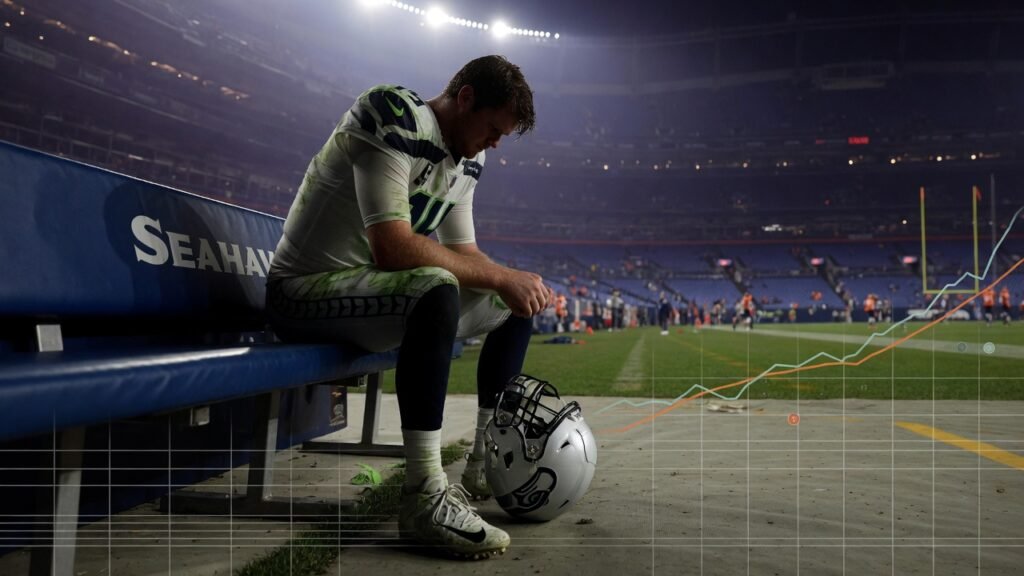
Seventeen quarterback hits in a single game will turn any progression passer into a gambler, yet the loudest debate in Seattle after Thursday night’s 17-14 overtime loss in Denver treats Sam Darnold’s right arm like the lone variable in the equation. When Ja’Quan McMillian undercut a third-and-7 throw intended for Rashid Shaheed at the Seattle 43-yard line in overtime, setting up Wil Lutz’s 53-yard game-winning field goal, the defending Super Bowl champions dropped to 3-3 and matched their loss total from last season. On Friday, Mike Macdonald went on Seattle Sports radio and shot down calls for backup Drew Lock. My take is simple: Macdonald is making the only mathematically defensible call, because benching Darnold for Lock ignores a pass-protection collapse that would wreck whoever takes the snap against Kansas City on October 25.
Look at the offensive structure from Thursday night before isolating the two fourth-quarter and overtime interceptions. Seattle dropped back to pass 56 times between Darnold’s 51 attempts and five sacks, absorbing 17 quarterback hits while managing 113 rushing yards. Darnold completed 27 of those 51 throws for 278 yards, hit Shaheed for a two-point conversion to trim a 14-3 fourth-quarter deficit to 14-11, and still engineered a late regulation drive for Jason Myers’ tying 34-yard field goal after throwing an earlier fourth-quarter pick to Kris Abrams-Draine near the Denver 31. Asking any pocket quarterback to survive that kind of hit rate on the road in Denver without pressing downfield is terrible process.
Why the Drew Lock Efficiency Argument Misreads the Protection Math
The pro-Lock camp inside the Seahawks’ fanbase has a clean, tempting stat line to wave around. In two wins while Darnold was sidelined with a glute injury earlier this season, Lock completed 72.9 percent of his passes for 422 yards, four touchdowns, and zero interceptions, while Darnold has thrown seven touchdowns against seven interceptions across four games since returning and entered Thursday ranked 29th in Total QBR at 34.4. When a defense allows a league-low 237.3 yards per game and holds Bo Nix and the Broncos to 168 total yards, the Lock camp argues that a zero-turnover game manager is all Seattle needs to stack wins.
That surface-level split collapses the moment you account for protection and down-and-distance leverage. Macdonald addressed the exact false equivalence on Friday when asked about switching to Lock: “To make it a one-for-one… I don’t think that’s doing the whole thing justice. There’s definitely more to the equation.”
The rest of that equation lives in the pocket timing and early-down sequencing. Cooper Kupp laid out the structural breakdown after the game: “We are not doing good enough offensively to get him into a flow, not enough job in the run game, protecting him. Sam is going to wear that, but that’s who he is. But that’s not fair to him since we all have a role in the offense.” When an offense falls behind the chains and forces 51 pass attempts while the offensive line yields 17 hits, defensive coordinators can sit in two-high shells, bracket Jaxon Smith-Njigba even on a 12-catch, 134-yard night, and bait a battered quarterback into forcing throws past the sticks.
Fixing the Progression Discipline Before Kansas City Arrives
None of that pass-protection context absolves Darnold from the specific tactical error that ended the game in overtime. Facing third-and-7 from his own 28-yard line, Darnold bypassed Kupp underneath to hunt Shaheed deeper downfield.
Darnold diagnosed the mistake himself after the game: “I just got greedy… That play specifically, I should have just gotten it down to Coop. Coop ran a really good route right under the sticks, and I feel like he would have caught it and got the first down. I’ve just got to continue to go through my progressions and trust it.”
I respect a veteran quarterback who calls out his own progression impatience rather than hiding behind the protection problems. Seattle’s 12 team turnovers through six games have handed opponents an NFL-worst 47 points, a massive anchor dragging down a championship-caliber defense. As Darnold put it postgame, “I just think it’s B.S. for me to keep turning the ball over. It’s not fair to our defense, it’s not fair to our special teams group, not fair really to the entire team.”
Macdonald paired his Friday backing of Darnold with a blunt assessment of the protection unit on Thursday night: “Our quarterback got hit too much today. We’ve got to do a better job protecting him, and we’ve got to be more decisive with the football.” That dual mandate is the entire 10-day mini-bye blueprint for Seattle. Calling a quarterback switch when the starter just delivered a world championship and the offensive line is leaking 17 hits a night would be panic masquerading as accountability.
Seattle has until Sunday night on October 25 against the Chiefs to recalibrate its protection slide rules and get Darnold checking the ball down to Kupp on third-and-medium. How many times the Chiefs’ blitz packages touch Darnold in the first half at Lumen Field will tell us whether Macdonald fixed the actual leak or merely delayed the inevitable.