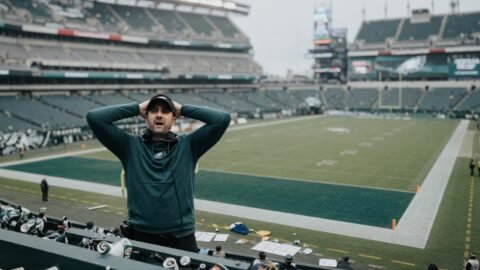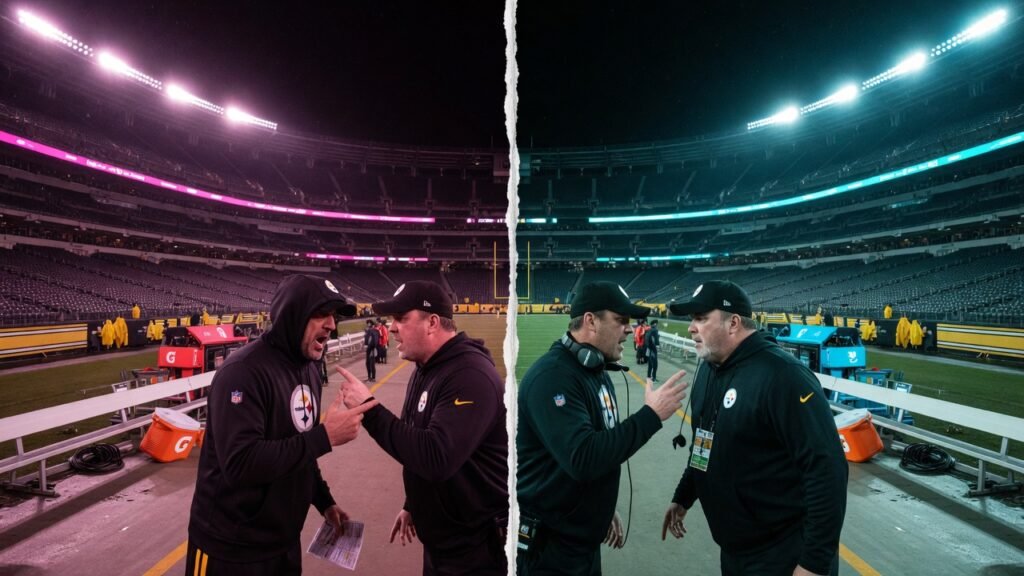
Aaron Rodgers stood outside the huddle with his arms stretched wide and the play clock dying inside Cleveland territory, and the demand that followed turned Thursday Night Football into a courtroom exhibit. “What the f—? Call it!” The hot mic did not miss a syllable. Cameras cut to Mike McCarthy on the sideline, and lip-readers across the league agreed the coach answered with profanity aimed straight at his quarterback. Pittsburgh still punched in a 12-yard touchdown to Roman Wilson on that 17-play, 9:48 opening possession. Then the Steelers lost 27-24 on Andre Szmyt’s 56-yard field goal with about ten seconds left. The clip cleared 2.6 million views in hours. The postgame regret arrived on schedule. The real charge is still pending.
This is not some random flare-up between strangers. McCarthy is in his 14th season coaching Rodgers. They spent 13 of those years together in Green Bay. The chemistry that once delivered a Super Bowl now shows up as a 42-year-old quarterback waiting on the call while the clock runs and a 62-year-old play-caller talking, by his own admission, “fast, more than normal” on a drive he labeled “hectic.” Al Michaels noted on the broadcast that Rodgers looked unhappy and tied it to similar waiting issues the week before against Cincinnati. The pattern is the evidence.
The Clock Ran and the Offense Still Lost the Fight
Rodgers finished 22 of 40 for 299 yards, three touchdowns and two interceptions with an 83.2 passer rating. He was sacked five times for 30 yards and hit ten times total. ESPN Research had already flagged him as sacked an NFL-worst 12 times against man defense this season, seven more than any other quarterback. The Steelers walked out of Huntington Bank Field at 2-2 and last in the AFC North. Time of possession favored them 31:11 to 28:49. Total yards were close. The result was not. Late touchdowns and a two-point conversion got them to 24-24 with under two minutes left, and it still was not enough.
McCarthy faced the microphones and reached for the old code. “Communication sometimes is not the best choice of words, but everybody’s competing on the field,” he said. “I think what’s said on the field, the way I grew up in this game, usually stays on the field. That’s not the case today. I understand that. But any negative communication on my part, I wish I wouldn’t use those words.” Fair. Competitive fire is real. The defense of the exchange stops right there. Once the language hits national television and the coach is forced into a public apology cycle, the “stays on the field” rule is already dead. Rodgers pointed at the crowd. “It was loud,” he said. “It was definitely a good crowd tonight. It was loud. So some of the calls, it was hard to hear for sure.” He also owned the bigger picture: “It wasn’t our cleanest game all the way around. They’re a good defense, so you got to give them credit, but they were getting after us on some of the long-yarded stuff that we weren’t winning a bunch, and I missed a couple throws that I usually hit.”
I hear the counter. Plenty of voices will frame this as two veterans who know each other too well letting steam off, nothing more than Thursday night soap. That reading collapses under the sack total, the interceptions, the repeated waiting for the call, and a 2-2 start that already has Pittsburgh looking up in its own division. Chemistry that requires a public apology after Week 4 is chemistry that has not solved the problem it keeps creating.
Fourteen Seasons Still Cannot Buy a Clean Operation
Legacy is the only currency that matters here. Rodgers is 42 and still capable of the late-drive magic that tied the game. McCarthy is the man charged with getting the play in before the clock forces a disaster. When the quarterback has to scream for the call on first-and-10 near the 20-yard line on the opening drive of a prime-time game, the process has already failed the standard both men spent a decade and a half claiming they own. The Steelers can spin “hectic” all they want. Hectic is what happens when the operation is not ready for the moment.
The Browns are 3-1 and just beat them with a 56-yard kick after Rodgers and company clawed back. Pittsburgh’s offense has the star, the history, and the salary. What it does not have yet is clean communication under noise and pressure. That gap is now on tape, on timelines, and in the standings. The next time the play clock is under 30 seconds and Rodgers is staring at the sideline with arms out, every defensive coordinator in the AFC North will know exactly what to expect. The curse traded on that Cleveland sideline was not the language. It was the proof that 14 seasons together still have not produced a system that can deliver the call before the quarterback has to beg for it.