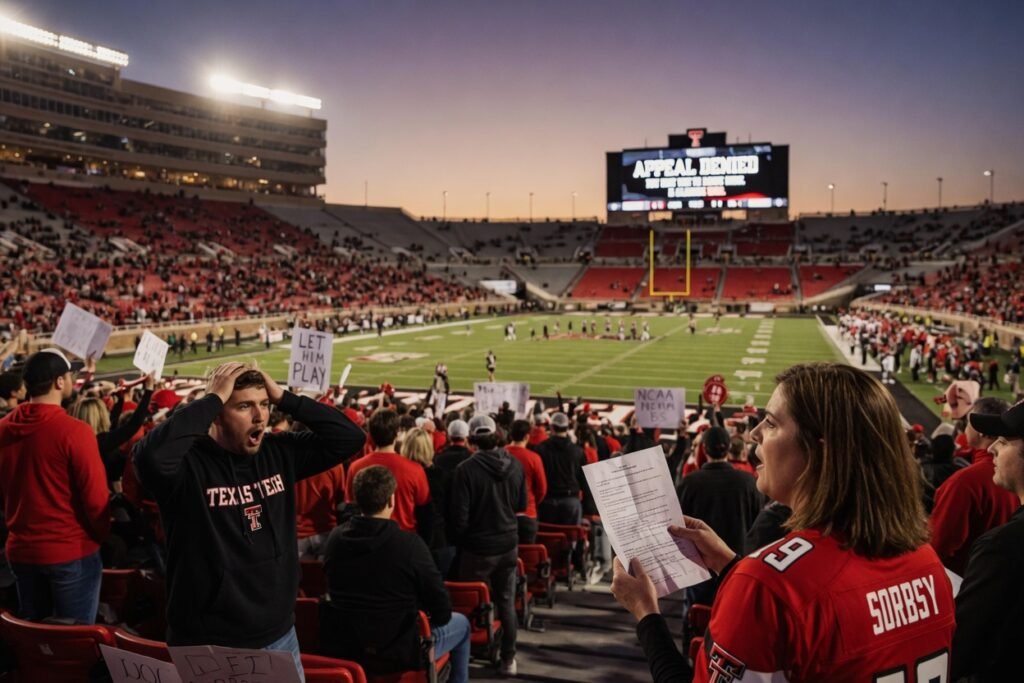
I read the reports on Friday and felt my slump crack open like a busted windshield. Texas Tech’s appeal for Brendan Sorsby got tossed by the NCAA, the same body that spent years pretending it could police player behavior while the entire sport sprinted toward a future where agents, boosters, and conference commissioners run the show. Sorsby bet on sports, including his own team at Indiana, and now the Red Raiders are staring at a roster hole with the season breathing down their neck. The denial sits separate from his lawsuit, but the whole mess smells like the NCAA flexing one last time before the courts finish dismantling what little authority it has left.
I watched this story drop and immediately thought about how cooked the eligibility rules have become. Sorsby transferred from Indiana to Cincinnati, started there in 2024 and 2025, then landed in Lubbock this January. The NCAA ruled him ineligible May 18. Texas Tech appealed, got rejected May 22, and Schovanec fired off a letter saying the ruling should be reversed or modified. Two days later the school was still pushing. Now the appeal is dead, and we’re left waiting on a Texas judge after a two-hour hearing in Lubbock County. Judge Ken Curry hasn’t ruled yet. Every day that drags is another day the NCAA looks more like a referee who keeps blowing the whistle after the play is already over.
The gambling angle is the part that usually triggers the loudest pearl-clutching. Sorsby acknowledged betting on his own team. That’s the line the NCAA drew in the sand years ago, and it hasn’t moved much even as NIL turned college athletes into semi-professionals overnight. I get the rule on paper. But I also remember when the same organization looked the other way on far worse behavior from programs that generated real revenue. The hypocrisy isn’t new, yet it still lands like a cheap shot every time another kid gets buried for it while conferences print money off expanded playoffs and TV deals.
Texas Tech president Lawrence Schovanec wrote that the NCAA’s ruling should be reversed or modified. That line tells me the school isn’t just going through the motions. They see a quarterback who can start immediately and they’re willing to fight the governing body in public. Most programs would have cut bait the second the initial denial hit. Tech kept swinging. That tells you something about how desperate the portal market has become for signal-callers who actually know how to run an offense under pressure.
I’m not here to defend betting on your own team. That’s reckless and it deserved scrutiny. What I am done with is the selective enforcement that lets blue-blood programs skate while a transfer from the Big Ten to the Big 12 gets the hammer. The NCAA has spent the last decade losing control of everything that matters—name, image, likeness, conference realignment, playoff structure—and the one area it still tries to police is player eligibility tied to personal conduct. It feels like the last stand of an organization that knows its power is evaporating.
Sorsby’s lawsuit against the NCAA is the real variable now. He filed May 18, the same day the school ruled him ineligible. A temporary injunction would let him play while the case plays out. If the judge grants it, Texas Tech suddenly has its quarterback for 2025. If not, the Red Raiders are back in the portal hunting a veteran who might not be as polished. I’ve seen this movie before. Courts have already chipped away at NCAA transfer rules and scholarship limits. Another loss here accelerates the erosion.
The timing is brutal. College football season isn’t waiting. Fall camp opens in weeks, and depth charts are already hardening. Sorsby was supposed to be the bridge for a Texas Tech offense that needs stability after years of inconsistency. Instead he’s in legal limbo, the NCAA is doubling down on its denial, and the rest of the conference is circling like it’s already August. This isn’t just one player’s problem. It’s a window into how broken the eligibility process has become when every meaningful decision now requires a lawyer.
I keep coming back to the broader picture. The NCAA spent years telling us it was protecting the “student-athlete” model while the sport mutated into something closer to minor-league pro football with classes attached. Gambling rules were part of that old model. Now those rules feel like speed limits on a highway where half the cars are already doing 100. Sorsby violated the rule. The punishment is landing on him and on Texas Tech. The question is whether the courts will keep letting the NCAA act as judge, jury, and appeals court when its own authority is under constant attack from every direction.
Pushback is already forming in my mentions before I even finish typing this. People will say rules are rules and betting on your own team crosses a line that can’t be ignored. Go ahead, @ me. I’ve watched enough seasons where the same organization ignored booster payments, academic fraud, and coaching misconduct when the dollars were big enough. Selective outrage is the real constant here, not the gambling itself.
The subtext nobody wants to say out loud is that Sorsby’s path—Indiana to Cincinnati to Texas Tech—represents the new normal. Players move for opportunity, schools chase production, and the NCAA is left reacting after the fact. Rejecting the appeal doesn’t restore order. It just forces another lawsuit and another round of headlines that make the governing body look smaller. Texas Tech already showed its hand by going public with the appeal. They aren’t backing down quietly.
If the judge sides with Sorsby, this becomes another precedent that weakens NCAA control. If the judge sides with the NCAA, Sorsby sits and Texas Tech scrambles. Either way, the sport keeps moving while the old rules get stress-tested in real time. I’ve been in a slump on takes lately, but this one feels like the swing that might finally connect. The NCAA isn’t protecting integrity anymore. It’s protecting whatever scraps of relevance it has left, and the courts are the only ones left who can tell it no.
What happens when the next quarterback in the same spot decides the lawsuit route is the only path worth taking?