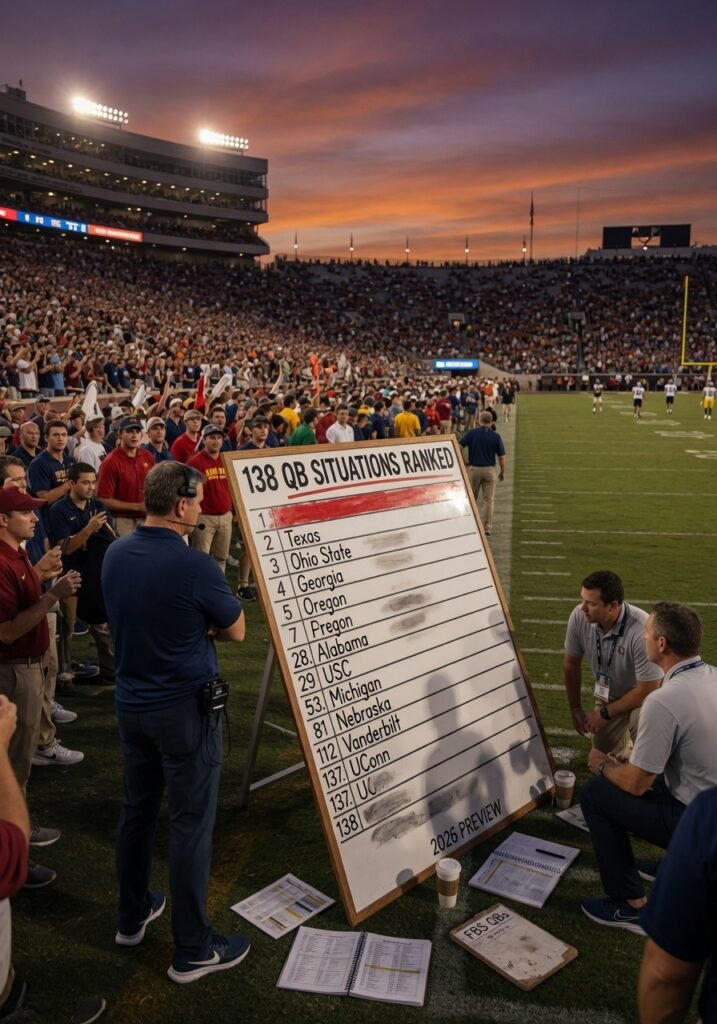
I sat with that ranking of all 138 FBS quarterback situations last night after the kids were finally down, and the more I read, the more I realized how much has shifted in one offseason. The source laid out those top tiers with real clarity—Darian Mensah at Miami, CJ Carr at Notre Dame, Trinidad Chambliss at Ole Miss, Arch Manning at Texas in Tier 1a, and Julian Sayin at Ohio State just behind—but it also reminded me why these projections always feel like educated gambling. Fewer sixth- and seventh-year starters means less experience across the board, yet the numbers from 2025 showed Power conference QBs posting the highest average Total QBR in the playoff era. That tells me the position is resetting, not regressing, and the guys who seize the moment will define legacies that last far longer than any single season.
I have watched this league long enough to know when a quarterback enters a situation that either elevates him or exposes every flaw. Take Mensah. Duke paid him four million to come in and deliver, and he did exactly that, posting big numbers en route to an ACC title. Now Miami has backed up the truck with an offer that pulled him to Coral Gables. The receivers around him are arguably deeper than what Carson Beck had, and the ACC schedule sets up favorably. I said last spring that Mensah had the arm talent and decision-making to be a difference-maker if the supporting cast matched, and Miami’s roster looks like the perfect fit. This is not just a transfer; this is a statement that the Hurricanes intend to contend immediately.
Carr’s path at Notre Dame feels different and more exposed. He proved he could manage an elite offense with Jeremiyah Love carrying a heavy load, but Love is gone. The Irish will lean on him as the centerpiece in 2026, and the margin for error shrinks when the run game loses that level of explosiveness. I have seen quarterbacks in South Bend thrive when everything around them is perfect and disappear when the line or skill players take a step back. Carr has the pedigree and the poise, yet the legacy question is simple: can he carry the program without a transcendent running back beside him?
Chambliss is the one who keeps me coming back to the tape. A Division II transfer who started the year as a backup, stepped in after injury, and delivered two playoff wins despite the chaos around the head coach. Nearly 4,500 yards of offense and a 97.0 QBR on third or fourth and long with zero turnovers—that is not luck. That is a quarterback who understands pressure and converts it. Ole Miss kept him for one more run, and the lawyers cleared the way. I am telling you right now, Chambliss has the chance to prove he was never just a system creation. If the line holds up and the skill players stay healthy, he could push Ole Miss deeper into the playoff conversation than most expect.
Arch Manning at Texas carries the heaviest name in the group. The hype cooled after early struggles, then roared back once he found rhythm late in 2025. The Longhorns’ infrastructure is built for a quarterback who can process quickly and distribute to playmakers on the perimeter. I watched Manning’s improvement in real time last year, and the footwork and anticipation were noticeably sharper by December. The question is whether the offensive line and run game give him the clean pockets he needs to avoid the mistakes that once fueled the bust narrative. One more year of growth and Texas could be looking at a Heisman contender rather than a developmental project.
Sayin at Ohio State still has Jeremiah Smith on the perimeter, which changes the math. The Buckeyes’ offense can mask certain limitations because that receiver demands attention on every snap. Sayin showed he could steward the attack as a first-year starter, but the path to a national title runs through a defense that will test his accuracy on intermediate throws and his willingness to take shots downfield when the run game stalls. I keep coming back to how Ohio State’s system rewards timing and rhythm; if Sayin takes the next step in those areas, the Buckeyes remain a top-three team regardless of what the rest of the conference does.
The rest of the Power Four landscape tells a different story. I have seen too many programs chase portal saviors only to watch the fit crumble under new coaching staffs. Quarterbacks who looked serviceable in one system suddenly look lost when the scheme changes. That is why the middle tiers matter more than the top five. A quarterback with average arm talent but elite processing can still lift a team if the protection is consistent and the weapons fit his strengths. Conversely, a rocket-armed kid with poor decision-making will sink even the most talented roster once the schedule toughens.
I am not buying the idea that the drop in experienced starters automatically means worse play. The 2025 numbers proved the opposite. What it does mean is more volatility. One injury, one portal surprise, or one coaching change can flip a situation from promising to disastrous in a single offseason. That volatility creates opportunity for the guys ranked outside the top ten who are ready to seize it. I have tracked this cycle long enough to know that the quarterback who posts elite numbers on third-and-long usually carries that trait into the next season if the supporting pieces remain.
The group of five and independent programs add another layer. Some of those situations are pure reclamation projects—coaches trying to install pro-style concepts with players who have never run them before. Others are wide-open races where a true freshman or a lightly recruited transfer could emerge simply because the competition is thin. Those stories rarely make national headlines until week ten, but they are the ones that shape conference title races and bowl berths.
Legacy is the thread that ties every one of these 138 situations together. A quarterback who leads his team to a conference title or deep playoff run moves up historical rankings in ways that stats alone cannot capture. One who fails to develop or forces turnovers in critical moments gets remembered for the missed opportunities. Mensah, Carr, Chambliss, Manning, and Sayin all have the platforms to write those chapters. The question is whether the systems, the lines, and the receivers will cooperate long enough for the talent to show.
I have no doubt the season will deliver surprises that render any preseason ranking incomplete. That is the beauty of resetting the quarterback position after the bonus-year era ended. The cream will rise, the pretenders will be exposed, and the conversations about who belongs where will rage from August through January. I am ready for every snap.