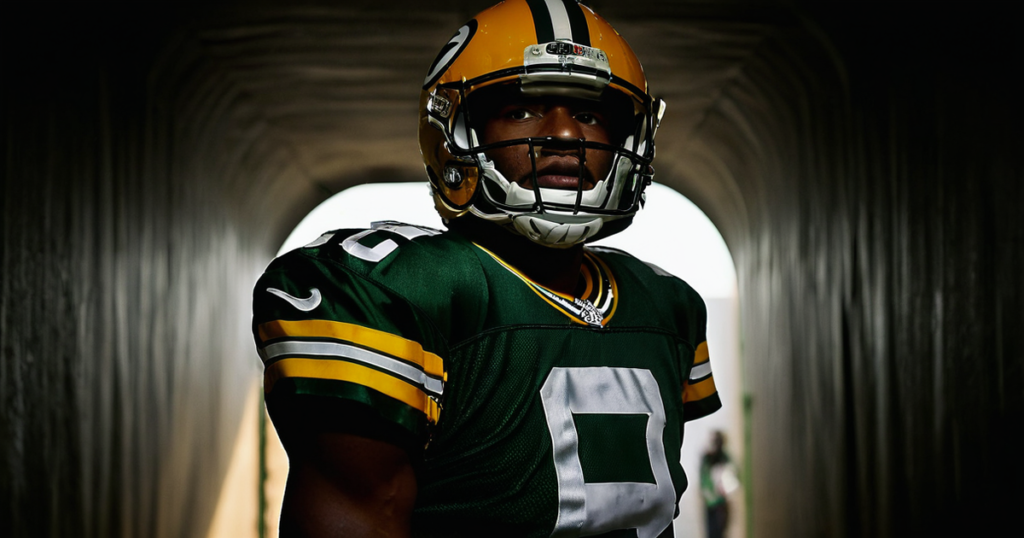
A professional football player coughed up blood on an NFL sideline, climbed into the back of an ambulance, sat through an emergency hospital CT scan, and reentered an active football game the same night. Emergency medical incident reports rarely double as Lambeau Field highlight packages. When Christian Watson jogged out of the tunnel with extra padding around a fractured rib, the television broadcast treated it like a modern miracle. I call it an organizational dereliction of duty.
The physical reality of the collision was violent enough on its own merits. Early in the second quarter, Jordan Love uncorked a 53-yard deep shot down the field. Watson tracked the ball, made the grab, and crashed directly onto the leather point of the football with his entire torso weight. The blunt rotational force transferred straight into his lower right chest wall, fracturing a rib and knocking the air entirely out of his lungs.
“I think I just landed on the ball, it got me in the ribs,” Watson said during a postgame appearance on “SportsCenter With Scott Van Pelt.” The medical tent visit immediately escalated when Watson began coughing up blood on the sideline, triggering mandatory transport to a nearby hospital for chest trauma.
The Illusion of Medical Heroism
At the hospital, doctors ran imaging to ensure the impact had not punctured a lung or damaged vital internal organs. “No internal bleeding, no anything that was raising suspicion,” Watson said of being cleared to return. “I was spitting a little blood at first, so they just wanted to make sure there was nothing crazy. … I cleared everything and was able to get back out.”
To my eye, Watson deserves zero blame for wanting to play. Every competitor wired for the National Football League possesses that exact brand of irrational devotion. “I’m trying to be out on the football field, that’s first and foremost to me,” Watson said. “I told them before we even left that I wanted to go back out there, so I was gonna make sure I was gonna be able to get back out there if they let me.”
Watson’s jog back onto the field drew a roar from the Lambeau crowd. That romance evaporates against the reality of the scoreboard. Green Bay held a 27-13 lead over the Carolina Panthers with 4:01 remaining in the third quarter when Watson strapped his helmet back on.
Green Bay Failed the Basic Test of Stewardship
My argument rests on a simple truth: leadership exists precisely to protect players from their own bravery. A fractured rib does not heal in the back of an emergency vehicle. Even with supplemental flak jackets and torso padding, a wide receiver operating in the intermediate passing lanes remains completely vulnerable to high-low collisions, where sudden lateral contact can turn a stable crack into a catastrophic puncture.
Consider Watson’s actual career stakes. Watson is in the middle of a breakout season, and he has every incentive to prove he can stay on the field. When an athlete feels that pressure, he will run through fire to prove his reliability. To me, that dynamic demands institutional discipline, not sideline cheerleading. To hand an injured receiver his helmet in the third quarter of an October regular-season contest against a Carolina team that ended up losing 27-19 was reckless gambling disguised as grit.
I look at that sideline and I see an absolute failure of perspective. If Green Bay cannot protect its most explosive boundary receiver when sitting on a two-touchdown lead, the entire operational compass is broken. You do not prove institutional toughness by letting an employee with a fractured rib run routes against an NFL secondary.
The true verdict on this decision arrives in the days ahead, when the Packers medical staff has to keep watching how that rib responds. Green Bay survived Carolina on Thursday night, but sacrificing long-term player safety for a burst of crowd adrenaline is a debt this training room will eventually have to pay in full.