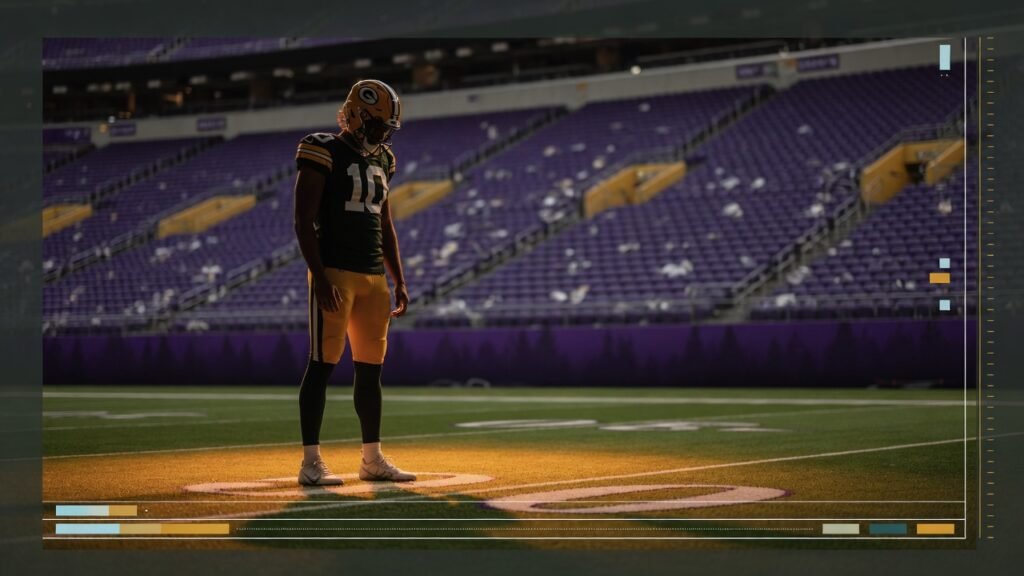
The Packers did not lose Week 1 because Jordan Love got stuffed six inches short. They lost it because the two men who call the offense cannot agree on whether their best short-yardage weapon was even legal to use.
I watched the sequence twice. Trey Smack drills the 40-yarder that would have made it 25-17 with 13:21 left. Dallas Turner jumps. Matt LaFleur waves the points off the board, parks the ball on Minnesota’s 17, and sends Love under center for the sneak. No conversion. Minnesota scores the next 22 points and walks out of U.S. Bank Stadium with a 39-22 win that felt like a 17-point indictment of process. Green Bay led 22-10 late in the third. By the final whistle the Vikings had piled up 29 unanswered and the Packers were staring at a sixth straight loss.
LaFleur’s postgame explanation was clean enough on the surface. “We’re going to be aggressive and go for the throat in that situation,” he said. He wanted the two-score lead. Fair. Aggressive fourth-down math has become league orthodoxy for a reason. The problem arrived 48 hours later when the coordinator started talking.
The Sneak That Existed in One Room and Not the Other
Matt Schneidman’s reporting laid it bare. On Monday, LaFleur said Tucker Kraft’s signature short-yardage sneak was not off the table simply because the tight end was playing his first game back from a torn ACL. A day later, Adam Stenavich said the opposite: Kraft’s knee and the limited reps made that option unavailable, and ideally the Kraft sneak would have been the call. Same staff. Same play. Different realities.
That is the entire story. Not whether the sneak would have worked. Whether the head coach and the offensive coordinator shared a live menu of available plays with 13 minutes left in a division game. Kraft had just signed a four-year extension the day before the opener. He played 45 snaps, caught three balls for 65 yards, and graded out with a 73.7 TE Impact Score that ranked 15th among qualifying tight ends. Stenavich himself said the tight end blocked well and made plays downfield. The body looked ready. The coaching language did not.
I keep circling the same question. If the “Tucky sneak” was unavailable for medical reasons, LaFleur should have known it before he waved the field goal off the board. If it was available, Stenavich should not have told the media it was not. One of those two statements is wrong, and the gap between them is larger than the six inches Love failed to gain.
The rest of the afternoon only sharpened the picture. Love finished 21-of-42 for 387 yards, two touchdowns and an interception. Christian Watson ripped off 147 yards and two scores. The offense still produced 419 total yards. Then the penalties arrived: 12 for 98 yards, several of them extending Minnesota drives, including three on the go-ahead possession. Red-zone trips kept turning into field goals. Carson Wentz, filling in for the concussed Kyler Murray, threw three touchdown passes on 239 total Vikings yards. Minnesota did not dominate the tape. Green Bay donated the game in pieces.
When the Call Sheet Fractures, the Lead Follows
This is the mechanism that actually matters. Fourth-and-1 from the 17 is a high-leverage decision that requires perfect alignment between the head coach, the coordinator, the medical staff, and the personnel package. LaFleur has spent years building a reputation for aggressive process. Stenavich is the man who installs the short-yardage package. When those two voices diverge in public about whether their best option even existed, every subsequent explanation sounds like damage control.
I am not arguing the go-for-it was automatically wrong. An eight-point lead is still a one-possession game; the expected-points math often favors the try. The failure is the mixed messaging afterward. Fans already watched a 12-point second-half lead evaporate. Then they watched the coaching staff offer two different inventories of the same playbook. “Just embarrassing,” one reaction read. Another called it a clown show. Those are not overreactions when the tight end who just got paid looks healthy enough for 45 snaps and still somehow sits outside the short-yardage conversation depending on which coach has the microphone.
The Packers also started Donovan Jennings at left guard over rookie Jager Burton and offered different rationales there too: LaFleur cited time on task, Stenavich pointed to practice performance. Pattern recognition is not conspiracy. It is the same staff giving different maps of the same terrain.
Green Bay’s ceiling still runs through Love’s arm and the skill players around him. Watson’s 81-yard score proved the vertical threat is real. Kraft’s production in his first game back from the ACL tear suggests the middle of the field can open again. None of that travels if the coaching staff cannot agree, in real time, on which bodies are cleared for which calls. The next short-yardage snap will arrive. When it does, the room has to know the same answer before the ball is snapped.
The fourth-down collapse was six inches. The contradiction is the actual distance that has to close.