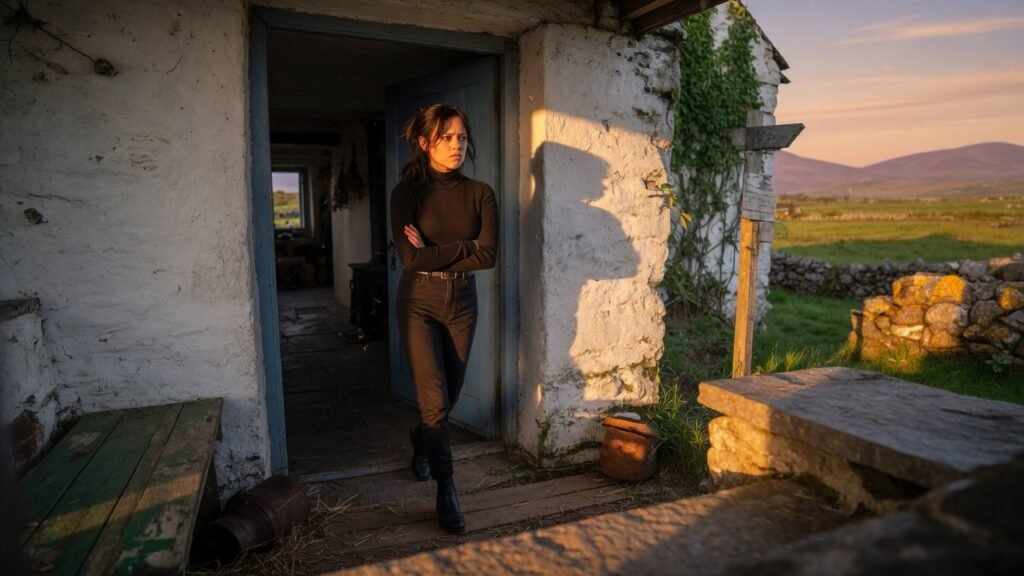
Jenna Ortega sat in Irish sunlight and described the exact moment a child learns her body is an inconvenience. The internet watched the same clip and started counting the bones in her face.
That is the story. Not a secret surgery rumor with nearly 51 million views. Not another round of “is Hollywood skinny again.” Ortega, 23, gave Esquire’s “How I Got Here” series a plain account of how gratitude becomes self-erasure on a set, and within a day the conversation had collapsed into the oldest public hobby we have: auditing a young woman’s silhouette until it yields a moral.
She said it without drama. “I wasn’t asking for a sip of water. I would go all day without eating, drinking, whatever, because I wanted so badly to not be in the way of anybody.” Then the line that should have stopped the room: “Maybe that was my mistake, was not actually looking after myself.” She was talking about being a kid who treated hunger like a scheduling problem. The replies treated it like a present-tense confession.
She Handed Us Industry Rot. We Handed Back a Mirror.
The Esquire piece, tied to the September 2026 “Mavericks of Hollywood” package, is mostly career texture. Child parts. Stubbornness. The long road from bit player to Wednesday Addams to a slate that now includes Taika Waititi’s Klara and the Sun. Ortega talks about an experimental phase giving way to focus. She talks about meshing with Wednesday and then deliberately chasing a hopeful robot who recharges in the sun. None of that survived the first wave of screenshots.
What survived was the frame. Sharper jaw. Hollowed cheeks. Comparisons stacked against Venice 2024 and the 2025 Wednesday promo run, when bleached brows and heavy makeup already had people whispering. Sundance in late January for The Gallerist had the same undercurrent. By the time the Esquire video crossed 250,000 views, the discourse had a ready-made villain: Hollywood’s alleged return to frailty as fashion, with Ortega cast as Exhibit A and Ariana Grande as the template.
Some of the fan panic is sincere. “This is not something children need to be aspiring to.” “Hollywood is sick.” Fair instincts, wrong target. Ortega did not announce a diet. She did not sell a cleanse. She described a childhood labor practice in which a seven-year-old’s primary skill was vanishing her own needs so adults could keep rolling. “I really had it going for me as a child ’cause I can’t think of one mistake I made,” she said. “I was so grateful and so excited to be there that my game face was on.” That is not wellness content. That is a status report from inside a system that rewards kids for becoming easy equipment.
If you actually listen, the scariest line is the one about stigmas. “Is it wrong to say that a lot of them are true? And do with that what you will.” She is not romanticizing the machine. She is confirming it. And still the dominant response is to put her current body on trial as if concern and scrutiny are opposites. They are not. They are a relay.
The Sister’s “!!!” Was the Only Adult Move
On or around August 13, Aliyah Ortega dropped a simple reaction on a fan post that said the quiet part cleanly: mind your business, she does not owe you a medical chart, her body is not a group project. The post begged people to stop building health narratives out of jawlines and a few interview sentences. The sister’s “!!!” did more honest work than a thousand thread diagnosticians.
No representative has confirmed illness, procedure, or crisis. Buccal-fat speculation has been circulating since at least a late-July post that went nuclear, which tells you how little evidence the rumor economy requires. Ortega is petite; listings put her around five-one or shorter. Petite frames photograph extreme under hard light, heavy contour, and the kind of black wardrobe that has become her off-duty uniform while she shoots Wednesday Season 3 in Dublin. None of that equals a diagnosis you get to crowd-source.
There is a version of this conversation that stays on the industry. Child actors trained to treat thirst as a personality flaw. Adult stars still living inside the gratitude trap. A culture that congratulates itself for body positivity until a famous woman looks thinner than last year’s red carpet, at which point the old measuring tape comes back out with new moral language. That conversation would require sitting with discomfort instead of performing it.
What we got instead is the Ariana reduction. “She’s Ariana Grande 2.0.” It is efficient, viral, and almost perfectly empty. It collapses two different careers, two different bodies, and two different public pressures into a single cautionary silhouette. It also lets the audience feel protective while doing the thing that makes protection necessary: turning a person into a before-and-after.
Ortega has spent the last stretch of her career choosing odd bets on purpose. Miller’s Girl. Death of a Unicorn. A Kazuo Ishiguro adaptation about an obsolete robot who still wants to matter. She keeps saying she wants characters she feels connected to, not just the ones that keep the abyss franchise humming. That is an artist mid-recalibration. The online diagnosis machine heard “I used to skip meals as a child so I wouldn’t bother anyone” and answered, essentially, prove you are fine now, in 4K, for strangers.
Surveillance Dressed Up as Care Still Counts as Surveillance
Here is the contrarian stake, and I am not soft-pedaling it. A lot of the loudest “get this girl a sandwich” energy is not care. It is ownership with better PR. It assumes public women forfeit opacity the second their face gets sharp under a Zoom key light. It treats privacy as suspicious. It teaches the next wave of kids watching that the prize for surviving child stardom is a permanent open comments section on your collarbones.
Ortega already told you the origin story. She started at seven because she was stubborn and her parents laughed, then never stopped. She learned early that being low-maintenance was the job. She is now powerful enough to pick Waititi and Abrams projects and still polite enough, in the same interview, to wonder out loud whether not looking after herself was the real mistake. That is self-awareness under fluorescent honesty. It is not an invitation to become her nutritionist.
The culture keeps insisting it has evolved past the early-2000s tabloid gauntlet. Then a 23-year-old actress does a career interview in a dark sweater, and the feed fills with unsolicited body autopsies dressed as empathy. If the fear is that young girls will internalize an impossible standard, start by modeling something other than obsessive public weighing of the women those girls already watch.
Leave her the sunlight she was sitting in. Leave her the robot who believes she can still be useful. Leave her the right to finish Season 3 without filing a health press release every time a still frame looks severe. The industry habits she described are the emergency. Her face is not.
The only verdict that holds: stop confusing access with entitlement. Watch the work. Hear the quote. And if your first instinct after a woman describes childhood self-neglect is to rank her current thinness against Ariana Grande, you are not the rescue. You are the weather system she already survived.