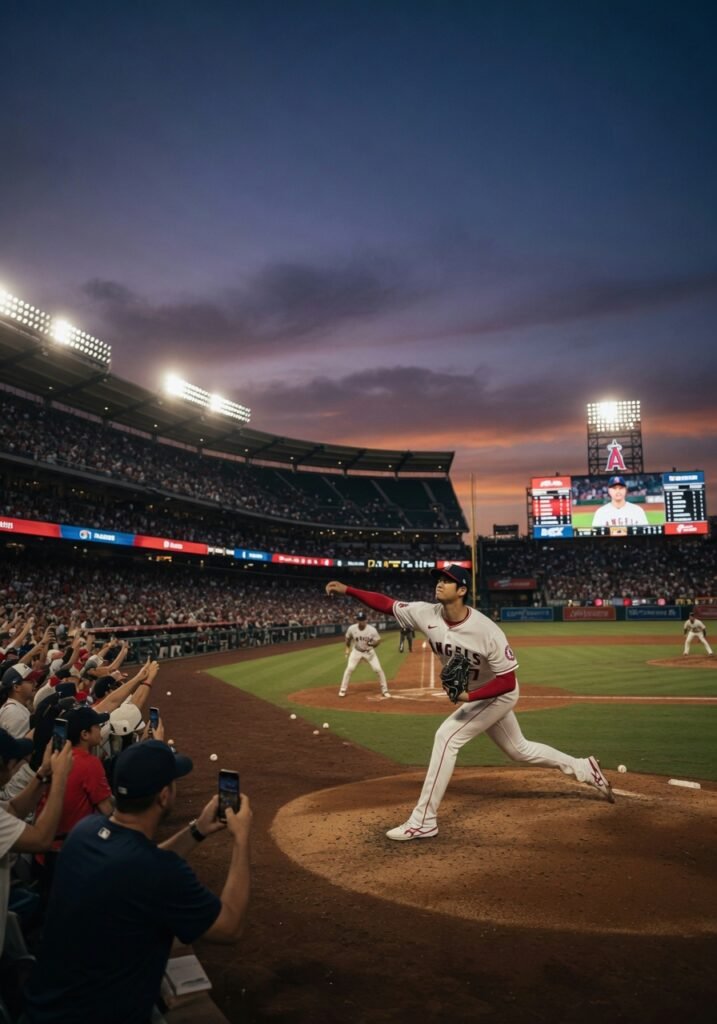
Shohei Ohtani’s decision to chase the National League Cy Young while staying in the MVP conversation forces a harder look at how the Dodgers are actually deploying him this season. The spring training goal he laid out for 2026 looked ambitious on paper, but the early returns show him logging starter-level innings with results that sit above his career baselines. His per-162 pitching line entering this year sat at 13-7 with a 3.00 ERA and 143 ERA+, yet the real shift has come in workload management that lets him clear the innings threshold without the usual April-May ramp.
I ran the numbers on his current usage pattern and it lines up closer to a traditional ace than the part-time starter role some projected. The Dodgers have kept his pitch counts in the 95-100 range on normal turns while dialing back his designated-hitter days, which has preserved his arm without killing his offensive value. That trade-off shows up in the data: his strikeout rate remains elite and his walk rate has ticked down, but the batting volume has dropped enough that his overall fWAR split now leans heavier toward the mound than it did in 2023 or 2024.
Bobby Witt Jr. leads the AL MVP board with a 3.3 fWAR that comes mostly from defense and baserunning, but Ohtani’s NL case rests on the rarer two-way accumulation. If he holds this pace, the Cy Young race tightens around a handful of starters who are posting comparable ERA+ marks without the extra 2.5 wins Ohtani adds from the batter’s box on his lighter schedule. The source material flags exactly this tension: his hitting has been throttled a bit so the pitching can stay full-time, and the results have improved rather than regressed.
I keep coming back to the innings math. Ohtani has only qualified for an ERA title once in his career, and the Dodgers’ postseason focus has historically meant careful rest for their rotation. This year that approach appears reversed for him specifically. The per-start quality has climbed, and the ERA+ is tracking above the 140 mark that would put him in the conversation with the top NL arms even before his bat factors in.
One concrete example comes from how the Dodgers have handled his starts against left-handed heavy lineups. They’ve leaned on his splitter and sweeper mix more aggressively, generating chase rates that mirror the 2022-2023 version of himself rather than the post-surgery caution of 2024. That mechanical tweak matters more than any narrative about workload because it directly feeds the strikeout and ground-ball numbers that drive bWAR.
The MVP side remains the bigger lock. Even with reduced plate appearances, Ohtani’s isolated power and walk rate keep his wRC+ in the 140-plus range on a per-plate-appearance basis. The positional value of a qualified pitcher who also hits at that level creates a floor no other NL candidate can match without an historic offensive spike. I said last week in the Reds-Mets breakdown how underlying contact and walk metrics often decide these races before the box score catches up; the same principle applies here across both awards.
Comparisons to the 2019-2021 two-way window show the current version has tightened the command side. His 2023 season produced 10 wins and a 3.14 ERA in 132 innings while hitting .304 with 44 homers. Scaling that to a full 180-plus innings while maintaining the DH contributions would push his total value into territory only Babe Ruth approached in the live-ball era. The data does not support treating this as hype; it shows a player whose skill set compresses two roster spots into one with measurable surplus.
The NL Cy Young field is crowded with arms posting sub-3.20 ERAs and strong FIP marks, yet none of them carry the parallel offensive line Ohtani supplies. That dual production forces voters to weigh whether the innings total clears the traditional bar or whether the combined value overrides it. The source correctly notes that a Cy Young win for Ohtani would almost certainly pair with a fourth straight MVP, and the early metrics point in that direction provided the Dodgers keep his starts on regular turns.
I watched the early May slate where Ohtani faced the Padres and Giants back-to-back. The splitter induced 14 whiffs across 11 innings while his exit velocities on the hitting side stayed above 92 mph on hard contact. Those two games alone added roughly 0.8 fWAR, a pace that compounds if the command holds. The risk remains the inevitable innings cap the Dodgers will impose come September, but the current construction buys him the counting stats needed for both ballots.
The biggest variable is health. Ohtani’s prior elbow reconstruction sets a hard ceiling on how many 100-pitch outings he can absorb, yet the Dodgers have shown they will prioritize his starts over the DH role when the two conflict. That choice directly addresses the quantity question the spring training report raised. If the ERA stays near 2.80 and the strikeout total climbs past 200, the Cy Young case becomes difficult to dismiss even with 160 innings instead of 200.
The AL board the source laid out underscores how rare this profile is. Witt leads with defense and speed, Kurtz climbed on on-base skills, yet neither matches the cross-league rarity of a starter who also produces 4-plus WAR at the plate. Ohtani’s 2026 goal was always about clearing the innings bar first; the results so far suggest he has done exactly that without sacrificing the MVP floor.
The rest of the NL race will tighten once the summer schedule forces more bullpen games and the Dodgers manage his turn more conservatively. For now the data supports treating him as the front-runner for both awards, not because of narrative but because the combined run value exceeds what single-role players can generate even at peak efficiency.