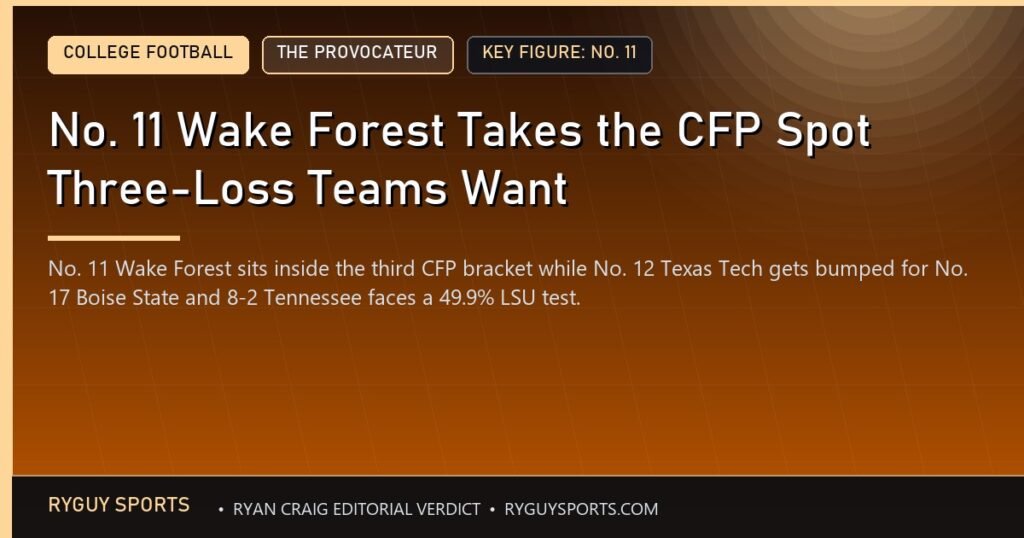
No. 11 Wake Forest crashing the College Football Playoff bracket while SEC blue-bloods sit in the living room watching on television is the funniest possible outcome for November football. Tuesday night’s third CFP committee ranking placed the smallest school in the Power 4 directly inside the projected field, bumping No. 12 Texas Tech out of the twelve-team bracket to make room for No. 17 Boise State as the fifth highest-ranked conference champion.
I love every single drop of the panic this causes in boardrooms from Birmingham to Rosemont. As ESPN’s Bubble Watch put it on Wednesday, “The smallest school in the Power 4 just got the biggest bump in the College Football Playoff race.” For two years, commissioners and television executives treated the expanded playoff like a velvet-rope VIP lounge built exclusively for SEC and Big Ten rosters with the deepest NIL payrolls. Instead, the Demon Deacons hammered SMU on Saturday, watched Kentucky faceplant against Florida, and took the eleventh seed for themselves.
Wake Forest Broke the Super-League Math
The best counterargument from the traditional power brokers comes straight from the Big Ten and SEC strength-of-schedule truthers, and ESPN laid out their lifeline clearly by warning, “With only two teams from the Big Ten currently in the field, it opened the door for Wake Forest, but don’t write off the Big Ten just yet — No. 13 Oregon is sitting right on the bubble as the committee’s top three-loss team.” The argument from the mega-conference camp is that a three-loss Oregon squad or a 7-3 Kentucky team survives a weekly physical Meat Grinder that Wake Forest and 8-2 BYU never have to see.
That excuse falls apart the second you look at how the 12-team bracket mechanics and conference cannibalization actually interact. When you cram sixteen or eighteen schools into bloated super-conferences without divisions, your middle class eats itself alive before Thanksgiving. Look at the SEC scoreboard carnage from Week 11. South Carolina lost. Kentucky lost to Florida and saw its playoff probability crater to 14.1%. LSU lost to No. 5 Texas and fell completely out of the Top 25.
Even No. 9 Tennessee, sitting at 8-2 as the SEC’s last team in, is walking a tightrope with zero net underneath. The Volunteers hold the No. 10 strength of record and No. 23 strength of schedule after beating Texas A&M 22-7, giving them a 68.6% playoff probability and a 17% shot at the SEC title game. Yet ESPN’s Football Power Index gives Tennessee a 49.9% chance to beat an unranked LSU team on Saturday. Why is the margin so razor-thin? Because as ESPN’s Bubble Watch noted, “With a trip to Vanderbilt to end the regular season, there might not be enough on Tennessee’s résumé to compensate for a third defeat — especially after both South Carolina and Kentucky lost in Week 11.” When your conference middle class collapses, your quality wins evaporate on the spreadsheet overnight.
Three Losses Should Put You on the Couch
I refuse to watch television analysts glaze three-loss football teams just because they wear shiny helmets. If you lose three games before December, your defensive front got cooked when it mattered and you forfeited your right to complain about the committee.
Look at the mechanical difference between how Wake Forest or No. 8 Indiana handles business versus how the three-loss bubble crowd plays. ESPN’s Bubble Watch nailed the comparison when describing Wake Forest’s surge: “The Demon Deacons are reminiscent of last season’s Indiana team — defeating opponents soundly and consistently.” In a twelve-team format where the top five conference champions are guaranteed spots, No. 17 Boise State locks down the final automatic bid and turns the No. 11 spot into the true cut line. No. 12 Texas Tech is already standing outside the door looking in despite a top-twelve ranking.
No. 10 BYU understands the assignment at 8-2. The Cougars sit as the Big 12’s last team in, holding at least a 71% FPI win probability against both Kansas and Cincinnati down the stretch. Meanwhile, No. 16 Kentucky sits at 7-3 with less than a 1% chance to reach Atlanta, hoping a trip to unranked Missouri (where a win hands the Tigers their fifth loss) and a finale against No. 23 Louisville will magically erase three defeats. It will not. Even ESPN admitted the ceiling on SEC depth has slammed shut: “It’s one thing to consider a three-loss contender, but dipping into the four-loss teams will have to wait until next season’s 24-team field.”
Saturday’s slate will test who actually belongs in this bracket when Wake Forest travels to Georgia Tech, Oregon visits Michigan State, BYU heads to Kansas, and Tennessee takes a coin-flip 49.9% FPI matchup against desperate LSU… and if the Volunteers drop that third game while the Demon Deacons keep stacking double-digit wins, the SEC office is going to learn the hard way that a conference patch does not block a pass rush.