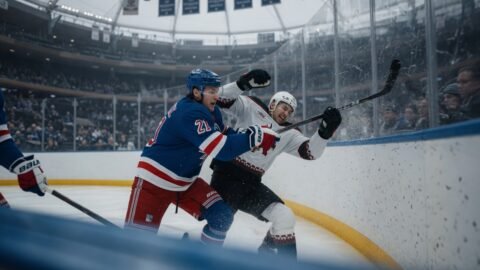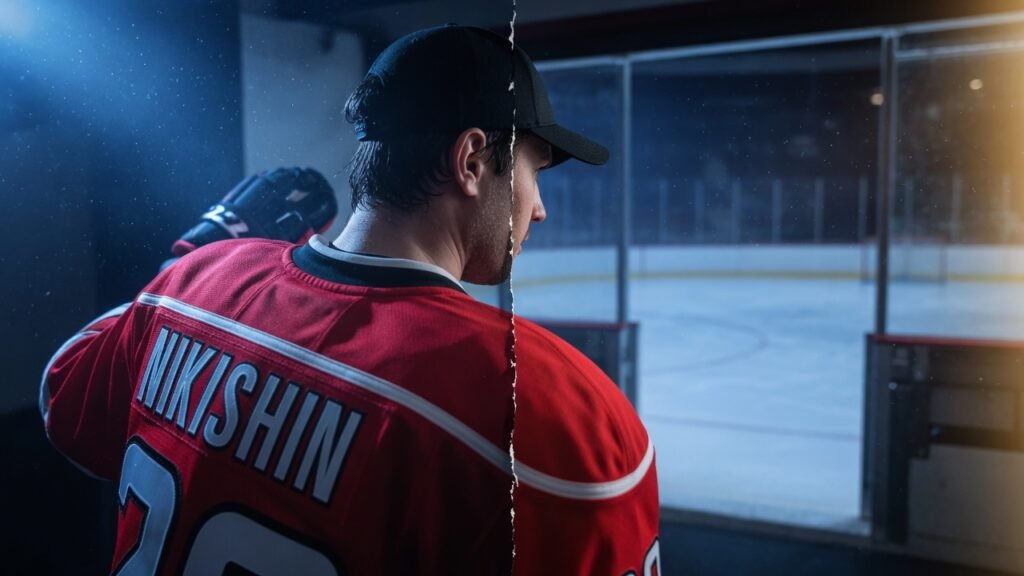
Alexander Nikishin helped the Carolina Hurricanes win the Stanley Cup, then decided he would rather sit than report. Training camp opened on the ice without him. A 24-year-old restricted free agent with no arbitration rights and no offer-sheet path just turned a championship hangover into a standoff, and I am done pretending this is normal business.
Eric Tulsky put it on the record himself. “Alexander Nikishin is not under contract currently, so he will not be at camp when we hit the ice on Thursday.” The next day he told Pierre LeBrun the organization is “playing it day by day.” Day by day. After a Cup. With a young defenseman who already requested a change of scenery and still has that request sitting on the table.
I look at the record and I do not see mystery. I see a player who just cashing a first NHL season into maximum leverage while the receipt from the postseason sits right there in plain sight.
One Assist Does Not Buy the Building
Regular season, Nikishin delivered. Eighty-one games. Eleven goals. Thirty-three points. Plus-18. Named to the NHL All-Rookie Team. Seventh in Calder voting. Those eleven goals set a Hurricanes and Hartford Whalers record for a rookie defenseman. The production was real. The size is real. The KHL résumé that made him a third-round steal in 2020 was real.
Then the games that actually decide legacies arrived. Seventeen playoff games. Zero goals. One assist. Ice time dropped to roughly 14:50 a night. Career playoff line across 21 games: zero goals, two assists. Carolina still hoisted the Cup. They did it while his minutes shrank and his offense vanished. That is the exhibit nobody in his camp wants entered into evidence while they chase a number north of $8 million.
When RG’s Daria Tuboltseva put the $8 million AAV figure in front of him, Nikishin’s answer was one word: “more.” He also said the salary cap keeps growing and defensemen are getting bigger contracts. Fine. Zeev Buium just got eight years at $9.38 million AAV in Vancouver. Šimon Nemec and Pavel Mintyukov landed in the $7.2–$7.25 million range on five-year deals. The market moved. Nikishin noticed. He also noticed that half the league kicked the tires over the summer. St. Louis, Nashville, the Rangers, and others inquired. He was floated as a centerpiece in talks that touched Connor Hellebuyck. Interest existed. A deal never did.
So here we are in mid-September. Camp is open. The trade request, per LeBrun on September 14, “remains in place.” And the player is home.
Rod Already Told You the Truth
Rod Brind’Amour did not dress this up. “He’s a young kid (with) a lot of promise; we’d want to have him back for sure, but we also know it’s a business and they get agents involved. We don’t waste time worrying about it.” Then the part that should have ended the romance: “We’ve got a lot of other guys that are wanting that spot, and we’ll get a little competition. We haven’t really had a lot of that in years past, because the seats on the bus are always full and now maybe there’s a spot open.”
That is a Stanley Cup head coach telling you the roster will keep moving. Carolina has somewhere in the $8–10 million range of cap space depending on the day you check. They can afford a resolution. What they cannot afford is an unsigned RFA with a live trade request turning the first week of camp into a daily referendum on whether the organization still controls its own blue line.
Nikishin’s KHL agent, Chernykh, said the player will not return to the KHL and hopes to resolve the Carolina situation. Good. The door back east is closed. That leaves two exits: an extension that respects both the regular-season breakout and the playoff disappearing act, or a trade that converts six teams’ summer curiosity into actual assets while the value is still high. “Day by day” is neither.
I am not buying the soft framing that this is just another RFA dance. Carolina just won the Cup. Championship teams do not let cornerstone pieces become absentees before the banners are finished. And a 24-year-old who just posted one assist in a title run does not get to dictate the temperature of an entire organization because the cap number in his head grew faster than his postseason production.
Tulsky is protecting private conversations. I respect the discipline. I do not respect the inertia. Multiple clubs already showed their cards. Brind’Amour already opened the competition. The regular-season tape is excellent. The playoff tape is thin. The ask is aggressive. The absence is public.
Sign him at a number that fits a Cup team’s structure, or move him while the suitors still remember the 33-point rookie instead of the silent playoff run. Every day this sits unresolved is another day a champion looks uncertain about its own assets. Alexander Nikishin skipped camp. Carolina is the franchise that allowed the empty stall to become the story. Fix it or deal him. The middle ground is how windows close.