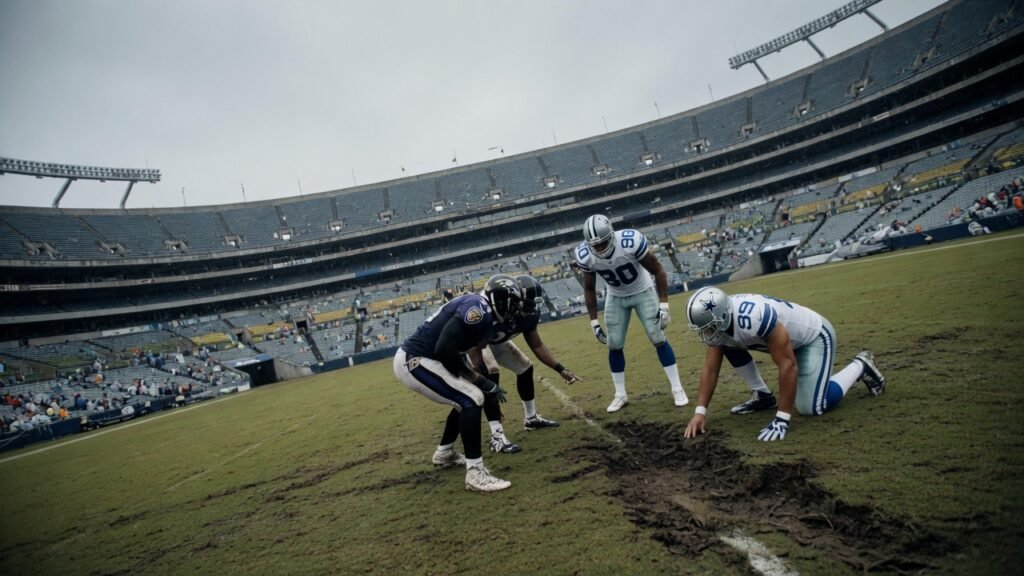
The NFLPA just admitted the Maracanã surface was loose, patchy, and built for slipping, then watched the league answer with a sewing machine and a weather prayer. Cowboys-Ravens in Rio is not a showcase. It is a stress test the players never signed up for, and JC Tretter finally said it out loud.
On Friday he dropped the union’s full position: the concern heading into the week was a field that would be loose, patchy, and lead to excessive slipping. He called those conditions “generally more of a playability and performance issue than a significant injury concern.” That sentence is doing a lot of work. It is also the softest possible framing of a hard problem. Players still have to plant, cut, and finish on it. Fans still paid for the version of football that does not look like a bad outdoor soccer night after six weeks of record rain.
Stitching Wet Grass Is Not a Standard
Tretter did not hide the response. Both the NFLPA and the league had field experts on the ground for days. Their assessment was blunt: the surface needed better traction and stability. So they recommended reinforced stitching, brought in the equipment, and started driving synthetic polypropylene fibers into the natural grass to hold it together. GrassMaster on a pitch that already hosts Flamengo and Fluminense roughly twice a week, after rainfall levels Rio has not seen since tracking started in 1997. Nick Pappas, the NFL’s field director, said Monday the league felt “in a good spot” with weather mitigation plans. That is the official temperature. The unofficial one is a tarp, a mower, goalposts, and a last-minute sew job before kickoff.
I know the pushback already forming. Both teams play on the same surface. Lamar and Dak will deal with it. Jerry Jones said the game is on. Fine. Equal misery is still misery. A thin, slick field does not have to snap an ACL to wreck the product. It just has to turn a third-down cut into a slide and a red-zone jump ball into a slip-and-fall. Tretter put it cleanly: “Players should be able to perform at the level they expect of themselves and that fans expect from them.” Performance is the standard the league sells every Sunday. It is also the first thing that disappears when the grass starts moving under cleats.
Then he connected it to Nashville. Surfaces that melt players’ cleats. Frozen fields that create unnecessary risks. The best athletes in the world on surfaces that fail the same excellence test the league demands from them. That is not a one-off Brazil complaint. That is the pattern.
International Growth Keeps Hitting the Same Patch
Here is the part the expansion press releases skip. Tretter said it straight: “This reinforces one of our concerns about international expansion. Two of the three games played in Brazil have had field-related issues.” São Paulo in 2024 already gave us the slick, soft surface and the cleat-change circus. Now Rio gets the reinforced-stitch treatment after soccer players publicly lit up the same grass. The NFL is running a record nine international games this season, firsts in Australia, Paris, and now Rio at a 78,838-seat stadium that was never designed as a weekly NFL plant. Growth is the word. Maintenance is the bill nobody wants to show on the broadcast.
I am done with the corporate sports-media shrug that treats this like atmosphere. Skip energy will talk “adjustments” and “execution” the second a receiver loses his feet in the open field. Stat guys will discover that both teams are 1-1 and the weather is a shared variable. None of that touches the actual failure. The league keeps shipping the product into venues that cannot guarantee a stable surface, then acts surprised when the union has to post a multi-paragraph warning two days before kickoff. Collaborative work and confidence statements do not change the fact that experts had to sew the field together in the final 72 hours.
Cowboys and Ravens land, walk the surface, and pretend it is just another road game with better scenery. The tape will decide whether the stitching held. The larger point already landed. Field standards that only care about catastrophic injury leave performance as an afterthought, and international expansion without those standards is just a longer travel schedule with worse grass.
Nine games overseas this year. Two of three Brazil surfaces already compromised before the ball is even spotted. The league can keep selling the globe. The players are still the ones who have to cut on it at 4:25 p.m. ET on CBS. If the next slip turns a drive or a season, the warning was already public.