Roger Goodell spent Friday inside the Élysée Palace with French President Emmanuel Macron, Saints owner Gayle Benson, and Steelers owner Art Rooney II to map out the long-term future of American football in France. Less than 24 hours later, the league was bolting the doors on its flagship NFL House in Paris and hiding behind the most cowardly corporate euphemism of the season.
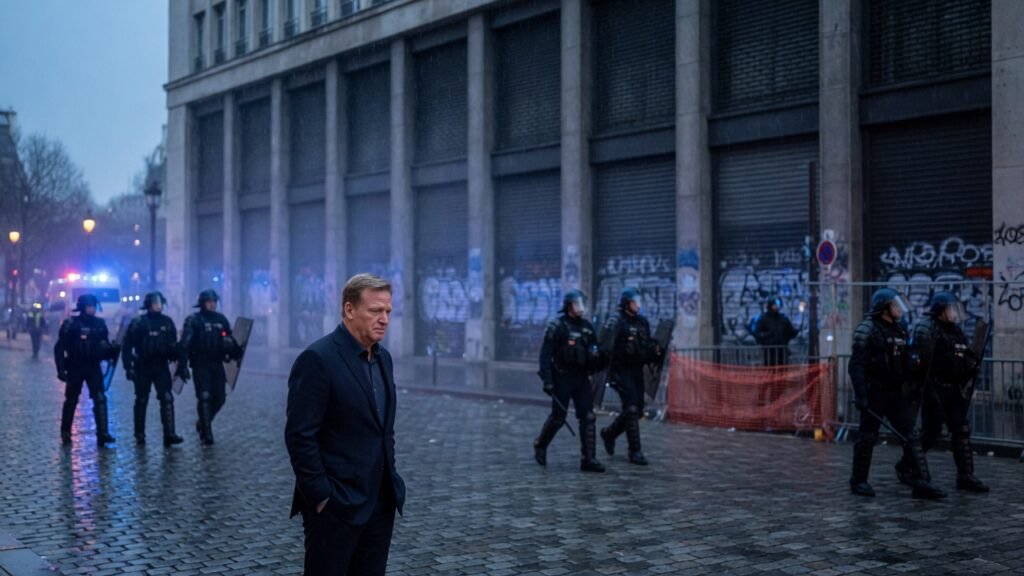
When 410,000 protesters flood the streets of France, the Louvre and the Musée d’Orsay lock their gates, and 70,000 police officers deploy with armored vehicles, helicopters, and water cannons, normal human beings call that a massive civil security crisis. The NFL’s OnePass app called it “potential accessibility issues.”
I have read plenty of sanitized league statements, but reducing tear gas, boarded-up storefronts, and nearly 1,000 Saturday arrests to a parking and sidewalk inconvenience insults the intelligence of every fan who bought a plane ticket to Europe. The league shut down its central Paris pop-up shop on Friday, watched the Steelers cancel their Bastille fan event on Thursday, and saw the Saints postpone Saints House on Saturday, all while pretending the calendar was proceeding according to plan.
70,000 Police Officers Expose Goodell’s PR Spin
Goodell tried to wave away the buildup on Wednesday before boarding his flight. “We’ve made all the preparations,” Goodell said via ESPN and the Associated Press. “Protests are not unusual in France, as you know, and that’s something that we will be aware of and make sure that the appropriate arrangements are made.” He even added a bit of tourist bravado: “Very high is my comfort level.”
My issue with Goodell’s breezy dismissals starts with the calendar from seven days ago. The prior weekend’s unrest across France over living costs and school funding left roughly 3,000 businesses damaged or looted, nearly 1,000 police officers injured, more than 2,000 people arrested, and at least two deaths reported. The U.S. State Department read those numbers and issued a formal security alert warning Americans in Paris for Sunday’s game to exercise caution because demonstration routes change without warning.
Even the domestic soccer league respected the operational reality on the ground. At the request of police, French authorities moved Paris Saint-Germain’s Ligue 1 match against Lyon from Sunday to Monday. Yet the NFL insisted on barreling ahead with a Sunday kickoff for an 80,000-seat stadium in Saint-Denis because nine international regular-season games across cities like Paris, Melbourne, and Rio are the crown jewel of the owners’ global media-rights expansion.
The Bubble in Saint-Denis Cannot Hide the City Center
Steelers quarterback Aaron Rodgers offered the players’ company line at his Friday press conference, deferring entirely to the shield’s security apparatus. “I definitely think that the NFL is alert to what’s going on,” Rodgers said via Reuters. “This game means a lot to the NFL. If it was unsafe, then I’m sure we wouldn’t be here.”
I understand why Rodgers trusts the perimeter around the team hotel, and his point represents the strongest case for playing on Sunday: Stade de France sits north of the city center in Saint-Denis, where French authorities can ring an 80,000-capacity venue with elite tactical units and funnel fans straight into the stadium. From a pure stadium-operations standpoint, keeping two rosters and a broadcast crew secure inside a suburban fortress is a solvable logistics problem when the host government deploys 10,000 more officers than it used the week before.
Where that defense collapses is the difference between protecting the players and staff in a secure bubble and inviting visiting American fans into the heart of Paris for a commercial festival. You cannot sell an international game as a citywide cultural takeover… schedule panels like “French Athletes in Football” in the middle of town… and then wash your hands via push notification on Saturday morning when the streets outside turn into a standoff between 110,000 Parisian demonstrators and riot police.
Even U.S. President Donald Trump weighed in on Friday via the Washington Post and Associated Press, saying, “I think maybe it’s looking like tomorrow is going to be a bad day in France, so you worry about it. I would have said the NFL could have probably postponed that match … because France is really in trouble.” When the league office is determined to protect a Week 7 television window, however, postponing a gate receipt is never on the table.
Global Expansion Meets a Schedule Reality Check
The structural problem with the NFL’s international footprint is that it treats foreign capitals like neutral-site soundstages that exist solely to host tailgate parties. In the domestic market, the league controls every square foot of the game-day ecosystem, from municipal tax breaks to local police overtime. Abroad, the league is a tenant borrowing public security resources from a government facing real domestic turmoil.
Goodell told reporters on Wednesday, “We’re guests in the country. We’re going to be good guests, and we’re going to do our thing.” A good guest does not ask a country that just had nearly 1,000 officers injured the previous weekend to divert thousands of police toward guarding a Week 7 game between Pittsburgh and New Orleans while Ligue 1 clears its own Sunday schedule to help out.
The Saints and Steelers will kick off at Stade de France on Sunday, the broadcast cameras will pan across the Eiffel Tower from a safe altitude, and the owners will count their international growth revenue at the next league meeting. Before the league commits to a long-term future in Paris, French taxpayers and travelling NFL fans deserve to know why a domestic soccer giant had to move its Sunday match to Monday just so American billionaires could keep their television slot on schedule.