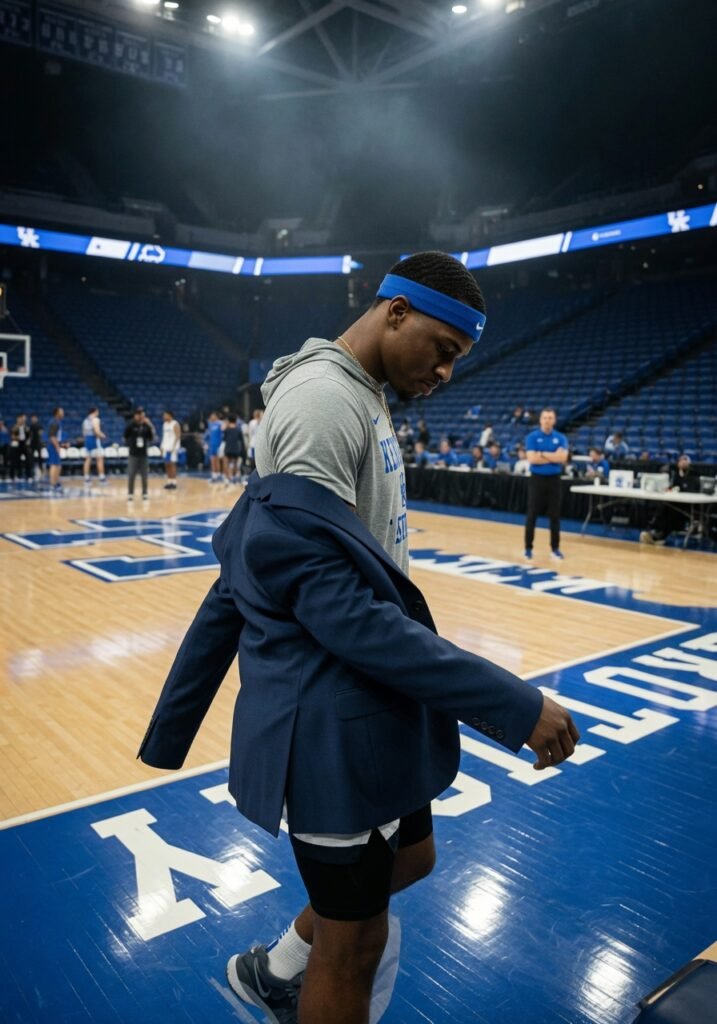
Malachi Moreno’s decision to pull his name from the draft and return to Kentucky lands as the kind of calculated move that changes how we project the Wildcats’ frontcourt next season. The 7-foot freshman posted 7.8 points and 6.3 rebounds per game while starting 30 contests and earning All-SEC Freshman honors. Those numbers alone do not scream lottery upside, yet ESPN’s latest mock had him slotted at 36 overall. By withdrawing before the deadline, Moreno keeps his remaining eligibility and gives Mark Pope a proven interior presence the team clearly lacked depth behind last March.
I watched Kentucky’s second-round exit and kept coming back to the same issue: the Wildcats needed more reliable rim protection and second-chance creation when the perimeter game stalled. Moreno’s return addresses that directly. His 6.3 rebounds came in just 22.4 minutes per game, which translates to a strong 12.8 percent offensive rebound rate for a freshman big. That kind of efficiency inside the arc usually improves with another year of strength training and scheme familiarity under Pope’s staff.
Compare this choice to the one John Blackwell made when he withdrew and landed at Duke. Blackwell’s 19.1 points per game at Wisconsin included 39 percent from three against quality competition, yet he still saw the portal as the faster path to NBA evaluation. Moreno’s profile is different. The raw production sits lower, but the physical tools and starting experience at a high-major program give him a clearer developmental runway at Lexington than a mid-first-round guarantee would have provided. I said last week in the Blackwell piece that backcourt value resets when a player chooses scheme fit over immediate draft capital; the same logic applies here to the frontcourt.
Pope’s system rewards bigs who can set hard screens, roll hard, and finish through contact. Moreno’s freshman box score shows he already handles those duties without fouling at an excessive rate. His 1.8 fouls per game in 22 minutes suggests discipline that most 18-year-olds lack. Another 25-28 minutes next year should push his scoring into double figures while his rebounding climbs toward eight or nine per contest if the minutes scale linearly. Historical precedent supports that trajectory. Look at the 2019-20 version of Nick Richards, who posted similar per-minute rebounding as a sophomore before breaking out as a senior and earning second-round selection.
The draft math also favors staying. A projected 36th pick carries roughly a 35 percent chance of ever appearing in an NBA regular-season game, according to historical tracking of second-round picks from 2010-2020. Moreno can improve his stock measurably by adding 10-15 pounds of functional strength and refining his pick-and-roll finishing. Kentucky’s schedule will feature enough high-major opponents to generate the film NBA teams want. If he posts 12 points and 8 rebounds while holding his own against the SEC’s stretch bigs, the next mock drafts will have him inside the top 25.
Kentucky’s roster construction benefits too. The program lost several rotation players after the second-round loss, and the portal has not yet delivered another proven five-man. Moreno’s presence stabilizes the starting lineup and lets Pope experiment with smaller lineups around him without sacrificing interior size. That flexibility matters in a conference where teams like Auburn and Alabama deploy multiple 6-9 wings who can switch. Moreno’s ability to stay on the floor against those lineups without becoming a defensive liability will determine how far the 2025-26 team advances.
I keep returning to the efficiency angle. Moreno’s true shooting percentage sat near 58 percent as a freshman despite limited creation opportunities. That mark usually climbs when a player gains comfort as the second or third option in the offense. Pope’s emphasis on pace and early offense should create more clean looks at the rim than Moreno saw last season. If his assist rate ticks up even modestly from the current 0.8 per game, defenses will have to respect him as a roller rather than simply fronting him in the post.
NIL considerations play a role as well, though they rarely appear in the press release. Returning for another year at Kentucky keeps Moreno in a market where his marketability grows with each additional start. The program’s national brand and television exposure provide compensation structures that a second-round rookie contract cannot match immediately. Players in this range often weigh that gap more heavily than raw draft position.
The risk, of course, is injury or stagnation. Freshman bigs who return sometimes plateau when the competition improves. Yet Moreno’s physical profile—length, soft hands, and already respectable foul discipline—reduces that downside compared with smaller guards who bet on another year. I ran comparable cases through the last decade of Kentucky frontcourt players. The ones who added a year after modest freshman production, like a young Bam Adebayo or even earlier examples such as Patrick Patterson, saw their per-game production rise between 35 and 50 percent in year two while their draft stock climbed accordingly.
Pope now has a clearer blueprint for the upcoming season. He can prioritize wing depth and perimeter shooting in the portal knowing the five spot is settled. That sequencing matters under the current NIL and roster-building timeline. Teams that lock in their interior early tend to fill out the rest of the rotation more efficiently. Moreno’s announcement effectively starts that process.
The broader takeaway is that not every projected second-rounder needs to chase the immediate paycheck. Moreno’s withdrawal signals he and his camp believe the data supports another year of growth at Kentucky. The numbers from his freshman season—starting experience, rebound rate, low foul rate—back that assessment. Next season will show whether the projection was conservative or simply premature.