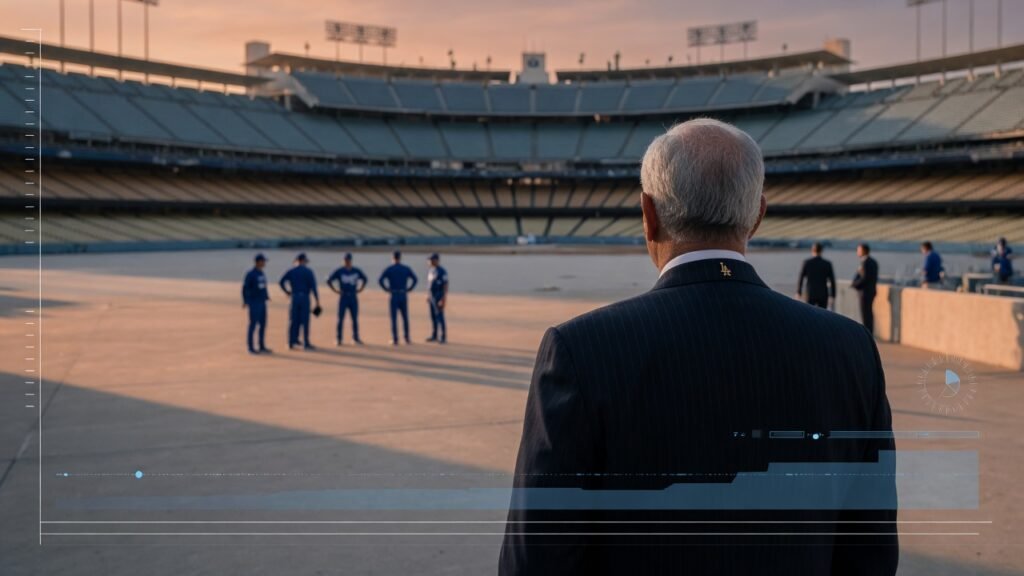
The lockout is already circling the calendar. December 1 is not a soft deadline anymore. It is the date the current CBA dies, and both sides have spent the summer proving they would rather stare at each other across a table than blink first.
MLB’s opening economic shot in late May was the first hard salary-cap proposal since 1994: a $245.3 million ceiling and a $171.2 million floor for 2027, with players taking 50 percent of defined revenues under an escrow system. Twelve clubs would have to pump roughly $617 million into payrolls just to clear the floor. Eight clubs, the usual suspects, would have to carve nearly $578 million off the top to fit under the lid. The Dodgers alone opened 2026 north of $415 million. That is not a gentle correction. That is forced compression.
The MLBPA called the whole package a non-starter within hours. Interim Executive Director Bruce Meyer tied it straight back to the 1994-95 strike that wiped out a World Series, and the union later put a hard number on the damage: if the league’s cap math had been applied to 2026, players would have lost more than $500 million. I buy the direction of that claim even if the exact ledger stays contested. A hard ceiling plus centralized local media revenue rewrites who gets paid and when.
The Floor Forces Spending. The Cap Ends Superteams.
I keep coming back to the distribution problem the current system actually creates. The big-market clubs with competent front offices and the superstars who hit free agency early enough to cash in are thriving. Everyone else is swimming against the current. Small-revenue clubs can tank or sit on cash without real penalty. Pre-arbitration players still get squeezed. Thirty-something free agents watch the market thin out. Bullpen and bench arms bounce between the majors and Triple-A like rental cars.
A floor of $171.2 million would drag the Marlins, Guardians, Rays, White Sox, Cardinals, Nationals, Pirates, Twins, Brewers, Athletics, Rockies and Reds upward. That part has real competitive logic. The NBA, NHL and NFL all run floor-and-cap models for a reason. Morning Consult and Athletic polling both show fans want something closer to parity. The problem is the other half of the proposal.
Eight teams would have to shrink. The Dodgers, Mets, Yankees, Blue Jays, Phillies, Red Sox, Padres and Braves did not build massive payrolls by accident. They built them because the luxury-tax thresholds never deterred them. Manfred has said as much, noting the payroll gap from top to bottom has stretched into the $400 million range and that the CBT failed as a deterrent. A hard cap solves the disparity the league keeps complaining about. It also freezes the market the stars just finished rewriting. Ohtani’s $700 million, Soto’s $765 million, Guerrero’s $500 million extension and Tucker’s $60 million AAV only exist in an uncapped world. Under the league’s math those deals either never happen or get chopped into pieces the next generation of free agents will hate.
Max Contracts Are the Real Poison Pill
The June follow-up proposals made the trade clearer. Accept the cap and you get shorter free-agent deals: five years and roughly $202 million if you switch teams, six years and about $265 million if you re-sign via the “Cornerstone Player Provision.” No deferred money. Qualifying offer gone. Free agency after five years instead of six, but only for players already 30 or older. Minimum salary jumps from $780,000 to $1 million for players with two-plus years, still well short of the union’s $1.5 million ask. Pre-arbitration bonus pool expands. Draft and roster tweaks get floated.
The MLBPA rejected the package as “misleading” because every sweetener was contingent on swallowing the hard cap first. That is the correct read. Earlier free agency for older players sounds progressive until you realize the max-contract rules and deferred-money ban kneecap the very leverage free agency is supposed to deliver. You get to the open market faster and then discover the market has a lid bolted on it.
I have lived through enough of these cycles to know the pattern. The 99-day lockout that delayed 2022 was a warning shot. The 232-day strike that canceled the 1994 World Series is the scar both sides still carry. Revenues have climbed past $12 billion and are pushing toward $13 billion. Franchise values keep exploding: Padres at $3.9 billion, Angels circling $4 billion. The money is there. The trust is not.
Player polls show near-total unity against any hard cap. Owner meetings keep returning to the same talking point: the luxury tax does not work, disparity is real, something has to give. Talks have continued on secondary items through the summer and into September, but the core economics have barely moved. That is how you get a lockout that eats spring training and threatens Opening Day.
The current system rewards the largest markets and the biggest stars while leaving the bottom half of the league and the pre-arb class under-served. A pure floor without a hard ceiling would address more of the actual competitive problem without torching free-agency leverage. The league will not offer that. The union will not take the package on the table. So the dark cloud hanging over October is not abstract labor noise. It is the cost of two sides who have already decided the fight is worth more than the season that follows it. December 1 is coming either way.