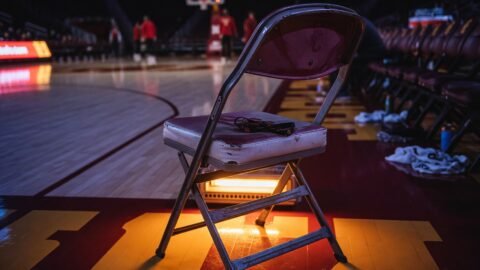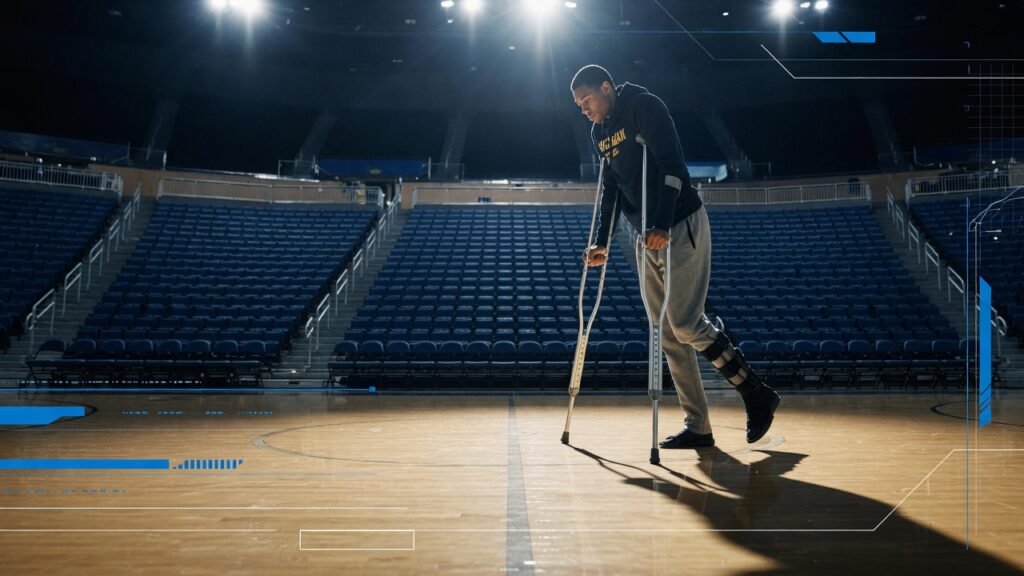
Twenty seconds into an exhibition in Igalo, Montenegro, Brandon McCoy Jr. forced a steal near midcourt, raced the floor, slipped near the basket, and grabbed his right knee. He could not put weight on the leg. Michigan still closed the game 84-81 against KK Mega Superbet. The defending national champions had already lost their top incoming guard for the entire 2026-27 season.
On September 10 in Los Angeles, Dr. Neal ElAttrache repaired the torn ACL. Michigan announced the next day that the surgery was successful and McCoy is expected fully healthy for 2027-28. The medical update is clean. The roster math is not.
McCoy, a consensus five-star and McDonald’s All-American listed at 6-foot-5, averaged 14.5 points, 5.0 rebounds, and 4.0 steals across Michigan’s first two European games in Lithuania. That was the tape Boynton had when he talked about the kid as a projected starter next to Elliot Cadeau and Trey McKenney. High school numbers at Sierra Canyon backed the projection: 19.2 points, 7.4 rebounds, 3.5 assists, and 2.2 steals while the team went 30-1 and won a CIF Southern Section Open Division title. Three-time gold medalist with USA at the FIBA U-17 and U-19 levels. Lottery buzz for 2027 after the April Hoop Summit. All of it parked for a full calendar year.
Boynton Called Him Different. Then the Floor Took Him.
Mike Boynton Jr. inherited a title roster gutted by NBA departures (Yaxel Lendeborg, Aday Mara, Morez Johnson Jr.) and still sold a preseason top-10 projection on the strength of the holdovers, transfers Moustapha Thiam and JP Estrella, and a six-man freshman class led by McCoy. Boynton did not hedge on what the freshman brought.
“He’s probably different – in terms of the collective skill and athleticism that he has – than anybody we’ve had the last two years, to be honest,” Boynton said earlier in the summer. After the injury, on the Defend the Block podcast, he framed the Europe trip as “90-plus percent successful, with the one (negative) being a pretty significant setback for our team.” He added that McCoy “worked his butt off this summer to put himself in position to earn that right” and called him “a rockstar as a person, as a player, from a work ethic standpoint, from a winning standpoint.” The coach’s expectation was clear: major impact, right now. That impact is gone until 2027-28.
I look at the remaining two-way pieces and the load shifts hard onto Cadeau and McKenney on the ball, with Thiam and Estrella asked to eat minutes that were never drawn up as primary. Roddy Gayle Jr.’s fifth-year injunction fight in New York suddenly carries more weight than a depth chart footnote; Gayle averaged 7.3 points and 3.3 rebounds last season, went undrafted, played Summer League with the Pistons, and re-enrolled. If the court clears him, Michigan plugs a 6-5 wing who already knows the building. If it does not, the wing rotation thins further in a league that punishes thin wings in March.
The One-and-Done Path Just Became a Two-Year Bet
McCoy’s draft clock is the quieter story. Evaluators had him as a potential 2027 lottery pick with one college season of tape. Zero NCAA minutes now means either a 2028 entry after a full recovery year or a 2027 declaration on high school and international film alone. History favors the players who come back explosive and force the league to re-rank them. Boynton’s language tracks that bet: he said McCoy will get back to being “the explosively athletic player that he’s always been.” ElAttrache’s track record and the early surgery date (barely two weeks after the tear) give Michigan the best available recovery runway.
The program’s message to McCoy was simple and public: “We’ve got you, Beezy.” That is the right institutional note. The competitive note is colder. Michigan is still a top-10 projection on paper, but the paper no longer includes the freshman Boynton described as unlike anyone on the last two title-adjacent rosters. The 2026-27 ceiling now runs through returning starters, two high-usage transfers, and whatever Gayle’s legal path delivers. McCoy’s path runs through Los Angeles rehab, a full redshirt season of strength work, and a 2027-28 return that will be measured against the athlete who averaged four steals in two games before the slip.
Successful surgery closes the acute chapter. It does not replace the production. Michigan opens the year without its most athletic two-way piece, and every possession that needed that steals-and-transition profile will have to be solved by somebody else.