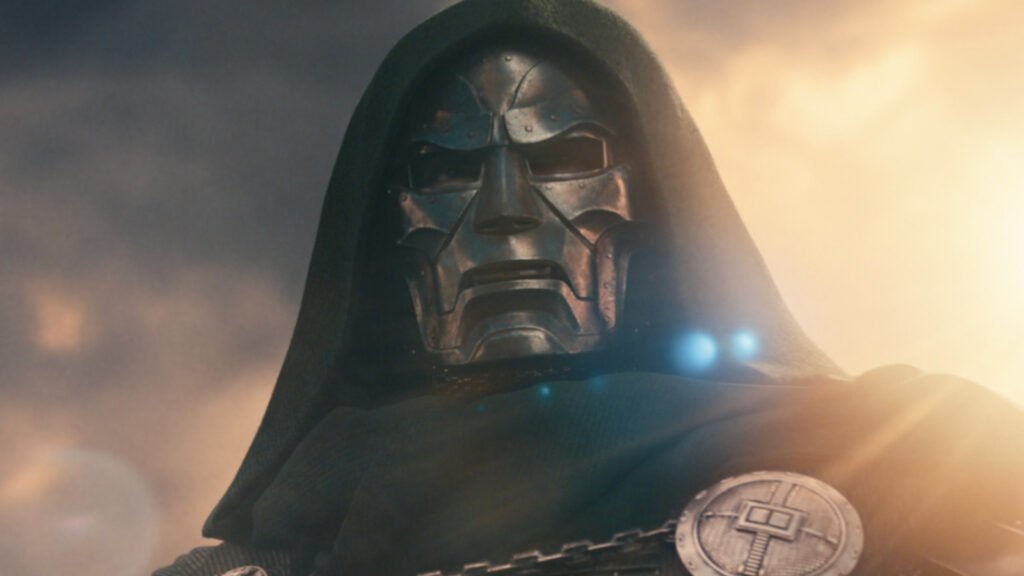
Robert Downey Jr. just looked into a camera, said hell answers to him, and half the internet acted like the MCU invented oxygen again. Massive shock: the most bankable face in modern superhero movies put the mask back on, only this time the mask is the point.
The Special Look that hit after D23 does what every late-era Marvel trailer has trained us to expect. Familiar faces. Swelling score. Enough characters to staff a mid-sized embassy. Chris Evans. Chris Hemsworth. The Fantastic Four. X-Men refugees. Thunderbolts. Sam Wilson. Shang-Chi. Shuri. Loki. You name a logo, it probably got a frame. The July trailer already pulled more than 64 million YouTube views. The D23 cut racked up tens of millions more in a day. The machine still knows how to make noise. Whether it still knows how to make a movie is the only question that matters.
Look, I get it. After years of Kang-shaped scaffolding collapsing under its own weight, Marvel needed a villain with gravity. Joe Russo called Doom “one of the most complex Marvel characters” and said he’s “always three moves ahead.” Fair. In the comics that is true. On screen, complexity has to be earned in the pages, not the press notes. Casting Downey was not a creative risk. It was a defibrillator. He even said the quiet part out loud at CinemaCon: he couldn’t have imagined reuniting with the team, “let alone as a new character.” New character. Same gravity. Same insurance policy.
The Family Funeral Is the Only Fresh Idea Left
Here is where the footage actually gets interesting, and where I stop rolling my eyes long enough to pay attention. The Special Look does not sell Doomsday as another multiversal traffic jam. It sells it as a grief story with capes. Sue Storm, played by Vanessa Kirby, delivers the line that should terrify every writer in the building if they blow it: “I knew he was lost. But I did not realize that he was broken.”
Broken. Not mustache-twirling. Not cackling over infinity rocks. Broken. The trailer keeps cutting to Doom staring at what looks like a portrait of a wife and child. The Fantastic Four talk to him like someone they used to love. That is not the usual MCU villain origin, where a guy monologues about balance or destiny for two minutes before the third-act portal opens. That is soap-opera stakes wearing a metal face. Stay with me here. The best superhero stories have always been family arguments with higher property damage. The Godfather is a family drama. Breaking Bad is a family drama that happens to involve meth. Aliens works because Ripley will burn the universe down for one kid. If Doomsday actually commits to Doom as a man who lost everything and decided the multiverse should pay the bill, that is a real engine. If it is just window dressing for another cameo parade, we already know how that ends.
Thor’s dialogue from the earlier trailer still hangs over the whole thing like a warning label. “Put aside your petty squabbles,” he says. “We are going to need a miracle.” Later he promises Doom will be “begging for hell long before I grant it.” Fine lines. Delivered by a god who has already buried half his friends on screen. The problem is Marvel has spent the Multiverse Saga teaching audiences that death is a revolving door and consequences are optional. A family tragedy only lands if the audience believes the door can stay shut. That is the writing test. Not the VFX budget. Not the cast list. Whether anyone stays dead long enough for Doom’s pain to mean something.
Nostalgia Is Not a Screenplay
Now, you might be thinking the Russos already stuck the landing once, so relax. Endgame worked because it paid off a decade of specific choices. Characters had arcs. Losses compounded. The snap was not a mystery box; it was a bill coming due. Doomsday arrives after years of soft reboots, variant fatigue, and shows that felt like homework. Bringing back the directors who closed the last chapter is smart brand management. It is not automatic storytelling. Michael Waldron, Stephen McFeely, Chris McKenna, and Erik Sommers have a mountain of IP to service and roughly two hours and forty-five minutes to do it. That is a lot of plates. Some of them will shatter. The question is which ones they protect.
The footage teases Doom raising Sentinels and overpowering Thor. Cool images. Cool images are the easy part. The hard part is making Reed Richards’ heartbreak legible while twelve other franchises scream for oxygen. The hard part is giving Florence Pugh’s Yelena something to do besides stand in a group shot. The hard part is remembering that Pedro Pascal’s Reed and Downey’s Doom need a relationship with texture, not just shared universe branding. Shared history only works if we feel the history. A couple of mournful glances and a portrait will not cut it if the second act turns into a roll call.
I walked into this trailer cycle expecting another round of “remember when we cared?” pageantry. What I got was something slightly more dangerous: a studio admitting, however accidentally, that spectacle without ache is just expensive noise. “He used to be different,” the official caption reads. That line should be the thesis of the whole Multiverse Saga. He used to be different. So did this franchise. So did the audience’s patience.
Doomsday hits theaters December 18. Secret Wars is already circling for the following year. The cliffhanger is promised. The army is assembling. Downey’s Doom has the voice, the presence, and the built-in goodwill of a man who once sold us on a guy in a flying suit. None of that guarantees a great movie. It guarantees a loud one. The only way this works is if the writers treat the mask like a wound instead of a costume change. Family melodrama of epic proportions only pays off if someone actually has to bury the body.
Marvel just spent a decade teaching us that everyone comes back. Doctor Doom is here to argue the opposite. For once, I hope the villain wins the thematic fight. The rest is just metal and marketing.