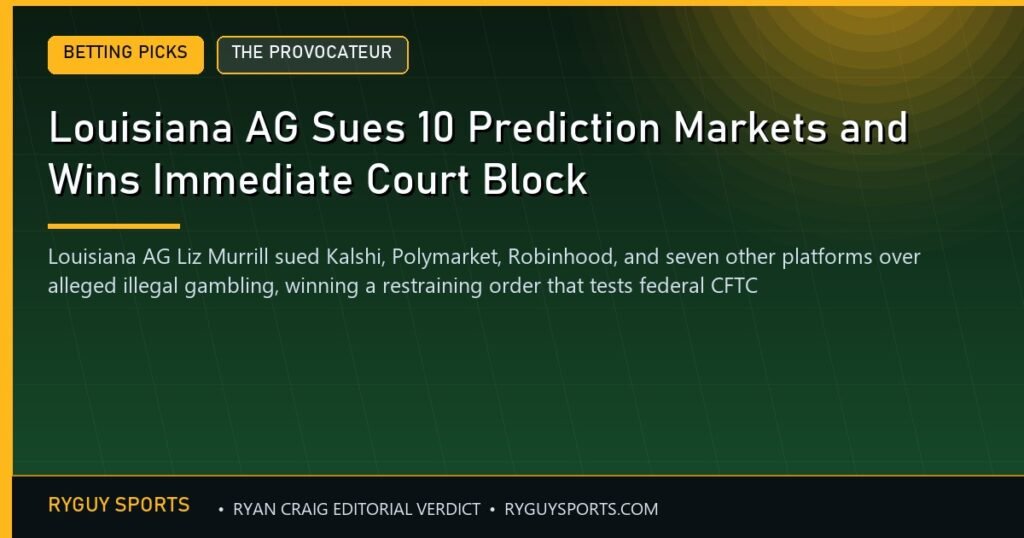
Slapping the words “event contract” on a Sunday parlay and pretending you are running the Chicago Mercantile Exchange is the greatest linguistic heist in modern American finance. On Thursday in the 21st Judicial District Court in Tangipahoa Parish, Louisiana Attorney General Liz Murrill dropped the hammer on 10 different platforms in a single civil enforcement action, and a state judge has already granted a temporary restraining order blocking their operations across the state.
Named in the state’s petition are Kalshi, Polymarket, Robinhood, Coinbase, Crypto.com, Novig, Underdog, Gemini Titan, ForecastEx, and ProphetX, all of whom state officials accuse of operating unlicensed online gambling operations across sports, politics, elections, and awards. According to sports betting and gaming attorney Daniel Wallach, Louisiana is the 13th state to take civil enforcement action against prediction market companies, and the very first to round up all 10 accused operators into a single lawsuit seeking restitution, disgorgement, and civil penalties.
I love watching a regulatory loophole get nuked from orbit. For the last year, tech founders and crypto exchanges have treated state gaming commissions like optional side quests. While licensed sportsbooks pay massive state licensing fees, submit to strict geolocation audits, and hand over a hefty cut of gross gaming revenue to state treasuries, prediction markets waltzed into all 50 states wearing a Wall Street trench coat.
The Derivatives Disguise Is Officially Cooked
The structural mechanism behind this entire gold rush is federal preemption under the Commodity Exchange Act. Instead of pricing a traditional sportsbook moneyline with a built-in house hold, platforms like Kalshi structure sports outcomes as binary yes-or-no event contracts that they pitch as financial instruments rather than bets. Because those contracts are cleared as financial derivatives, the platforms argue that the Commodity Futures Trading Commission holds exclusive federal jurisdiction over their markets, rendering state gambling laws completely powerless.
That legal shield is taking heavy fire right now. Kalshi immediately ran to federal court seeking an emergency temporary restraining order and preliminary injunction against Louisiana, citing the threat of imminent enforcement and “criminal, administrative, and forfeiture exposure” following discussions with state officials. Even the federal regulator they are hiding behind is catching shrapnel from the bench… U.S. District Judge Colleen McMahon recently criticized the CFTC’s actions in prediction market litigation as having “smacked of collusive effort.”
Murrill isn’t playing the semantics game with Silicon Valley lawyers. “For too long, (prediction platforms) have violated our laws with impunity,” Murrill wrote in a post on X on Thursday. “No longer.”
Once the Tangipahoa Parish judge signed off on the temporary restraining order, the Attorney General went right for the jugular on the vocabulary gymnastics. “It’s not complicated: if you aren’t a licensed gaming operator, you aren’t legal. Illegal gambling is a crime and is subject to jail time and significant penalties,” Murrill said in her statement following the ruling. “Judges all over the country have overwhelmingly called this activity what it is: gambling. Kalshi’s and the other operators’ attempts to make up new words to evade state gambling laws, regulators, and taxes are not fooling anyone.”
Why Your Bankroll Is Sitting In The Crossfire
I use Polymarket probabilities to gauge live market sentiment all the time because peer-to-peer liquidity strips out the bloated vig that traditional books charge on futures and moneyline pricing. As prediction markets spread into mainstream trading apps, plenty of bettors liked having an exchange-style model where you can trade in and out of a position mid-game without begging a risk manager for limits.
Here is the brutal reality for anyone keeping serious liquidity on these apps: regulatory arbitrage works right up until a state attorney general freezes the pipes. Louisiana banned sweepstakes casinos back on August 1, and Arizona and Utah have already escalated past civil suits by filing criminal cases involving prediction market company officials. When 13 states have taken civil enforcement action and a state judge has already signed a restraining order, your open futures positions are one parish courthouse signature away from being locked in legal limbo.
The courts remain split, with operators winning restraining orders and injunctions in several state disputes while recent decisions have also let states pursue enforcement or denied operators’ requests to block it. Until the appellate courts or Congress draw a hard line between a legitimate financial hedge and an unlicensed moneyline bet, every state treasury watching untaxed sports volume bleed onto crypto apps is going to copy Murrill’s 10-defendant blueprint. The next time a state attorney general files a single-docket sweep before a major football weekend, the sharpest move on the board will be withdrawing your balance before the process server knocks.
21+. Commentary, not betting advice. Gambling problem? Call or text 1-800-MY-RESET (in Wisconsin, 1-800-GAMBLE-5).