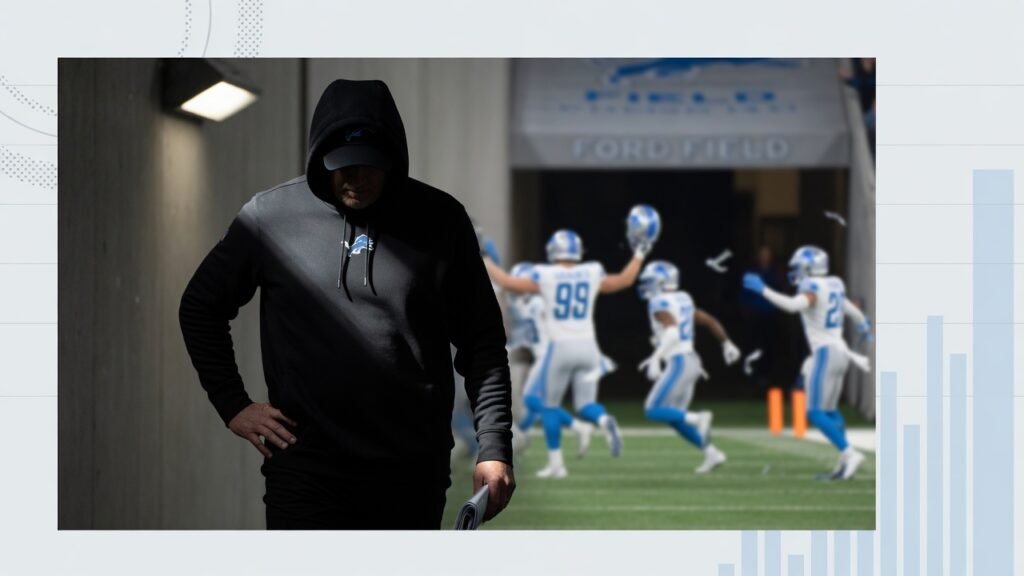
Minnesota entered Ford Field on Sunday allowing fewer than 100 rushing yards per game, yet Detroit tore through that front for 164 rushing yards in the second half alone to end the NFL’s last unbeaten run at 19-15. By the final whistle, Detroit had piled up 230 yards on 39 carries, turning a defensive slugfest into a structural demolition. Even with the division race tilted back toward the 5-2 Lions, nobody in a Honolulu blue uniform felt like celebrating after All-Pro linebacker Jack Campbell left on a backboard.
With 14:48 remaining in the fourth quarter, Jack Campbell collided with Vikings tight end T.J. Hockenson alongside teammate Jimmy Rolder and lay motionless face-down on the turf for nearly 10 minutes. Medical staff immobilized him before carting him off to a local hospital for overnight evaluation of a neck injury, while the entire Lions team and most of the coaching staff surrounded the cart. Quarterback Jared Goff captured the locker room mood postgame for the team’s official site: “Jack’s deal was definitely scary. It just brings you back to reality for a moment that he’s a husband and a father.”
Head coach Dan Campbell echoed that heavy reality to CBS Sports and the Associated Press, calling the victory “a little bittersweet” even after reports confirmed Jack Campbell was breathing and alert when leaving the stadium. From a pure football standpoint, losing the centerpiece of the second level along with six other injured Lions during the afternoon forced Detroit to win this game exclusively in the trenches.
Detroit’s Gap-Scheme Adjustments Broke Minnesota’s Two-High Shell
To understand how Detroit cracked the league’s stingiest defense after scoring six points in the first half, look at the math of play-caller spacing and box counts. Minnesota entered Week 8 having not lost since November 30, 2025, largely by dictating terms to opposing quarterbacks with disguised coverages and light boxes that still choked out the run. Through two quarters on Sunday, Detroit’s offense stalled out on self-inflicted wounds, including taunting penalties by Amon-Ra St. Brown and Jameson Williams on the opening two drives that left the Lions settling for Jake Bates field goals of 25 and 37 yards.
The second half flipped the entire geometry of the field. Instead of letting Goff drop back into Minnesota’s pass rush, which still recorded four sacks and forced Goff’s first interception of the season, Detroit leaned on condensed formations and duo concepts that forced Minnesota’s safeties to fit the run from depth. The split tells the story:
* **First-half rushing output:** 66 yards against Minnesota’s base front.
* **Second-half rushing output:** 164 yards on the ground.
* **Explosive backfield efficiency:** Jahmyr Gibbs carried 23 times for 153 yards, highlighted by a 30-yard third-quarter touchdown run where he broke through second-level arm tackles, while Sione Vaki added 65 yards on 11 carries.
After Kyler Murray hit Hockenson for an 8-yard touchdown and Jordan Addison for the two-point conversion to give the 6-1 Vikings a 15-12 fourth-quarter lead, Detroit immediately answered on the ground. Gibbs ripped off a 17-yard gain on the very next snap, followed by consecutive nine-yard carries that forced Minnesota’s linebackers to step up toward the line of scrimmage. That horizontal and vertical stress opened the exact window Goff needed to hit Williams for the go-ahead 7-yard touchdown with 4:35 on the clock.
Kevin O’Connell’s Fourth-Down Punt Handed Away Expected Win Probability
Even after Detroit’s defense forced a three-and-out, Minnesota’s coaching staff defended the conservative fourth-quarter sequence that sealed its fate. Facing fourth-and-5 from his own 33-yard line with the game hanging in the balance, Vikings head coach Kevin O’Connell elected to punt rather than keep Murray and Justin Jefferson on the field. “We still had all three timeouts and we have total trust and confidence in our defense,” O’Connell told reporters after the game. “We thought we could get a stop and get the ball back.”
My model rejects O’Connell’s logic the second you plug Detroit’s second-half rushing efficiency into the equation. Punting with three timeouts works when your defensive front is winning early downs. Handing the ball back to an offensive line that is actively bludgeoning your defensive tackles for 164 second-half rushing yards is a surrender of expected points added. Minnesota’s offense had struggled on the ground all afternoon, totaling 81 rushing yards with Murray accounting for 35 on four scrambles, which meant Murray’s arm (17-of-29 for 210 yards and two touchdowns) was the only reliable lever O’Connell had left to pull. Trusting a gassed defensive front to get three stops against Gibbs and Vaki ignored every piece of live data from the second half.
Detroit walks out of Week 8 having proved its offensive line can bully one of the league’s best run defenses, yet the roster attrition from those 60 minutes threatens everything they built. Beyond Jack Campbell’s overnight hospital stay, the Lions saw defensive backs Brian Branch and D.J. Reed, pass rusher DJ Wonnum, linebacker Jimmy Rolder, offensive lineman Cade Mays, and running back Jacob Saylors exit with injuries ranging from concussions to hip and neck issues. While Minnesota gets an extra day to regroup before facing the Buffalo Bills, Detroit’s medical reports on Monday morning will determine whether Sunday’s 230-yard clinic launched a division title run or hollowed out the defense that has to carry it.