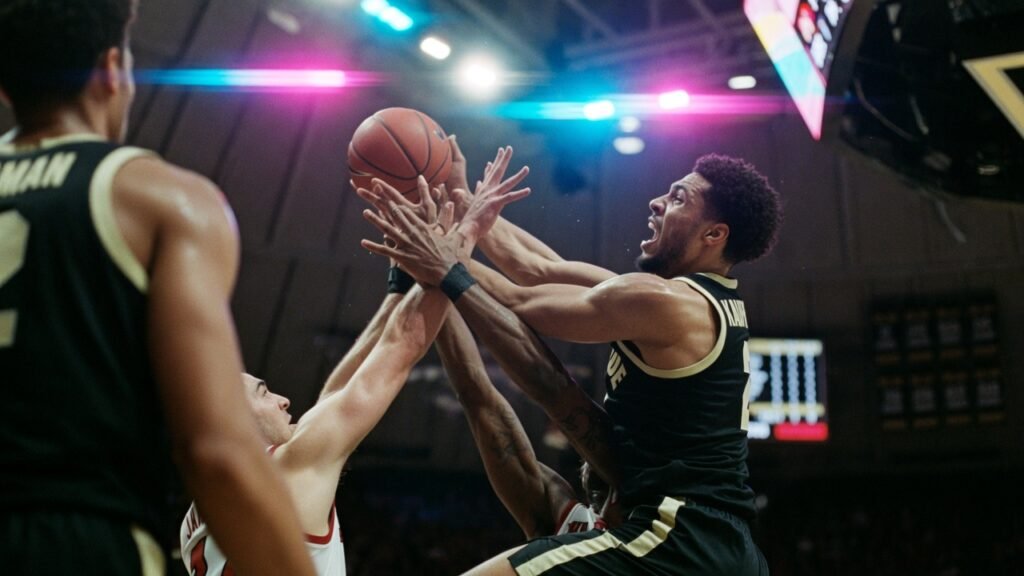
Trey Kaufman-Renn is not fighting for a fifth college season. He is fighting for a sixth, and that extra digit is the whole knife fight set for September 29 in Clark County Circuit Court.
I have sat with this one long enough to know it is not another cookie-cutter eligibility plea. The temporary restraining order he already won on September 9 cracked the door. The preliminary injunction hearing is the part where the NCAA tries to slam it. Kaufman-Renn spent five seasons at Purdue, one as a redshirt and four as an active player. Under the old clock that was a full career. Under the new five-playing-seasons model, same result. He is asking the court to invent a lane the rulebook never drew.
He already said he will not go back to Purdue. Court filings make the motive plain: several programs have interest for 2026-27, and the revenue-share plus NIL packages on the table blow past what a second-round Timberwolves deal would pay a first-year pro. He never signed with Minnesota. Summer League bought him a per diem, travel, and a hotel key. That is the entire economic ledger the NCAA wants to treat like a finished NBA chapter.
The Sixth Year Is the Real Break Point
Courts have been softer on Class of 2022 guys chasing a fifth season. An Oklahoma judge just let a group of former Tulsa athletes keep competing ahead of their own injunction hearing, calling out the NCAA for freezing those players to the old standard while newer classes get the new one. A former Emory basketball player won a preliminary injunction in New York on the bylaws’ missing exclusion language for anyone who already burned a fourth season in 2025-26. Those rulings matter. They also stop short of what Kaufman-Renn needs.
The NCAA’s counter is blunt and, if I am being honest, cleaner than most of its recent eligibility theater. His case stands apart because he already exhausted the old model and the new one. Fifth-year seekers are arguing about a bridge. He is asking for a sixth floor. That is why the September 29 docket is not a routine continuation. It is the first real stress test of whether “five is five” still means anything once a second-round pick walks back through the portal with a TRO in hand.
I do not blame him for running the numbers. A second-round NBA check is real money until you stack it against what a high-major program can put in a revenue-share envelope plus NIL. He is a Silver Creek kid who put in the redshirt year the old system demanded, then produced for four seasons at Purdue. The model shifted under him. The draft selection landed. The compensation did not. From where I sit, the personal calculus is rational. The institutional one is a mess.
Purdue Is Out. The Market Is Not.
Sources have him in the portal after the TRO. That move tells you everything about leverage. He is not trying to finish unfinished Boilermaker business. He is shopping a proven big for one more college winter while the injunction window is open. Programs that smell a short-term upgrade will line up. The ones that still care about roster continuity will wait for the judge.
I keep seeing the same pattern across these cases: the NCAA writes a new ceiling, then litigates the floor one athlete at a time. Kaufman-Renn’s filing forces the question nobody in Indianapolis wants answered out loud. If a player can redshirt under the old rules, play four, get drafted, decline the contract, and still win a sixth season in court, the five-year model is a suggestion with a gavel attached. If the court sides with the NCAA, the sixth-year market dies on contact and every second-round pick who thinks the portal still owes him something gets the message in writing.
The TRO already let him and interested programs start the roster paperwork. That temporary order holds until the preliminary injunction decision lands. So the September 29 hearing is not ceremonial. It is the hinge. Win it and he plays somewhere in 2026-27 with a real paycheck. Lose it and the Timberwolves path, or the overseas path, or whatever comes next becomes the only path.
I am not romantic about the amateur ideal here. That ship sailed, burned, and had a naming-rights deal before it sank. What I am watching is the precedent. Fifth-year sympathy from Oklahoma and New York does not automatically stretch to a sixth for a drafted player who already burned both clocks. Kaufman-Renn’s lawyers will lean on fairness and the draft exclusion. The NCAA will lean on the math: five seasons used, five seasons allowed, request denied.
My read is simple. The money argument is his strongest card because it is true on its face. The eligibility argument is his weakest because he is asking for something the new model never promised. Judges have been willing to paper over gaps for Class of 2022 athletes still chasing year five. Extending that logic to year six for a guy who already heard his name called in the second round is a different ask, and the NCAA knows it.
September 29 decides whether the back door stays cracked or gets sealed. Kaufman-Renn already left Purdue behind. The only question left is whether college basketball still has a seat for him at all.