July. Man, I love July. It used to be this pure, unadulterated shot of optimism right to the veins, a blast of summer air before the grinding pressure of fall camp and preseason polls. It was about the future, about these fresh-faced kids stepping onto the biggest stage of their young lives, ready to ink their names into legend. I’m talking about high school basketball recruiting, the lifeblood of the sport, the beating heart of what makes college hoops so damn special. But now? Now I’m watching these coaches descend on the EYBL circuit, the Adidas Gauntlet, the Peach Jam, and I feel this tightening in my chest, like I’m watching a scene from *The Wire* where the corner boys are still hustling, but the rules of the game have fundamentally changed, and nobody’s quite sure if the old plays even work anymore.
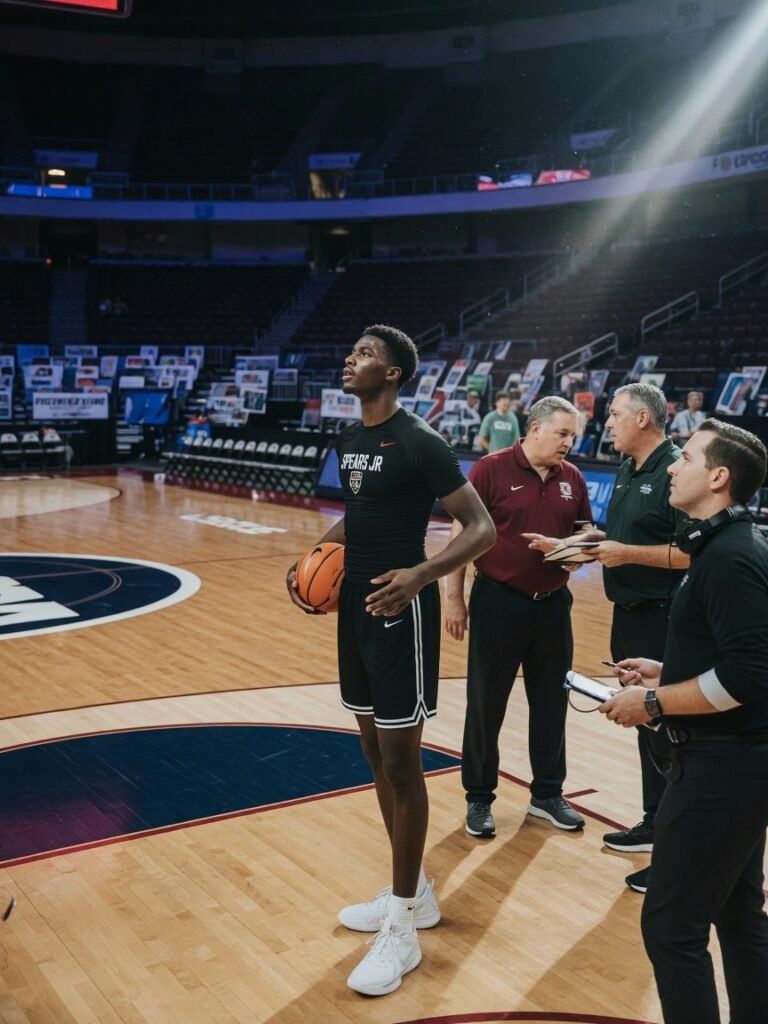
I’m looking at this new SC Next 100 list for the class of 2027, and my stomach is doing that slow, churning flip I described when I was talking about the *Heat* heist, where you just *know* something’s about to go sideways. Marcus Spears Jr. at No. 1. Beckham Black right behind him. Demarcus Henry, C.J. Rosser, Adan Diggs rounding out the top five. These aren’t just names. These are the protagonists of the next great drama, and I’m sitting here, three beers deep, wondering if the script they’re following even makes sense anymore.
Because let’s be real, the college basketball landscape isn’t just changing; it’s been blown up, rebuilt from the ground up, and then set on fire for good measure. We’ve got the transfer portal acting like a free agency period that restarts every spring, NIL deals turning amateurism into a hazy, forgotten myth, and this new “5-for-5” eligibility model that means players are sticking around longer than ever. It’s a complete seismic shift. I mean, Michigan just won a national championship with a starting five composed entirely of transfers, four of whom arrived just last offseason. That’s not a team; that’s a mercenary squad, assembled in a single summer, and they just ripped the trophy right out of the hands of the traditionalists.
So, I’m watching these coaches flock to these gyms, clipboards in hand, eyes scanning for the next Marcus Spears Jr., and all I can think is: where do these freshmen fit in? Seriously. This isn’t just a rhetorical question for column inches; this is a fundamental existential crisis for the sport. If you can plug and play an entire starting five from the portal, if you can buy experience and immediate impact with NIL money, what’s the incentive to invest three or four years in a raw, 17-year-old kid who might not even see significant minutes until his sophomore year?
It’s like the mob bosses in *The Godfather* suddenly realized they could just buy out all the local businesses instead of slowly consolidating power through intimidation and loyalty. The long game? Forget about it. It’s all about the quick score. And I gotta tell you, it hurts my soul a little. I’ve always been about the narrative arc, the hero’s journey from unknown phenom to college legend. But the new reality feels more like a cold, calculated transaction.
I remember John Calipari, a man who built an empire on the backs of elite freshmen, saying, “You can recruit older players. You can recruit international players. You can recruit transfers. But you still need to get those freshmen.” He said that back when the portal was still finding its legs, and even then, he knew the game was changing. He saw the shift coming, but he still held onto that fundamental truth: you need the talent pipeline. But *how* do you get them now? And how do you convince them to come for anything less than a guaranteed starting spot and a lucrative NIL package that rivals what they might get in the G-League or overseas?
This is where Marcus Spears Jr. and the entire 2027 class come into focus. Spears isn’t just a top recruit; he’s a walking, breathing testament to the kind of talent that *should* be the bedrock of college basketball. He was top-10 in scoring and rebounding on the Nike EYBL circuit – 20.9 points, 8.7 boards. That’s not just good; that’s elite, next-level production for a kid his age. He’s got that blend of athleticism and skill that screams “future lottery pick.” But even for a player of his caliber, the path to college stardom is now fraught with more peril than ever before. He’s the star of the show, but he’s entering a show with a completely rewritten script, and I’m terrified for him, for all of them.
Then you look at Beckham Black, the younger brother of Anthony Black, who just went to the Magic. Beckham’s fresh off a gold medal with USA Basketball at the FIBA U17 World Cup, making the all-star five as a 2027 prospect, averaging 12.3 points and 8.3 assists. This kid isn’t just talented; he’s got the pedigree, the international experience, the winning mentality. He’s a proven commodity on a global stage. He’s the type of player who, in the old days, would be the undisputed crown jewel of a recruiting class, the centerpiece around which a program would build for years. But now? He’s a piece in a much larger, more complex puzzle, and the coaches have so many other pieces available to them.
Demarcus Henry, No. 3, saw his stock explode in the spring, adding dozens of offers. Versatile, productive, 19 points, 9.7 boards, 2.7 assists on EYBL. C.J. Rosser, another U17 gold medalist, dropped 23 in the final against Serbia. Adan Diggs reclassified from 2028, a 6-foot-4 playmaker who averaged 19.6 points, 4.4 rebounds, 3.4 assists. These are not just prospects; these are *assets*. They are high-yield investments, but in a market that’s become incredibly volatile.
Bruce Pearl, the Auburn coach, he nailed it when he said, “The transfer portal has become the free agency of college basketball. You can build a team overnight.” That’s the cold, hard truth of it. Why spend years cultivating a relationship with a high school kid, hoping he develops, praying he doesn’t transfer, when you can just pick up a proven, experienced college player who’s already put up numbers in Division I? It’s the instant gratification economy, applied to roster building. And it’s not just about winning; it’s about survival. Coaches are under immense pressure to win *now*, and the portal offers the fastest path to that.
This isn’t just about coaches being lazy; it’s about the entire system being rigged for immediate returns. The boosters want wins, the fans want wins, the ADs want wins, and they want them yesterday. The patience required to develop a freshman, to nurture his talent, to let him make mistakes and learn from them – that patience is a luxury few programs can afford anymore.
I remember watching that whole Amir Khan, “Aura” student manager thing with Will Wade at LSU, and it gave me that same uneasy churning feeling of watching a con artist like Jimmy McGill become Saul Goodman. This isn’t a con, not exactly, but it’s a fundamental redefinition of the game, and the traditional values are getting squeezed out. The loyalty, the development, the long-term vision – it’s all on the chopping block.
So, when I watch these kids play in July, I’m not just seeing talent; I’m seeing uncertainty. I’m seeing young men who are about to step into a new world, a world where their value might be seen as less than a proven commodity from the portal, where their development might take a backseat to immediate needs, where their future is a rolling dice throw. Rich Paul, the super-agent, he summed up the player’s side of this whole equation perfectly: “Kids are looking for the best fit, where they can develop, and also where they can maximize their NIL.” It’s no longer just about the banner on the wall or the coach’s reputation; it’s about their personal brand, their immediate earning potential, and their direct path to the pros. The stakes are higher, the decisions are more complex, and the loyalty is, by necessity, more transactional.
My gut tells me, despite everything, that the elite freshmen will always find their way. The Cameron Boozers, the AJ Dybantsas, the Darius Acuff Jr.s of the world – they’re too good to ignore. They might take a different path, they might be more selective, they might demand more upfront, but the raw, unadulterated talent of a Marcus Spears Jr. will always be coveted. But the *number* of freshmen who make an immediate impact, the *depth* of the freshman classes contributing to top teams? That’s where I see the squeeze.
This July isn’t just an evaluation period; it’s a proving ground. It’s these kids fighting for their futures in a game that’s changed under their feet, a high-stakes poker game where the house rules are still being written, and they’re just trying to figure out how to play their hand. I’ll be watching every dribble, every dunk, every pass, because these kids aren’t just prospects; they’re the last bastions of an era that might be slipping away, trying to forge a new one in the crucible of this wild, unpredictable, and frankly, terrifying new college basketball world.