America, I have seen a lot of things in my time covering this league. I have witnessed dynasties rise and fall. I have watched legends etch their names into the annals of history, and I have stood by as pretenders crumbled under the weight of expectation. But what I observed this week, emanating from the gilded gates of the Hamptons, was more than just a party. It was a statement. It was a declaration. It was a flashing, neon sign, illuminating the profound, unsettling shift in the very fabric of professional football, and I, for one, am not going to stand idly by and pretend it’s merely harmless fun.
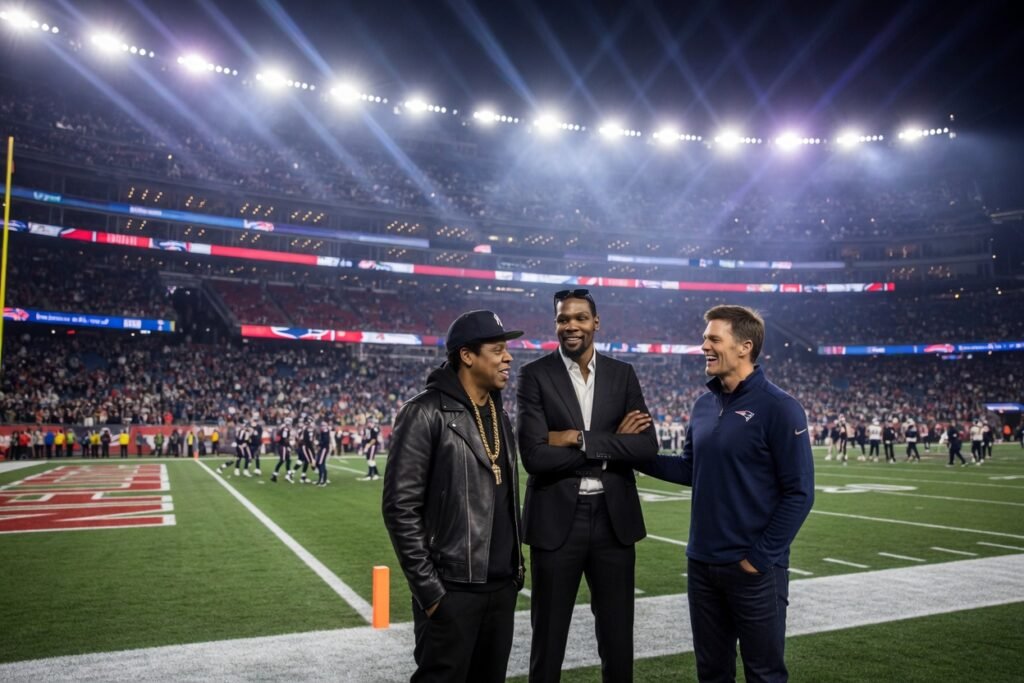
Michael Rubin, the Fanatics CEO, threw his annual “White Party,” a spectacle of wealth and celebrity, a veritable who’s who of sports and entertainment royalty. Jay-Z was there. Kevin Durant was there. Cardi B. Justin Jefferson, dripping in all-white, attempting to blend into the scenery while simultaneously screaming for attention. And yes, even Tom Brady, the greatest of all time, was among the revelers. On the surface, it’s a high-profile social event. A chance for the elite to mingle, to network, to flex. But peel back that pristine white veneer, and what you will find, what I found, is a troubling testament to where the priorities of some of our biggest stars truly lie.
Now, I understand the allure. I comprehend the desire for these young men, who give so much of themselves on the field, to enjoy their downtime, to celebrate their success. But there is a line, America. A very distinct, very clear line that separates professional dedication from celebrity indulgence. And what Michael Rubin himself admitted, what he confessed to *People Magazine*, is precisely where that line was not just crossed, but obliterated entirely. He said, and I quote, “We were debating the dates. We were certainly aware of that date, but we didn’t change it because of that date … But we were aware of that date and we didn’t want to have people have to choose.”
Let me tell you something about that quote. It is a damning indictment, a casual admission of a fundamental misjudgment. “Aware of that date.” What date was that, you ask? The date of the wedding of Travis Kelce and Taylor Swift. A wedding so significant, so culturally seismic, that it forced a titan of industry to reschedule his annual, star-studded event, lest his VIPs, his *athletes*, be forced to choose between a lavish party and a celebrity nuptial.
I have watched Travis Kelce for years. I have seen the greatness. I have seen the clutch catches, the Super Bowl rings, the way he dominates a game when he is locked in. He is, without question, one of the greatest tight ends to ever play the game. But let me ask you this, America: when did the priorities shift so dramatically? When did the relentless pursuit of gridiron glory take a backseat to the pursuit of paparazzi flashes and tabloid headlines? I hear the whispers. I see the magazine covers. And I remember a time, not so long ago, when the focus, the *singular* focus, of an athlete of his caliber, would be on the upcoming season, on the grind, on the next championship.
Just a few years ago, Travis Kelce himself, perhaps sensing the shifting sands of public perception, tried to reassert his primary identity. I recall him saying in an interview, “I’m just living my life, man. I’m just trying to make great music, make great football plays, and get the hell out of here, you know what I mean?” Great music? Great football plays? I understand the multi-faceted nature of modern athletes, but when the “great music” aspect becomes so prominent that it dictates the social calendar of the entire sports world, I have to stand up and ask: What are we doing here? What message does this send to the young men entering this league? That celebrity, that a high-profile relationship, can supersede the very demands of your profession? That the off-field narrative is as, if not more, important than the on-field legacy?
This is not about begrudging a man his happiness or his personal life. Not at all. This is about what it signifies for the NFL, for the culture of champions, for the very definition of what it means to be a professional athlete. This is about the normalization of a level of celebrity that, I fear, distracts from the singular, brutal focus required to truly be great, to truly reach the pinnacle of this unforgiving sport.
Think about it. Tom Brady, the man whose shadow still looms large over every quarterback in the league, was at this party. He’s retired now, a living legend, free to enjoy the fruits of his unprecedented labor. But I remember a different Tom Brady, a Brady who was so laser-focused on his craft, so utterly consumed by the pursuit of perfection, that anything, *anything* that could even remotely be construed as a distraction, was summarily dismissed. I recall him speaking about his unwavering commitment, stating, “I always say that I want to be a professional in every way. I want to represent the organization the right way. I want to represent my family the right way. I want to represent my teammates the right way. And I want to do it in a way that I can look back and be proud of.” That, America, is a man who understood the assignment. That is a man who understood that his professional life, his legacy, was built on an uncompromising dedication to the game itself.
And what about the active players at this party? Justin Jefferson, one of the most dynamic wide receivers in the game today, a man who is chasing greatness, a man who will soon command a contract that will make your head spin. What is the message he absorbs from this environment? Is it that the path to true football immortality is paved with disciplined training and unwavering focus, or is it paved with exclusive parties and high-profile social events? I believe, I *know*, it’s the former. But the lines are blurring, America. The temptation of the social circuit, the allure of being seen, of being part of the “in crowd,” it’s a siren song that can pull even the most dedicated athlete off course.
I have watched this game since before many of these young men were even a twinkle in their daddy’s eye. I have seen the rise of social media, the explosion of endorsement deals, the increasing commodification of the athlete as a brand. And I have warned, I have *screamed*, about the dangers of losing sight of the core mission. The core mission is to play football. To win football games. To dedicate yourself, body and soul, to the pursuit of a championship.
I think about the coaches, the true architects of sustained success, who preach nothing but discipline and focus. I think about a man like Bill Belichick, whose mantra was not about celebrity, but about execution. He once said, “Every day is a work day. Every day you’ve got to come in and try to improve.” That’s it. No frills. No white parties. Just the relentless pursuit of improvement. That is the mentality that builds champions. That is the mentality that creates legacies that transcend the transient glow of celebrity.
So, when I see a party, no matter how exclusive, no matter how star-studded, taking precedence over the *perception* of absolute, unwavering commitment to the game, it sends a shiver down my spine. When the personal life of one star, no matter how famous, can dictate the schedule of a major industry event, it tells me that something is fundamentally out of whack. This is not about fun. This is about the integrity of the game. This is about the message we send to the next generation of athletes.
Are we going to be a league where the offseason is for grinding, for preparing, for sharpening the tools of your trade? Or are we going to be a league where the offseason is for networking, for being seen, for cultivating an image that may or may not align with the brutal realities of what it takes to win a Super Bowl? I tell you, America, the scales are tipping. They are tipping dangerously, irrevocably, towards the latter. And if we don’t recognize it, if we don’t call it out for what it is—a distraction, an indulgence, an affront to the very essence of competitive excellence—then we risk losing something far more valuable than a few missed reps in the weight room. We risk losing the soul of the game itself. It is a PATH to MEDIOCRITY. It is a DECLARATION that celebrity has CONQUERED substance. And I am here to tell you, America, that this is an UNMITIGATED DISASTER waiting to happen for the athletes who prioritize it.