Peter Seidler’s death last November left the Padres with a roster built for sustained contention and a fan base that finally trusted the front office would not revert to old habits. This week’s $3.9 billion sale to Jose Feliciano and Kwanza Jones turns that trust into the highest franchise valuation in MLB history, five times what the club fetched in 2012. The number is not just a windfall for his estate. It is the market’s verdict on what happens when an owner stops treating San Diego like a perpetual rebuilding market.
I have covered enough ownership transitions to know most sales reward past restraint more than recent aggression. The Padres case flips that script. Seidler entered as a minority partner and eventually took control with an explicit mandate to end the cycle A.J. Preller described to me in recent weeks. “All the time,” Preller said when asked how often Seidler raised the city’s history of watching stars leave or get traded away. That history included the Clippers’ 1984 departure and the Chargers’ 2017 relocation. Seidler treated both as warnings, not excuses.
The payroll trajectory tells the story cleanly. In 2017 the roster sat at $70 million. By 2023 it reached a franchise record $249 million. This season it stands at $202 million. Seidler refused to hand Preller a hard cap. Instead he asked what roster options existed and listened. That approach produced the 2022 deadline additions of Juan Soto and Josh Bell, the extensions for Manny Machado and Xander Bogaerts, and the continued commitment to Fernando Tatis Jr. after his suspension. None of those moves looked conservative on paper. Each one increased the chance the Padres would stop resembling the franchise that once drew under 1.7 million fans in a full season.
Attendance followed the spending. The club had never approached three million fans in its first 53 seasons. In 2022 they reached 2,987,470. The past three seasons have cleared that mark, and through the first two months of 2026 the average stands at 41,557 per game, second only to the Dodgers. Petco Park now sells out on weeknights against non-rivals because the product on the field matches the promise ownership made. Machado captured the shift when he said the sale price represents “a tribute to him, and what he did for that city and that organization.” He added that players once avoided the Padres; now they line up to sign. The data backs the claim. Free-agent traffic into San Diego has increased in both volume and quality since 2021.
Skeptics inside the game never bought the model. One long-serving executive from another club told a reporter he never would have guessed the Padres could sustain the outlay. Seidler heard the same doubts during the 2022 season and told a reporter the franchise would be fine anyway. The executive later conceded Seidler was right. That admission matters because it highlights how rare it is for an owner to absorb industry pushback and keep the payroll elevated without a hard budget. Most owners default to the median. Seidler treated the median as the floor.
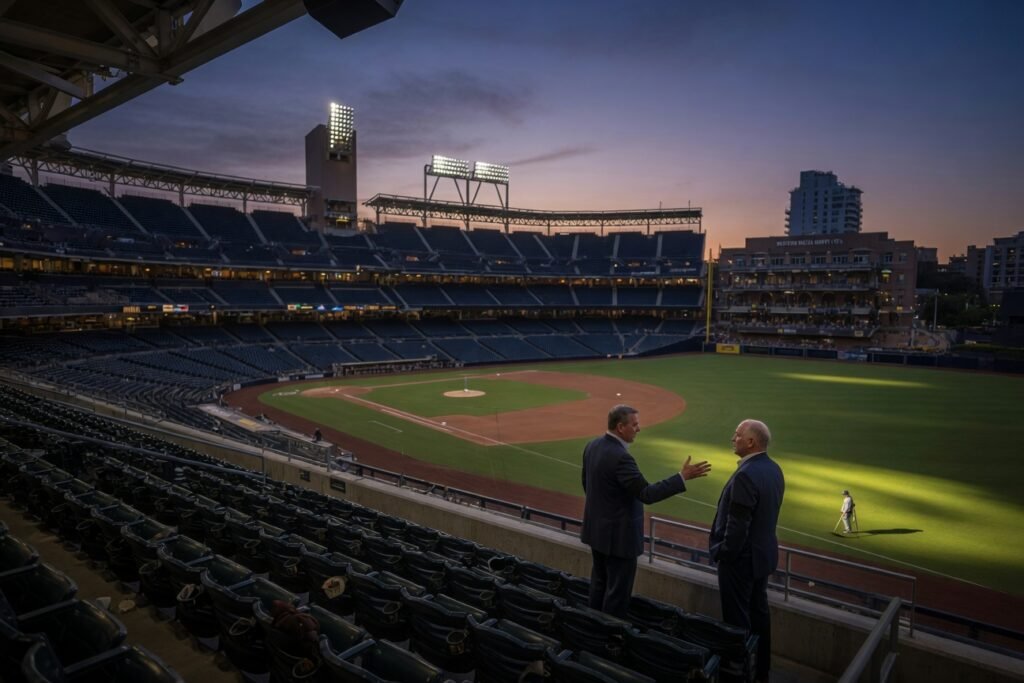
The new owners inherit a different set of variables than the ones Seidler faced. Feliciano and Jones are buying a club already embedded in the playoff picture, with a front office that has demonstrated it can identify and retain talent at the top of the market. They also inherit a venue whose atmosphere no longer requires explanation. Petco Park’s crowds now rank among the league’s most consistent, which in turn supports higher local broadcast and sponsorship revenue. The $3.9 billion price reflects that full package, not just the current roster.
I keep returning to the contrast with prior San Diego sports decisions. When the Chargers left, they cited stadium economics that the city could not match. When the Clippers left, they followed a larger market. Seidler rejected both precedents by spending into a smaller media market and betting the on-field product would generate its own demand. The attendance surge and the sale price show the bet cleared. The Padres are no longer the team that resets every time payroll pressure appears. They are the team whose ownership model other clubs now study when they want to move from perpetual contention to actual contention.
The risk for Feliciano and Jones lies in maintaining the same posture once the honeymoon numbers fade. MLB economics reward those who keep payroll flexible enough to add at the deadline without destroying future flexibility. Seidler proved the Padres could absorb that flexibility while staying above the luxury tax line. Preller has the track record to continue the same process, but the new owners will face the first test when the next extension or trade deadline decision arrives. The $3.9 billion valuation gives them room to operate, yet it also raises the bar for what “trying to win” looks like in San Diego.
Seidler’s legacy sits in that raised bar. He took a franchise defined by its departures and turned it into one defined by its arrivals. The sale price simply records how much the rest of the league now values that transformation. The next chapter belongs to new ownership, but the foundation they bought was built in plain sight over the past five seasons. The numbers, the crowds, and the roster all trace back to the same decision: stop treating San Diego like a market that could not afford to keep its best players.