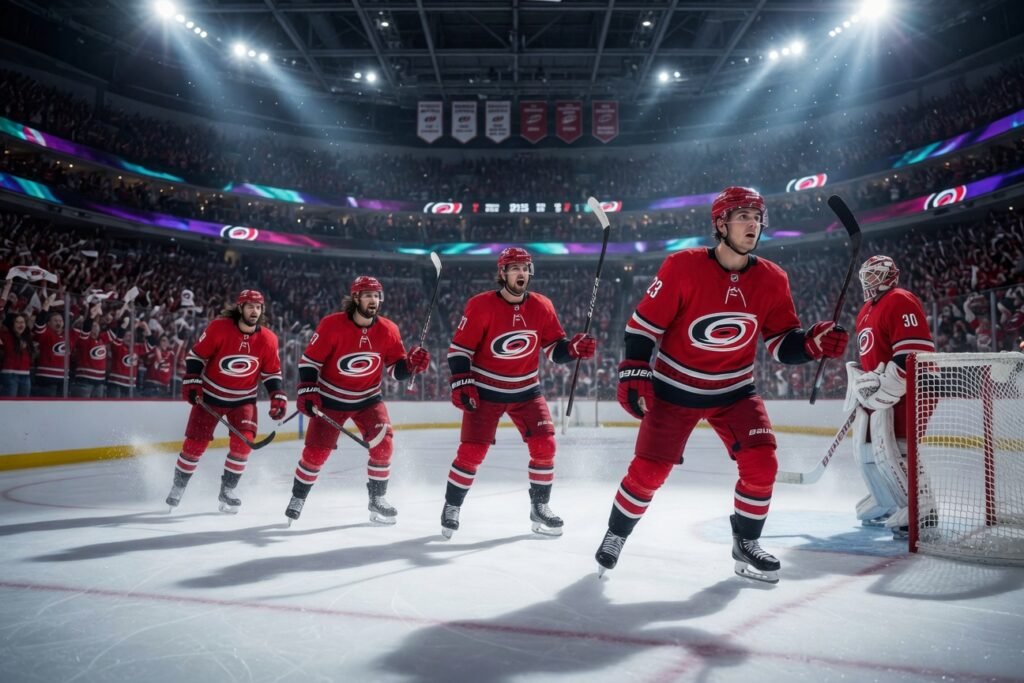
I have watched this Carolina Hurricanes team all year and I am telling you without hesitation that they are winning the Stanley Cup. The regular season numbers told one story. The postseason has told another. What I saw in those five overtime wins and the way their bottom-six units have produced is not luck. It is the result of deliberate roster work that finally fixed what had broken them in prior deep runs.
First, they solved the scoring drought that defined every Brind’Amour-coached playoff team before this one. I said after their conference-final loss to Florida in 2023 that the Canes could not buy a clutch goal when the series tightened. That problem has vanished. They are 5-0 in overtime this spring, including the pair of wins that flipped the Montreal series after the Game 1 stumble. Nikolaj Ehlers and Andrei Svechnikov delivered those strikes. Those are not fluke bounces. They are evidence that the same forwards who once went silent in later rounds are now finishing when the game is on the line. The difference shows up in the raw data: Carolina is scoring 2.83 goals per sixty at five-on-five, up from the 2.57 mark in Brind’Amour’s earlier postseason appearances. That is not a small adjustment. It is the difference between another early exit and a parade.
Second, general manager Eric Tulsky turned the Mikko Rantanen misstep into three pieces that now power the attack. Taylor Hall leads the playoffs with sixteen points after arriving via the cap-space maneuver that started with Rantanen. Logan Stankoven has nine goals. K’Andre Miller anchors the blue line with eight points. None of those names were on the roster two years ago. I watched the Rantanen trade unfold in real time and thought it looked messy. What Tulsky did next—flipping the assets into Hall, Stankoven, and Miller—has given Brind’Amour three new difference-makers who do not need the top line to carry them. Hall himself put it plainly after Game 5: “They’ve laid the foundation for everything that’s gone on here, and we’ve kind of added to it.” That quote lands because it is true. The additions are not complementary. They are the reason the Canes no longer live or die on whether Sebastian Aho or Seth Jarvis finds the net.
Third, the depth is not theoretical. It is showing up on the ice every night. Hall’s line with Stankoven and Jackson Blake is posting 4.87 goals per sixty at five-on-five, the best mark of any playoff unit. The checking line of Jordan Staal, Jordan Martinook, and Ehlers owns a 70.3 percent expected-goals share. Even the fourth line of Eric Robinson, Mark Jankowski, and William Carrier has scored in two of the four conference-final wins. I have covered enough playoff hockey to know what happens when only one line produces. The Canes are the opposite of that team. Four separate groups are generating offense, which means opposing coaches cannot game-plan around one or two names. That is how you win seven-game series without the superstars the other side keeps trotting out.
Fourth, the regular-season offensive identity has carried over instead of disappearing the way it always used to. Carolina finished second in the league at 3.55 goals per game. Their power play sat fourth at 24.9 percent. Those figures used to evaporate once the postseason began. Not this year. The five-on-five expected-goals rate is 3.51 per sixty, a clear jump from the 2.67 mark of prior Brind’Amour teams. The power play is still only 12.5 percent in the playoffs, yet the even-strength production has more than compensated. I kept waiting for the familiar collapse into low-event hockey. It never arrived. The Canes are playing the same aggressive style they showed from October through April, and the results are following.
Fifth, the Aho line and the power play have not even hit their stride yet. That is the part that should terrify the rest of the field. If the top unit starts converting at five-on-five the way the middle-six units already are, the goal totals climb again. If the man-advantage unit climbs even five percentage points, the margin in a Cup Final widens. The Canes are reaching the Final while still carrying that extra gear in their pocket. They do not need Jack Eichel, Mitch Marner, or Mark Stone to do it. They are winning with structure, depth, and the quiet accumulation of smart acquisitions that finally addressed the exact weaknesses that ended their previous runs.
I have seen enough championship teams to recognize when the pieces align this cleanly. The Hurricanes are not hoping to get hot at the right time. They have built the habits and the roster that make sustained success the baseline. The Stanley Cup is coming to Raleigh. Everything I have watched this postseason points to that outcome, and I am done hedging.