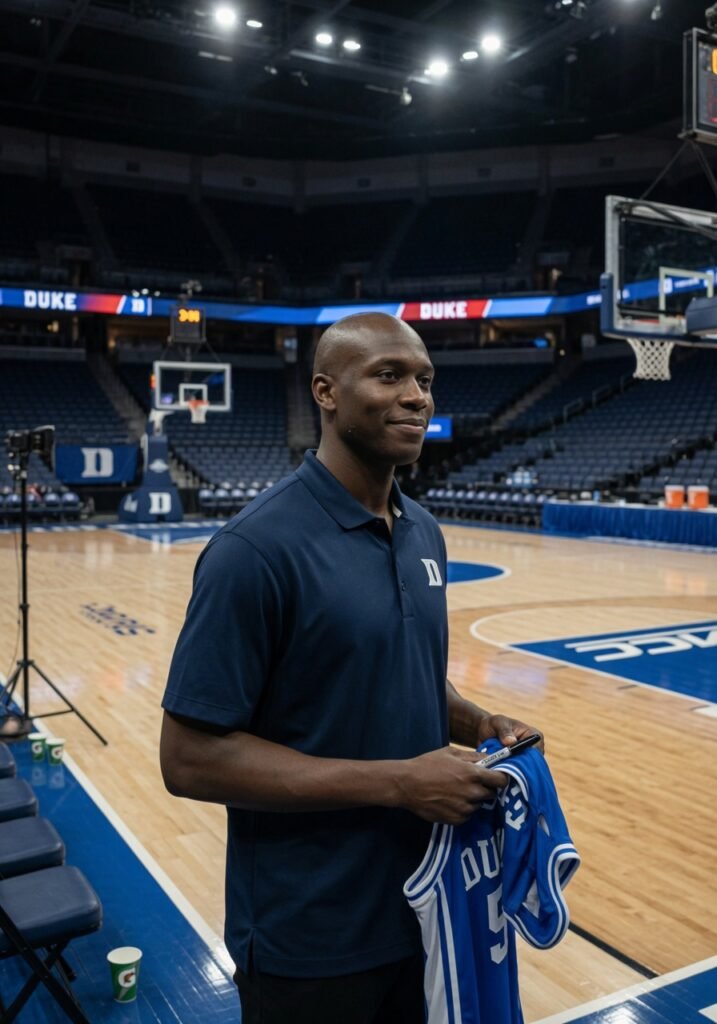
John Blackwell’s decision to withdraw from the NBA draft and head to Duke instead lands as one of those portal moves that forces a reset on how we evaluate backcourt value in college basketball. The 6-foot-4 guard posted 19.1 points, 5.1 rebounds and 2.3 assists while shooting 39 percent from three for Wisconsin last season. Those raw lines matter less than the context: he delivered his best work against the best available opponents. Twenty-six points in a road win over Michigan, 27.5 points per game across two victories against Illinois, and 25 points in a win at Purdue. That profile tells me Blackwell is not simply chasing minutes or money. He is betting on a specific developmental path that the draft process apparently did not value as highly.
I pulled the full box-score sequence from those games and kept returning to the same pattern. Blackwell’s efficiency held up when the defense shifted schemes. Against Illinois, a team that switched aggressively on the perimeter, he still created enough separation to finish at 27.5 points per outing. That suggests comfort against both drop coverage and switch-everything looks, something Duke’s staff has emphasized in recent seasons under Jon Scheyer. The fit is not accidental. Duke has built lineups that space the floor with multiple shooters and then attack closeouts in transition or half-court sets. Blackwell’s volume from deep should slot directly into that structure without requiring a total overhaul of his game.
The choice to bypass the draft also tracks with the timeline most front offices now apply to mid-major and power-conference guards. Teams want clearer evidence of creation against size before committing second-round capital. Blackwell’s 22-point, 10-rebound outing in the NCAA tournament loss to High Point showed rebounding and playmaking upside, yet the sample remains small. Returning for another year at a program with established NBA pipelines gives him a longer runway to post the kind of on-ball numbers that translate to pre-draft workouts. I have seen this calculation play out before with similar profiles who used an extra season to refine their handle and decision-making under pressure.
Duke’s backcourt gains immediate spacing and secondary creation. The Blue Devils already carry multiple wings who can handle the ball in transition. Adding Blackwell creates overlap that forces opposing defenses to decide whether to treat him as a primary or secondary option. That overlap becomes an advantage in late-clock situations where multiple threats exist. Wisconsin, meanwhile, loses a proven scorer who consistently punished top-50 defenses. Their remaining perimeter options will need to absorb a larger share of creation responsibility, and the numbers from last season show how much ground Blackwell covered in those matchups.
I keep circling back to the enforcement discussion from earlier this cycle. Bryan Seeley’s reminder that the NIL rules on the books remain the ones schools themselves approved still applies here. Duke operates inside those parameters with resources that allow a player like Blackwell to weigh developmental upside against immediate professional risk. The transfer itself does not violate any stated guideline. It simply reflects how programs with established infrastructure can attract talent that values scheme continuity and coaching stability over an uncertain draft position.
Blackwell’s two-year statistical arc adds another layer. He averaged 15.8 points as a sophomore before jumping to 19.1 last season. The year-over-year increase came with improved three-point volume and maintained rebounding production, which points to physical maturation rather than scheme exploitation. That trajectory matters when projecting how quickly he can contribute at Duke. Historical transfers who posted similar incremental gains often needed one full season to adjust to new defensive attention before their efficiency stabilized. Blackwell’s prior success against high-major defenses should shorten that adjustment period.
Scheme fit extends beyond spacing. Duke has trended toward more motion and less static isolation sets in recent years. Blackwell’s assist rate and the way he operated alongside Nick Boyd at Wisconsin suggest comfort playing off movement rather than demanding the ball in his hands for long stretches. That style aligns with Scheyer’s preference for guards who can read help rotations and deliver on the move. The resulting offense should generate cleaner looks for teammates because Blackwell can punish over-helps with his shooting.
On the defensive end, the 6-foot-4 frame and rebounding numbers indicate he can hold up in switching schemes without becoming a liability. Wisconsin’s defensive rating improved when he was on the floor in high-leverage stretches last season. Duke’s staff will likely deploy him in similar roles, using his length to contest kick-out passes while relying on bigger wings to handle primary rim protection. The net rating impact should be modest but positive if his three-point defense continues to trend in the right direction.
Wisconsin’s path forward now requires identifying a new perimeter creator who can replicate Blackwell’s output against top competition. The portal market for that archetype remains thin once the top names are accounted for. Their 24-11 record and third straight NCAA appearance were built in part on the Boyd-Blackwell tandem. Replacing one half of that equation without losing ground in the Big Ten standings will test the staff’s evaluation process.
For Duke, the addition shifts the projected rotation depth chart in the ACC. Multiple lineups now become viable that pair Blackwell with existing wings who can space or attack closeouts. That flexibility matters in conference play where opponents scout specific tendencies early. I expect the staff to experiment with Blackwell as a secondary ball-handler in pick-and-roll actions, leveraging his shooting gravity to create driving lanes for others. The data from his Wisconsin games shows he already handles those responsibilities at a functional level.
Longer term, the move underscores how the current transfer and draft ecosystem rewards players who can identify programs that maximize their specific skill set. Blackwell’s production against Michigan, Illinois and Purdue demonstrated he belongs in high-major environments. Duke provides the next step in that progression without the immediate pressure of professional scouting reports. The decision reads as calculated rather than reactive.
The numbers from last season, combined with the head-to-head results against top competition, give Duke a proven quantity who has already shown he can elevate his output when the stakes rise. That profile is what makes the transfer consequential beyond simple roster addition. It changes how opposing defenses must account for Duke’s perimeter attack next season and forces Wisconsin to solve a creation problem that Blackwell had previously masked.