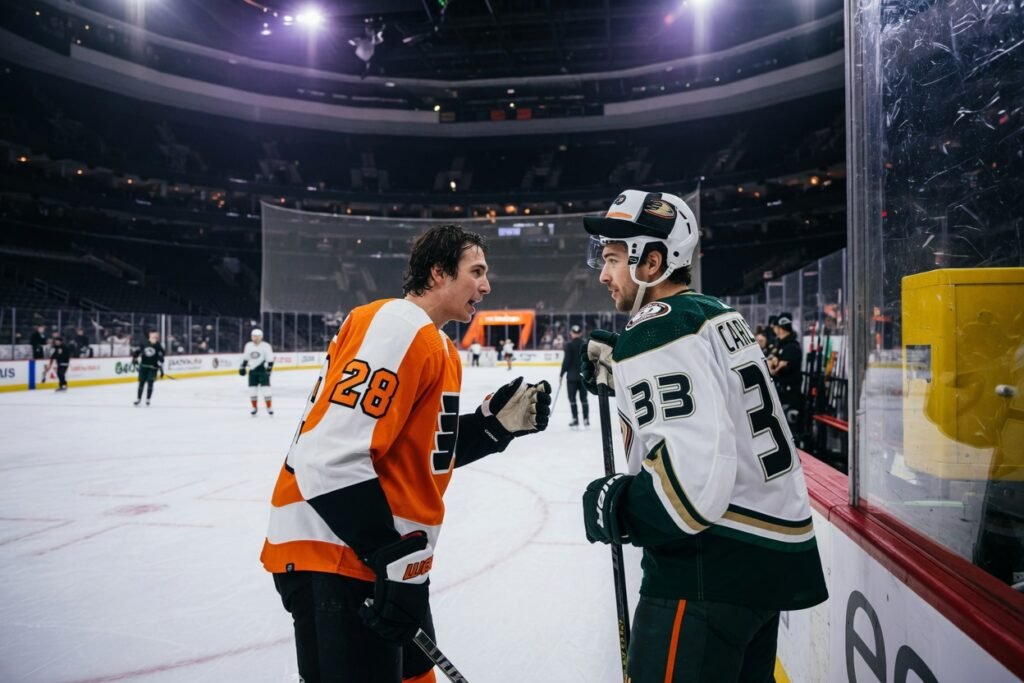
I’m still trying to pick my jaw up off the floor. I mean, I’ve seen some wild swings in this league, man. I’ve watched GMs make moves that looked like they were cooked up in a back alley in *Goodfellas*, all smoke and mirrors and whispered promises. But what Pat Verbeek and the Anaheim Ducks just did, matching that $90 million offer sheet for Leo Carlsson? That wasn’t a swing; that was a full-blown, two-handed, aluminum-bat-to-the-kneecaps, seismic event that just rattled the entire goddamn NHL.
When I saw the news pop up, I actually felt my chest tighten, that familiar knot in my stomach. Not the good kind, like when your team just pulled off a buzzer-beater. This was the sickening lurch, the kind you get when you’re watching a character in *Breaking Bad* make a decision you *just know* is going to unravel everything, even if it looks like a win in the short term. Because on one hand, yeah, the Ducks kept their guy. They kept the prodigy, the future, the kid who just dragged them to the playoffs for the first time since 2018. They said, “He’s ours, and we’ll pay whatever it takes.” But on the other hand, the cost? The sheer, unadulterated *cost* of that decision is going to ripple through that organization like a Category 5 hurricane for the next half-decade.
Let’s be real, the Philadelphia Flyers, bless their rebuilding hearts, pulled off a move so brazen, so audacious, it bordered on a declaration of war. An offer sheet for $90 million over five years, making a 21-year-old coming off his entry-level deal the highest-paid player in the entire damn league? That’s not just an offer; that’s a power play. That’s sending a message. That’s walking into the casino, throwing all your chips on red, and daring the house to blink. And for a moment, I thought the Ducks might. I mean, who wouldn’t at least hesitate when you’re talking about an $18 million AAV for a guy who just played 70 games?
Ducks GM Pat Verbeek admitted as much. “Did we expect the offer sheet to be this high? No. We did not see that one coming,” he told reporters. He even tried to spin it, saying he felt “flattered.” Flattered? Pat, my man, that’s the kind of thing you say when you’ve just been handed a bill for a party you didn’t throw. It’s the kind of “compliment” that comes with a shiv in the ribs. It’s like Michael Corleone saying, “My father sends his regards,” before dropping the hammer. Verbeek knew he’d said privately he’d match *any* offer, but you could hear the shock in his voice. He was caught off guard, and now he’s got to deal with the fallout.
Because let’s not pretend this was a simple business decision for the Ducks. This was a forced hand. This was a high-stakes poker game where the Flyers went all-in, and the Ducks, with their franchise cornerstone on the table, had no choice but to call. Henry and Susan Samueli, the owners, put out a statement calling it “an easy decision.” Easy? Easy for whom? Maybe easy for the guy whose name isn’t on the cap sheet that just got blown to smithereens. Easy when you’re writing bonus checks, which is exactly what this contract is built around – $85.3 million in bonuses, only $4.7 million in base salary. Carlsson gets nearly $20 million immediately in Year 1. That structure is a masterclass in creative accounting, designed to manage cash flow for the owners, but it doesn’t change the $18 million cap hit that Verbeek now has to dance around.
I mean, Carlsson is a hell of a player. I’ve been watching him since he was drafted second overall in 2023, and I said then, and I’ll say it again now, this kid has got that “it” factor. He’s got the vision, the hands, the hockey IQ that makes you lean forward in your seat. 29 goals, 67 points in 70 games this season, even with an injury slowing him down. He was a force in their first-round win over the Oilers, putting up 11 assists in their 12-game playoff run. He’s the real deal. But an $18 million AAV? For a 21-year-old coming off his ELC? That’s not just a reflection of his current talent; that’s a bet on him becoming the next Sidney Crosby, Connor McDavid, or Nathan MacKinnon *tomorrow*.
And Carlsson? He played it perfectly. “It’s a lot of business in hockey,” he said. “I knew it, obviously, but it’s more business than I thought. [The details are] something for my agent to answer more on, but [the offer sheet] was just too good to pass on. I think everybody understands that.” He’s not wrong. Every player in the league just saw Carlsson’s agent, Pat Brisson, pull off a heist. He got his client paid, and he leveraged the Flyers’ desperation against the Ducks’ need. That’s a lesson for every young star out there: get yourself an agent who isn’t afraid to go nuclear.
But now, the real work begins for Verbeek, and this is where the *Heat* analogy kicks in. You pulled off the big score, you got your guy, but now you’ve got to clean up the mess. You’ve got bodies on the floor and sirens wailing in the distance. The Ducks already re-signed Pavel Mintyukov for five years at $7.2 million AAV. That’s another significant chunk of change. And now, they still have Cutter Gauthier, who also had a breakout season, needing a new deal.
Verbeek’s got “2 1/2 months to figure out” how to fit Gauthier under the cap, which he admits will “certainly” involve doing “business in a different type of manner moving forward, and so…” And so what, Pat? And so you’re going to have to dump a veteran’s salary. And that’s where the pain starts. That’s where you start trading good, useful players for pennies on the dollar, just to clear space. That’s where you lose depth. That’s where you create holes in your roster that you might not be able to fill. It’s the cost of keeping your superstar. It’s the price of a pyrrhic victory.
This isn’t just about the Ducks, though. This is about the offer sheet itself. It’s a tool so rarely used, it feels like an ancient relic from a forgotten era. The last one that actually changed teams was back in 2007 when the Oilers signed Dustin Penner from the Ducks. Think about that. Seventeen years ago! GMs have always treated offer sheets like a nuclear option, a violation of an unwritten code. You just don’t do it. But the Flyers, under Danny Briere and Keith Jones, looked at their rebuild, looked at their desperate need for a franchise center, and said, “Screw the code.” And I respect that. They took their shot. They forced the Ducks’ hand, and even though they didn’t get Carlsson, they got something else: they got the Ducks to commit to a contract that will undoubtedly hamstring their flexibility for years to come. They won by losing, in a way. They forced the Ducks to show their cards, and those cards were very, very expensive.
I look at this, and I see a pivotal moment for the league. This wasn’t just about Carlsson. This was about the rising cap, about player empowerment, and about GMs finally being willing to take huge swings. We’re in an era where the cap is projected to keep climbing, and players are going to demand their worth. Kirill Kaprizov was the highest-paid player at $17 million, and Carlsson just blew past him at $18 million. Who’s next? What’s the ceiling now? This isn’t an anomaly; it’s a new benchmark.
For the Ducks, the pressure on Carlsson is now astronomical. “It’s going to be a special feeling, having this pressure,” Carlsson said. He’s got to live up to that $18 million AAV every single night. Every missed shot, every turnover, every quiet game will be magnified under the harsh glare of that contract. It’s not just about being good anymore; it’s about being *transcendent*. It’s about being the guy who can single-handedly win you games, because that’s what you pay $18 million for.
I’ve seen enough of these narratives unfold to know that sometimes, the biggest wins come with the biggest hidden costs. The Ducks kept their guy, yes. They made a statement, yes. But they also put themselves in a cap straitjacket, forcing painful roster decisions, and placing an almost unbearable burden on the shoulders of a 21-year-old. I’m not saying it was the wrong move, not yet. But I’m holding the receipts, folks. I’m watching every move Verbeek makes from here on out, every veteran he has to dump, every cap-induced compromise he makes. Because this “easy decision” for the owners is going to make life incredibly hard for the GM, and it might just be the pivot point that defines the next five years of the Anaheim Ducks, for better or for worse.