I was sitting at the kitchen table last night after the kids finally crashed, the house quiet except for the low hum of the fridge and my laptop screen still glowing with the latest SC Next Junior 300 rankings, and I couldn’t shake the feeling that this stretch of columns has turned into another one of those runs where everything lands clean. My last few pieces hit on the Jayhawks flattening West Virginia and the North Carolina baseball surge, and now here we are again, staring at the spring camp circuit wrapping up and the first real look at how the 2026, 2027, and 2028 classes stack up position by position. I’ve been saying for months that the 2027 group was going to separate itself early, and the numbers are starting to back that up in ways that make my chest tighten a little when I think about what it means for the next few signing periods.
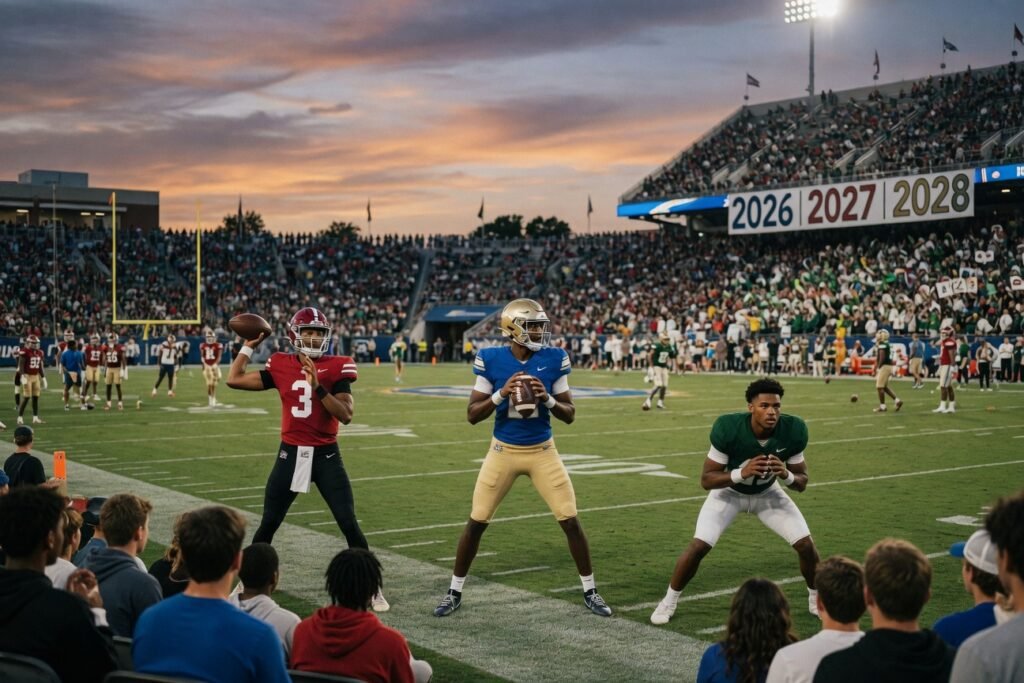
The quarterbacks jumped out first because that position always tells the story of a cycle. The source laid it out straight: Jayden Wade from the 2028 class, already a Georgia commit at No. 4 in the Junior 300, sits at 6-foot-4 and 195 pounds with that long, loose frame and improving pocket discipline. He’s shedding the dual-threat crutches and becoming more patient, which is exactly the arc I’ve seen with Keisean Henderson in the 2026 group out of Houston. Henderson is listed at 6-foot-3 and 185, and the kid has piled up nearly 7,000 total yards and 90 touchdowns in Texas high school ball. He’s a natural gamer with top-notch arm talent, but he’s still raw fundamentally. Wade looks like the mirror image in size and the same developmental path. Then you get to Elijah Haven, the 2027 Alabama commit ranked No. 6 overall. At 6-foot-5 and 220, he’s built like a linebacker who happens to throw lasers. The description compared him to Joe Milton at a similar stage—imposing in the pocket, physical, but not quite as fluid a runner as Henderson or Wade. His running style leans more toward Bryce Underwood than Darian Mensah. Edge to Haven, and I agree without hesitation. He checks every measurable box right now and still has the highest ceiling as a pure passer. I’d argue that if Haven stays healthy and keeps adding polish, the 2027 class just locked in the best quarterback prospect across these three cycles before most of them even hit their junior years.
That quarterback gap matters because it ripples through everything else. A class with a true franchise arm at the top tends to attract the complementary pieces faster, and Alabama already has the infrastructure to develop him. Georgia taking Wade in 2028 gives them a different kind of athlete who can extend plays, but Haven’s combination of size, power, and arm strength feels like the total package that projects earliest to the next level. I watched Henderson’s film again after reading this and remembered how raw he looked early in his junior season before cleaning up the accuracy. Haven is already past that stage. My gut says the 2027 edge here isn’t just physical—it’s the developmental runway. Haven can sit behind a veteran for a year or two at Alabama and still enter the league with starter traits. That’s the kind of projection that separates cycles.
Running back is where the picture gets messier and, honestly, more interesting. The 2028 group is already being called out for thinner top-end talent, and Zaiden Jernigan at No. 63 is the guy they’re hanging their hat on. He’s 5-foot-10 and 191, runs low, bursts through cutback lanes like a zone-scheme specialist, and ran a 4.41 laser-timed 40. He’s a Swiss Army knife who catches passes and hides behind the line before exploding. That’s valuable, but it’s not the same as having a bell-cow who can carry a program. Compare that to Kemon Spell in 2027, the Georgia commit ranked No. 8 overall at 5-foot-10 and 205. He’s short but not small, slippery in traffic, and has that 10.8-second 100-meter time that translates to chunk-play creation with vision. The comparison to Sony Michel’s style at Georgia feels right—patient, explosive, hard to square up. Then there’s Derrek Cooper from the 2026 class at Texas, the complete back at 6-foot-1 who already shows advanced pass-blocking, route-running feel, and the ability to hit 21 mph on film while pushing piles with forward lean. Cooper looks like the most well-rounded of the three right now, the kind of back who can stay on the field in every situation.
I keep coming back to how the 2027 class is stacking these two positions. Haven at quarterback and Spell at running back give them a one-two punch that feels like it could dominate early signing windows. The 2026 group has Henderson and Cooper, which is solid production and physical tools, but the developmental polish on Haven feels a step ahead. The 2028 crew has Wade and Jernigan, athletic traits for days, yet the overall depth at the top of the rankings looks lighter. I said last week in the baseball piece that redemption arcs linger when you least expect them, and I’m seeing the same pattern here—the 2027 class is redeeming the narrative that every other cycle has to wait its turn. They’re not waiting.
What this means for the sport is the part that keeps me up after the kids are down. Georgia and Alabama are already positioned to reload with these guys, which only widens the gap between the blue bloods and everyone else trying to break in. If Haven develops the way the measurables suggest, he could be the kind of quarterback who forces defensive coordinators to game-plan differently by his sophomore year. Spell gives Georgia that Michel-like home-run threat without needing to be the biggest body in the backfield. I’m not buying the idea that smaller classes automatically mean weaker ones, but the source data here shows the 2027 group pulling ahead on the two most important positions for winning at the highest level. My prediction is that by the time these kids are sophomores in college, we’ll be talking about the 2027 cycle the way we still talk about the 2019 or 2021 groups—loaded at the top and deep enough to sustain success.
The physical feeling of watching a class separate like this is the same stomach punch I get when a team I’ve invested in falls short in March. It’s not just rankings; it’s the projection of what these bodies and skill sets will do once the pads come on for real. I’ve been wrong before—my early take on one of the 2026 quarterbacks needing another year to clean up accuracy aged poorly once the production numbers came in—but this one feels different. Haven’s size and poise combination is rare enough that I’m locking it in as the best across the three classes. The rest of the positions will fill in as more camp data drops, but the quarterback and running back edges already tell me which cycle is setting the standard.