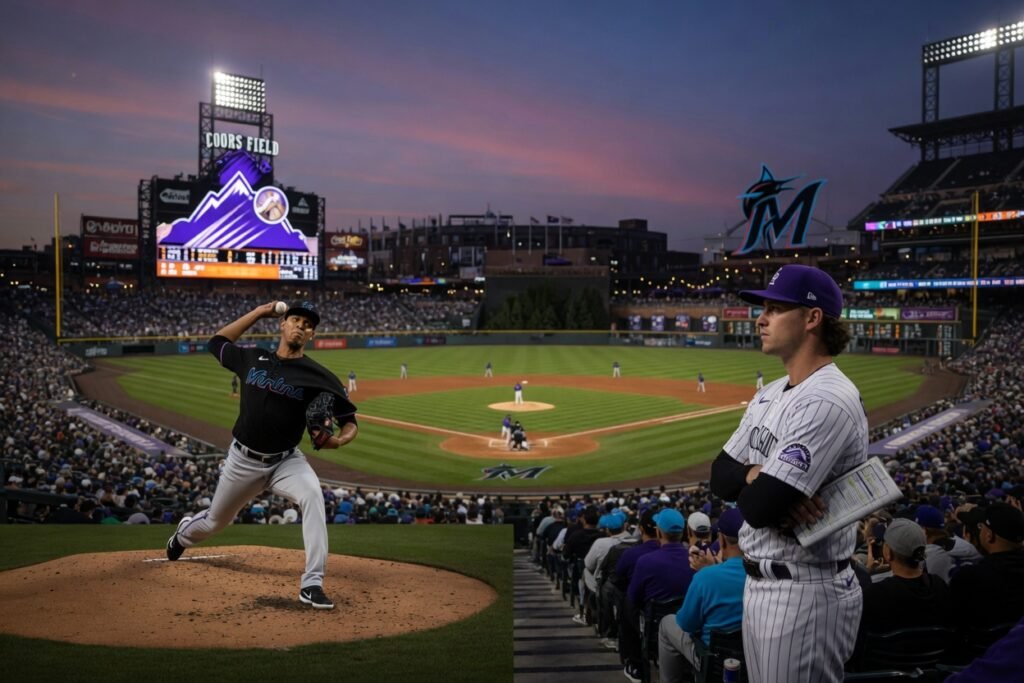
America, let me tell you something. I have watched this game, I have dissected every pitch, every swing, every front-office decision for longer than most of these players have been breathing. And what I witnessed in Game 1 between the Colorado Rockies and the Miami Marlins was not merely a defeat for the home team. No, no, no. It was a declaration. It was an indictment. It was a *preview* of the profound, systemic failures that continue to plague one franchise, and a chilling question mark hovering over the future of another.
Tonight, as the sun sets over Coors Field, we are presented with a pitching matchup that, on paper, should offer a glimpse into the future of baseball. The Miami Marlins, with their phenom Eury Pérez on the mound. The Colorado Rockies, countering with Tanner Gordon. But I’m here to tell you, America, this isn’t just about two arms on a mound. This is about vision. This is about execution. This is about what it means to be a professional sports franchise in the year 2026, and whether some organizations have simply given up on the very concept of competitive baseball.
Let’s start with the Miami Marlins. They bring to the mound Eury Pérez, a young man who, not two years ago, was heralded as the future of pitching. A towering figure, blessed with a fastball that sings and secondary offerings that dance. I remember the buzz, the anticipation. Marlins General Manager Kim Ng, in 2023, spoke with such conviction, saying, “He’s a special talent. He’s a guy that you dream on, with the size, the velocity, and the secondary stuff. He has a chance to be a legitimate top-of-the-rotation starter.” And I watched him, I saw the flashes of brilliance, the moments that made you believe the hype was not just justified, but *understated*.
But then, I look at his 2026 numbers. I look at the reality. A 4.41 ERA through 67.1 innings pitched. Twelve home runs surrendered. Twenty-eight walks. A 1.22 WHIP. Now, let me be clear, this is not a scrub. This is still a young pitcher with immense talent. But where is the progression? Where is the refinement? Where is the consistent dominance that we were promised? This is a player who, in his last outing against the Rockies in March, gave up three earned runs and two home runs over seven innings, even in a Marlins victory. I’m not saying he’s a bust. I’m saying the Marlins, an organization that has historically prided itself on developing pitching, seem to be presiding over a stagnation, if not a regression, in a player who *should* be ascending to superstardom right now. Is it the pressure? Is it the coaching? Is it the inherent difficulty of developing a young arm in today’s slugger-friendly game? Whatever it is, the results, as I see them, are not meeting the promise. And for a team that is hovering around .500, a team that *should* be making a push in the NL East, relying on a pitcher who is delivering merely average results, despite his extraordinary talent, is a perilous tightrope walk.
And then, America, we turn our attention to the other side of the diamond. We turn to the Colorado Rockies. And this is where my patience, I’m telling you, begins to wear thin. They send out Tanner Gordon. This will be his third start, his tenth appearance of the season. And I look at his numbers, and I ask myself: What are we doing here? A 6.37 ERA. A 1.57 WHIP. Thirty-five strikeouts to eight walks in 35.1 innings. I’m not here to demonize Tanner Gordon. I’m not here to suggest he isn’t giving his all. But I am here to question, vehemently, the organizational philosophy that repeatedly puts players in positions where they are set up for failure, and then acts surprised when the results are exactly what anyone with a pair of eyes and a basic understanding of baseball would predict.
I remember watching the Rockies in 2025, a season that was, by all accounts, historically bad. They won a grand total of two series before the All-Star break. TWO! This year, they’ve managed eight series wins, a statistic that the primary source notes matches their *entire* total from last season, and their most first-half series wins since 2023. And let me tell you, America, when your benchmark for progress is simply “not as historically terrible as last year,” you are not building a contender. You are simply treading water in a sea of mediocrity, hoping nobody notices you’re drowning.
The narrative around the Rockies has always been the Coors Field effect. “It’s hard to pitch there,” they say. “The ball flies.” And yes, I understand the atmospheric conditions. I understand the challenges. But I also understand that professional baseball organizations are supposed to *adapt*. They are supposed to *innovate*. They are supposed to *find solutions*. And what I have seen from the Colorado Rockies, year after year, is an unmitigated refusal to do so. They trot out pitchers who are ill-equipped for the environment, they fail to develop talent effectively, and then they throw their hands up in exasperation when the results are predictably disastrous.
Former Rockies pitcher Kyle Kendrick, a man who knows a thing or two about navigating the altitude, said it best in 2022: “It’s a tough place to pitch, but you can’t use that as an excuse for never developing pitching. At some point, you have to find a way to make it work.” Kendrick understood. He understood the challenge, but he also understood the expectation of a professional. And what I see from the Rockies is a consistent abrogation of that expectation. They are not finding a way. They are simply repeating the same mistakes, year after year, expecting a different outcome. That, America, is the very definition of insanity!
This isn’t just about Tanner Gordon’s ERA. This is about a front office, led by General Manager Bill Schmidt, that has consistently failed to provide its coaching staff and its players with the resources, the talent, and the strategic vision necessary to compete. When Schmidt himself admits, as he did to the Denver Post in 2023, “Winning in Denver, it’s a difficult thing to do. It’s a challenge, and we understand that,” I hear a man who understands the problem but has offered no tangible, long-term solution. Understanding a challenge is one thing. Overcoming it is another. And the Rockies, for too long, have been content with merely understanding.
I look at the Marlins, and I see a team that, despite its current struggles with Eury Pérez, at least *has* the foundational talent. They *have* the potential for greatness. They *have* a young arm that could still blossom into an ace. The question for them is one of execution and development. Can they unlock Pérez’s full potential? Can they guide him through this period of relative inconsistency to the superstardom he was promised? That is a challenge that holds real stakes for their division hopes and for Pérez’s legacy.
But I look at the Rockies, and I see something far more troubling. I see a franchise that seems content to drift, a franchise that consistently puts a product on the field that is simply not competitive. A 6.37 ERA from a starting pitcher isn’t just a bad outing; it’s a symptom of a deeper malaise. It’s a reflection of an organization that has, by all appearances, given up on the very idea of building a winning team. They are not just losing games; they are losing the faith of their fanbase. They are losing the respect of the league. And they are, quite frankly, squandering opportunities with every single season that passes without a coherent plan for improvement.
Tonight, Eury Pérez will take the mound for the Marlins, and he will have every opportunity to prove me wrong, to prove that his trajectory is still upward. He will have the chance to make a statement, to declare that the hype was real. And if he falters, if he continues to struggle, it will be a black mark, a serious question about the Marlins’ ability to nurture their generational talent.
But Tanner Gordon will take the mound for the Rockies, and I’m telling you, America, the stakes for *him* are not about personal legacy. The stakes for *him* are about what he represents: a continuous cycle of futility. An organizational failure to put players in a position to succeed. The Rockies are not just playing a game tonight; they are putting on a clinic in how *not* to run a baseball team. This isn’t just about a 33-52 record; it’s about a franchise that seems to have forgotten what it means to aspire to excellence. IT IS A DISGRACE. IT IS AN AFFRONT TO THE GAME ITSELF. And until the fundamental philosophy changes, until real, actionable steps are taken to address the systemic issues, I will continue to DECLARE, with every fiber of my being, that the Colorado Rockies are not just losing games, THEY ARE FAILING THEIR FANS! THEY ARE FAILING THEIR PLAYERS! AND THEY ARE FAILING THE VERY SPIRIT OF COMPETITION!