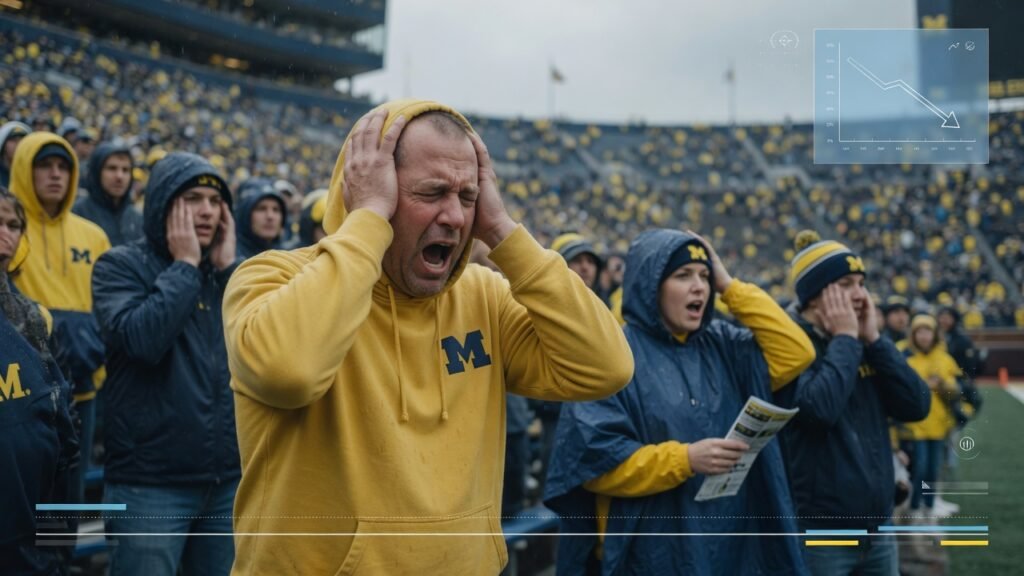
Five completions on 11 attempts for 43 yards and two interceptions against Penn State is what $3 million a year in prep quarterback projection looks like when the bills come due in the Big Ten. When Michigan quarterback Bryce Underwood walked toward the sideline late in the first half last Saturday, pulled off his helmet, and barked at the bench before getting pulled for Tommy Carr, the visual killed off the last of the hype from his 2025 recruitment. Ahead of today’s matchup against No. 6 Indiana, Carr is expected to start while the former No. 1 overall recruit holds a clipboard. I look at the macro numbers across college football, and Underwood’s benching is the final nail in the coffin for multimillion-dollar high school quarterback bidding wars.
The financial structure behind Underwood’s flip from LSU to Michigan was broken before he ever took a snap in Ann Arbor. Back in the 2025 cycle, Michigan’s NIL collective, with heavy involvement from Oracle founder Larry Ellison and Barstool Sports founder Dave Portnoy, put together an approximately $10 million package that pays Underwood around $3 million annually. They priced a Belleville High School prospect like a proven All-Big Ten starter before he ever read a collegiate two-high safety shell.
“Underwood’s value, I think, what Michigan was willing to pay him was way more than what anyone else was willing to pay him,” longtime recruiting analyst Steve Wiltfong said. “I don’t think it was just a little more. At some point, they were bidding against themselves.”
Bidding against yourself in an uncapped environment creates a roster distortion that no coaching staff can scheme around. When you allocate $3 million of your annual player payroll to a freshman, you force your offensive staff to play him immediately to justify the booster outlay, regardless of whether his footwork or post-snap processing is ready for Big Ten disguised coverages. In 2025, Underwood completed 60.3% of his passes for 2,428 yards, 11 touchdowns, and nine interceptions while adding 392 rushing yards and six scores on 88 carries for a 9-4 Michigan team. Those are serviceable baseline numbers for a true freshman learning on the fly, yet they represent a massive negative return on investment at a $3 million cap hit.
The Transfer Allocation Shift Exposes Prep Quarterback Risk
The smartest front offices in the country have already adjusted their spending math to avoid the exact trap Michigan walked into. According to revenue-sharing data reported by BVM Sports, four-year transfers now command about 48% of football revenue-sharing dollars, while high school recruits receive about 9%. Overall, transfers’ share of total roster spending jumped from 36% last year to 54% this year. I view that 18-percentage-point swing in a single cycle as the sharpest market correction of the modern NIL era.
“I always try and lean toward paying for guys that come with less projection,” one Power Four general manager told FOX Sports. “Ideally, you see what you’re getting before you buy it. Spending big on a high school QB is a massive gamble, and it’s really hard on both sides because there is an urgency to play that player early because of the money.”
Wait-and-see roster building works because college football evaluation at the quarterback position comes down to processing speed against complex defensive rotations, something seven-on-seven camps and high school tape cannot measure. When Underwood threw two second-half interceptions that set up two Minnesota scoring drives in a 20-14 loss earlier this season, and followed it with that 5-for-11, two-interception disaster against Penn State, the tape showed a young passer still fighting the speed of Big Ten coverage windows. Paying $3 million a year for that learning curve is bad portfolio management when you can buy a full body of verified Power Four tape in the portal for the same price.
Coaching Turnover Cannot Excuse the Roster Math
Still, Underwood’s defenders inside the Michigan ecosystem and across national media point to the institutional chaos around him, arguing that the Sherrone Moore scandal and the subsequent coaching transition to head coach Kyle Whittingham and offensive coordinator Jason Beck ruined his development timeline. That argument has real teeth, especially given how rival coaches view the current staff’s track record with passers.
“He’s a good head coach, but in 21 years, they haven’t had a quarterback drafted,” an opposing coach told ESPN’s Adam Rittenberg regarding Whittingham. “Just because you pay somebody money doesn’t make them good. There’s going to be a little reality check on that.”
I agree that pairing a five-star pocket talent with a defensive-minded head coach whose staffs went 21 years without producing an NFL Draft pick at quarterback is a brutal schematic mismatch… yet that only reinforces my core thesis. In modern college football, coaching stability is a myth. If a front office commits $10 million over multiple years to a high school recruit, it is betting that both the teenager’s development curve and the coaching staff’s job security will hold steady for three years. Both bets rarely cash at the same time.
“Sometimes you have to walk away and get your ego out of the way,” another Power Four general manager said anonymously. “[Michigan] didn’t need Bryce Underwood. Let him go somewhere else for $3 million. There are plenty of quarterbacks that can get you to a championship that are not named Bryce Underwood.”
When Tommy Carr takes the field against No. 6 Indiana today, Michigan will effectively have $3 million in annual NIL money sitting on the sideline in a baseball cap. That visual will echo through every December signing day meeting in the Power Four this winter, ensuring no general manager writes a seven-figure check to a high school quarterback again without a transfer portal exit ramp already priced in.