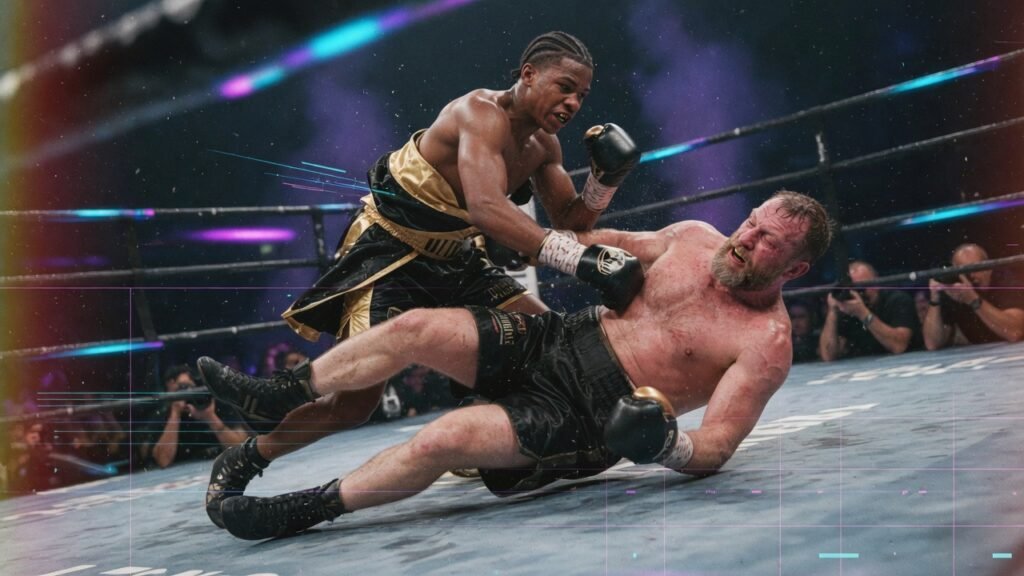
Brock Lesnar is retired at 49, and the man who flipped the switch was not some faded rival or a doctor with bad news. It was Oba Femi.
That is the detail that should stop every combat sports argument cold. A 10-time WWE champion and former UFC titleholder looked at the next monster in the building, ran the internal tape, and said “That’s it.” No farewell tour packaging. No carefully staged sendoff. Just the cold recognition that the physical standard he set for two decades had been matched by someone younger, fresher, and built for the same violence.
I have watched Lesnar’s entire arc long enough to know this was never about narrative. It was always about leverage, force, and who could impose their will first. When that calculus flips, guys like him do not negotiate with it. They exit.
Femi Did Not Beat Him. He Made the Mirror Honest.
The report is simple and brutal. Lesnar saw Oba Femi and understood the window had closed. Femi is the kind of athletic problem WWE has been trying to manufacture since Lesnar first walked through the curtain: size that moves like a linebacker, power that ends exchanges, and no interest in the old choreography of selling for smaller men.
That is the mechanism. Not a lost step in isolation. Not a single bad night. A living measuring stick who made the former college wrecking ball from Minnesota admit the body no longer answered the same way. Lesnar’s career was built on being the unmatched physical outlier. Once that stopped being true inside his own company, the decision made itself.
I keep coming back to the athletic origin story here, because it explains the exit better than any press release. Lesnar was never a pure wrestling creation. He was a University of Minnesota product, a heavyweight who treated the Big Ten like a demolition site and carried the same frame into football conversations before the bright lights pulled him elsewhere. College football has always understood what he was: a defensive line prototype who chose a different cage. When an athlete that rare tells you the next version of himself has arrived, you listen.
The Sport Does Not Get Many Clean Hand-offs
Most superstar retirements are messy. Contracts, egos, one more payday. This one has a cleaner through-line. Lesnar’s value was never charisma first. It was the threat that he could end you before the second commercial break. That threat requires a body that still scares the locker room. Femi represents the updated blueprint, and Lesnar had the self-awareness to read the tape instead of fighting it.
The implication for WWE is obvious and uncomfortable. You do not replace a Lesnar with nostalgia acts and part-time legends. You elevate the Femi types while the audience still believes the violence is real. The company has spent years teasing the next dominant big man. Lesnar just endorsed one by walking away.
I am not interested in the sentimental version of this. Lesnar leaves as a two-sport destroyer who cashed every check the industry offered and refused to become a reduced version of himself on weekly television. That is a professional decision, not a tragic one. At 49, after dominating WWE and proving himself inside the UFC, the only remaining opponent worth measuring against was time. Femi simply made time visible.
College football fans should feel this one in a specific way. Every program is hunting the unmatched physical freak who changes practice pads and game plans. Lesnar was that guy who left the sport early and still cast a shadow back over it. His retirement closes a loop that started in Minneapolis weight rooms and ended when he saw a younger version of the same problem staring back at him under WWE lights.
The next time someone asks when the torch actually moves in combat sports, point them here. Not to a farewell match. To the moment a champion looked at the future, said “That’s it,” and meant it.